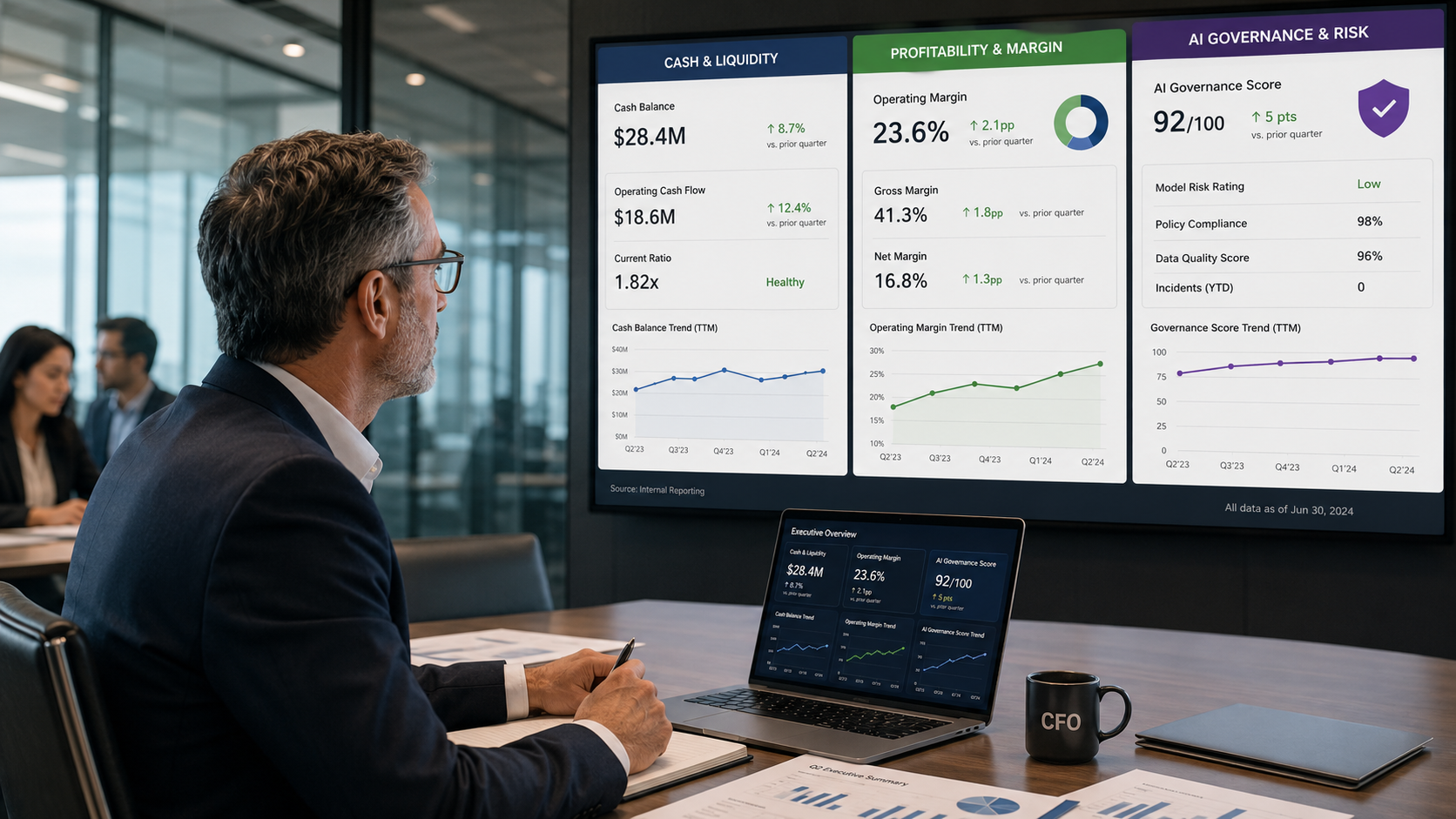
Suggested: CFO reviewing dashboards on cash, margin, and AI governance metrics in a boardroom.
 –>
–>
Business Insight
Five CFO Priorities for the Second Half of 2026
What recent CFO research says finance leaders should focus on before the year closes out
Heading into H2 2026, research points to five priorities converging on the CFO’s desk: closing the cash-visibility gap, defending margins against tariffs, governing AI adoption that has outpaced its guardrails, building a policy-ready playbook, and raising the bar on transparent reporting.
Halfway through 2026, finance leaders have less room for error than a year ago. CFO confidence has softened, slipping from 6.6 to 6.3, and only 37% of CFOs rated the North American economy “good” or “very good” in Q2, down four points from Q1.
Yet a 2026 outlook report describes leaders as “enterprise strategists,” expected to fund growth, manage risk, and satisfy stakeholders at once.
That combination — more caution, more mandate — is what makes H2 different from a routine cycle: the five priorities below are where CFO surveys show the gap between what boards expect and what finance can deliver is widest.
1. Cash Visibility: Close the Real-Time Gap
Cash forecasting has moved from a treasury housekeeping item to a board-level concern, and most finance functions are not there yet:
- Real-time visibility gap. 59% of CFOs lack a complete, real-time view of cash and liquidity, per Kyriba’s 2026 survey.
- Top liquidity challenge. Cash flow forecasting was the top liquidity challenge for 2026, cited by 38% of CFOs, J.P. Morgan found.
- Rising priority. Finance leaders are placing growing emphasis on liquidity visibility and working capital optimization.
- Predictive forecasting. 90% of CFOs now prioritize predictive cash forecasting, and 89% are scaling working capital optimization, per FTI Consulting.
Kyriba’s 2026 survey found 59% of CFOs still lack a complete, real-time view of cash and liquidity — the most-cited gap behind H2 forecasting problems.
The practical issue is usually not a lack of data but a lack of a single, trusted view of it. Cash sits across multiple banks, ERP instances, and regional entities, and reconciling those into one forecast is often a manual, end-of-month exercise.
For H2, prioritize the connective tissue — bank feeds, treasury systems, consolidation tools — over any single new model.
2. Margin Defense: Managing Tariffs and Cost Pressure Without Cutting Growth
Margin protection has become one of the clearest near-term battles CFOs are fighting:
- Top-tier risk. Recent research ranks margin pressure just behind cyber threats and macro uncertainty as a top risk.
- Profit impact. Nearly a third of CEOs (29%) expect tariffs to reduce net profit margin over the next twelve months.
- Supplier renegotiation. 65% of finance leaders are renegotiating pricing with suppliers.
- Cost pass-through. 60% are passing tariff-related costs on to customers, or plan to.
- Budget resets. A similar 65% are adjusting budgets — a top-two force shaping cost management in early 2026.
60% of finance leaders are passing tariff costs on to customers, while 65% are renegotiating supplier pricing — margin defense is running on both fronts at once.
The tension for H2 is that margin defense and growth investment pull in opposite directions, and indiscriminate cuts can undercut AI investments boards are also asking for. The more durable approach: renegotiate where tariff exposure is concentrated, protect growth-tied investments, and use scenario planning.
3. AI Governance: Scaling Adoption Without Losing Control
AI has moved from experimentation to embedded use faster than governance has kept up, and the research is unusually direct about it:
- Adoption has accelerated. 93% of CFOs say their organizations now use AI extensively or modestly, up from two-thirds still experimenting three years ago.
- Confidence hasn’t caught up. Only 43% of CFOs feel confident in their organization’s current AI governance.
- The core tension. 59% cite balancing pressure to deploy AI quickly against managing risk as their biggest governance challenge.
19% of CFOs say they personally hold the greatest responsibility for AI governance — ahead of CEOs (12%), AI committees (8%), and boards (4.5%).
Cost is a specific pain point, and the concerns split between internal and external risk:
- Cost uncertainty. 46% of CFOs name cost uncertainty in AI spending as their top internal concern.
- Litigation risk. 43% worry about litigation tied to protected or private content.
- Cybersecurity. 41% cite cybersecurity risk as a top external concern.
For CFOs already accountable for AI governance, H2 is the moment to formalize it — defined approval paths, cost visibility, and clear ownership — before gaps widen as adoption accelerates.
4. Regulatory Readiness: Building a Policy Playbook for an Unsettled Landscape
One 2026 CFO research report frames this priority as “redefining resilience for a new policy era” — several things are moving at once, and boards want visibility into risks that once sat several tiers down the supply chain:
- Multiple fronts in motion. Tax reform, tariff rules, and the mainstreaming of digital assets are all moving at once.
- Policy tops the strategy agenda. In an earlier pulse survey, 57% of CFOs cited economic policy as a top-three factor affecting short-term strategy.
- Stress-testing is underway. Finance leaders are stress-testing capital allocation against tax and cross-border rule changes reshaping cash flow with little warning.
The firms best positioned for H2 are not the ones predicting which policy changes will land, but the ones with a standing process for absorbing whichever ones do: named scenarios, a defined trigger for each, and pre-agreed actions instead of ad hoc responses.
5. Transparent Reporting: Raising the Bar on Financial and Sustainability Disclosure
The last priority is less about new rules and more about rising expectations under existing ones: investors and boards expect the same rigor applied to sustainability disclosures as financial statements.
- Data quality is the bottleneck. More than half of companies reporting under CSRD or ISSB standards cite data quality as their primary challenge.
- Treat it as transformation, not a bolt-on. A separate survey found treating sustainability reporting as a genuine transformation — not a bolt-on — separated ready organizations from those still catching up.
More than half of companies reporting under CSRD or ISSB standards cite data quality — not the rules themselves — as their primary implementation challenge.
For CFOs, the H2 task is to apply the same discipline to sustainability data that finance applies to financial data: clear data lineage, defined ownership, and an audit trail that can withstand the same scrutiny as the 10-K.
Where to Focus in H2 2026
| Priority | What H2 2026 Planning Should Include |
|---|---|
| Cash visibility | A single reconciled cash forecast across banks, entities, and systems — not a faster version of a fragmented one |
| Margin defense | Targeted repricing and supplier renegotiation where tariff exposure is concentrated, protecting growth investment elsewhere |
| AI governance | Named ownership, defined approval paths, and cost visibility by AI use case |
| Regulatory readiness | A standing playbook of named policy scenarios with pre-agreed triggers and actions |
| Transparent reporting | Data lineage and ownership for sustainability disclosures with the same rigor as financial statements |
Bottom Line
These five priorities share one pressure: boards, investors, and regulators are asking finance to move faster and prove more, while the tools and governance needed to do that are still catching up.
Organizations making real progress in H2 2026 treat these as one connected agenda: better data underneath, clearer governance on top, and a standing process for absorbing whatever comes next.
How PNJ Can Help
PNJ works with CFOs on the practical side of these priorities — building cash visibility, designing AI governance frameworks, stress-testing regulatory scenarios, and strengthening sustainability reporting.
Sources and Professional Notes
- PwC, “2026 CFO priorities,” PwC Leadership Center, accessed August 2026.
- PwC, “Pulse Survey: CFOs 100 days in: What’s next for business,” April 2026.
- Deloitte Insights, “North American CFOs express concerns about AI governance and risk management” (Q2 2026 CFO Signals), July 23, 2026.
- Deloitte Insights, “Facing uncertainty on several fronts, North American finance leaders zero in on cost management” (Q1 2026 CFO Signals), 2026.
- CFO Dive, “CFOs expect tariff-fueled price pressures to persist into 2026.”
- Kyriba, “2026 CFO Survey: Confidence.”
- FTI Consulting, “FTI Consulting Survey Finds CFOs Expect Growth in 2026.”
- PwC, “How are financial institutions adopting ISSB disclosure standards?” PwC-IIF Global 2026 ISSB Adoption Survey.
Disclaimer
This material is for general informational purposes only and does not constitute accounting, tax, financial, or legal advice. The figures cited reflect third-party research current as of the dates noted and may change. This is a summary, not a substitute for the primary research or advice based on specific circumstances. Consult qualified advisers before making financial decisions.