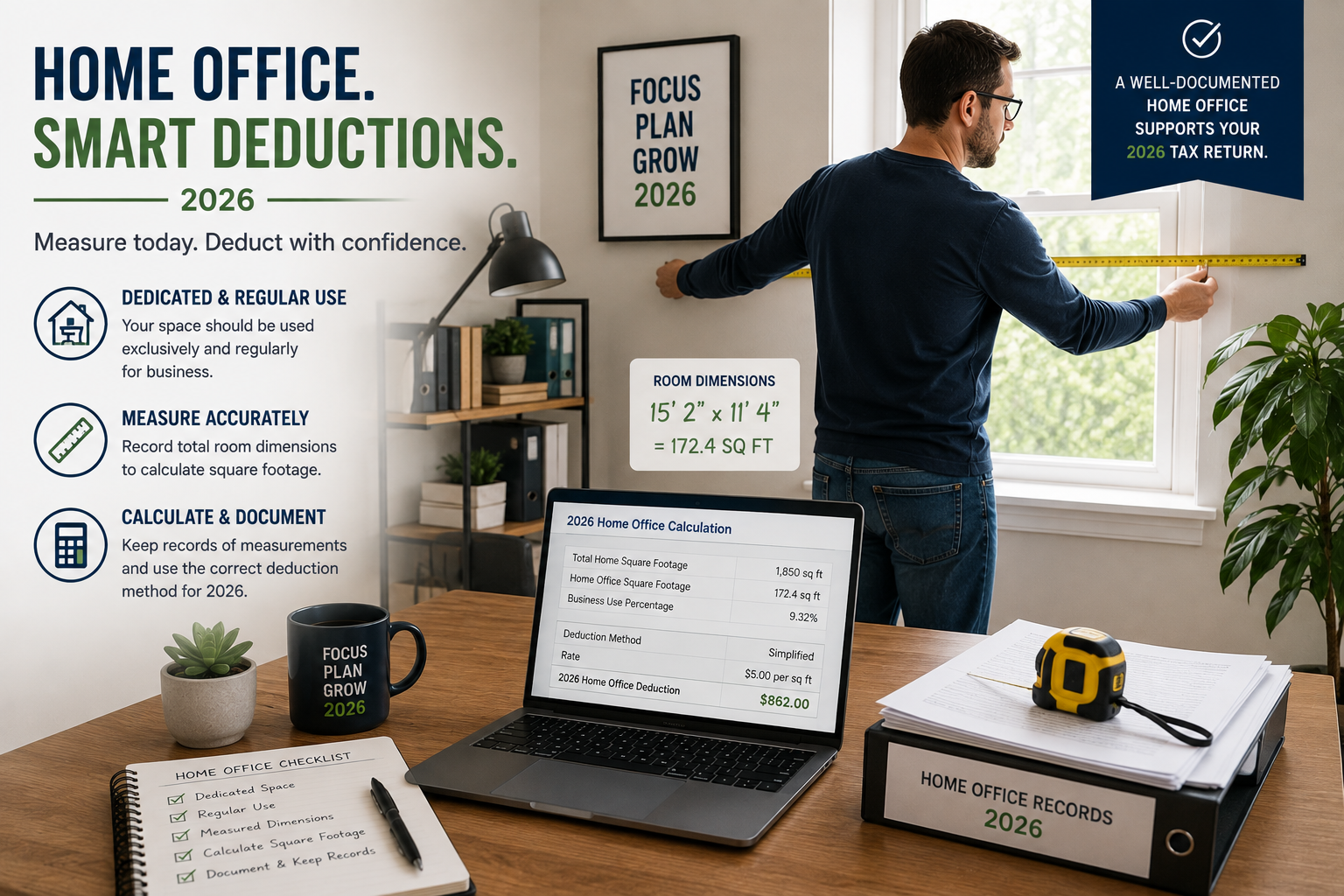
Suggested: business owner working at a dedicated home-office desk, measuring the room.
 –>
–>
Tax Intermediate Practical Guide
Home-Office Deduction for Business Owners
How to qualify the workspace, compare calculation methods and report the expense correctly
Working from home does not automatically create a federal tax deduction. A workspace must meet the home-office rules and be reported based on the owner’s entity structure.
A qualified home office may support deductions for part of rent, utilities, insurance, repairs, mortgage interest, real estate taxes and depreciation. But mixed personal use usually fails the exclusive-use test.
First confirm the workspace qualifies. Then compare the simplified and regular methods and report the deduction under the correct entity structure.
1. Definition
The home-office deduction applies to the qualified business use of part of a home, including a house, apartment, condominium or qualifying separate structure such as a studio or garage.
In most cases, the workspace must be exclusive, regular and used for an active trade or business:
- Exclusive use: the area is used only for business. Shared personal use generally disqualifies it.
- Regular use: business use is recurring and meaningful, not occasional.
- Trade or business use: the space supports an operating business, not merely investing or a hobby.
- Limited exceptions may apply to qualifying inventory storage and daycare use, subject to specific rules.
2. Why It Matters
A home office may qualify as the principal place of business when it is used exclusively and regularly for administrative or management work and there is no other fixed location for those activities.
A workspace may also qualify when used regularly to meet clients or customers or when a separate unattached structure is used for the business.
The distinction matters because the regular method may involve depreciation and future home-sale consequences, while reporting differs for sole proprietors, partnerships and corporations.
3. How It Works
Step 1: Confirm the Qualifying Business Use
Confirm the exact workspace and exclusive, regular business use.
Step 2: Measure the Business Area
Under the regular method, the allocation is commonly based on qualified office square footage ÷ total home square footage. Use a consistent, supportable method.
Step 3: Compare the Two Calculation Methods
| Feature | Simplified Method | Regular Method |
|---|---|---|
| Basic calculation | $5 x qualified square feet | Direct expenses plus business share of indirect costs |
| Area limit | Maximum 300 square feet | Actual qualified business-use percentage |
| Maximum before income limit | $1,500 | No fixed dollar maximum |
| Depreciation of home | Not claimed | May be claimed on qualified business portion |
| Recordkeeping | Mileage-like area and eligibility support | Detailed household expense, basis and allocation records |
| Unused amount | No carryover of disallowed simplified amount | Certain disallowed actual expenses may carry forward |
Direct expenses relate only to the office and may generally be allocated fully to it. Indirect expenses—such as rent, utilities, insurance, repairs, mortgage interest, real estate taxes and depreciation—are allocated to the business-use portion.
Step 4: Apply the Business-Income Limitation
The deduction is generally limited by business income. Under the regular method, certain disallowed expenses may carry forward; under the simplified method, they do not.
Step 5: Report It Under the Correct Entity Structure
| Business Structure | Typical Federal Approach | Important Point |
|---|---|---|
| Sole proprietor or disregarded SMLLC | Generally claimed with Schedule C; Form 8829 is used for the regular method. | The owner may claim directly when all qualification rules are met. |
| Partner | Potential unreimbursed partnership expense treatment when the expense is ordinary, necessary and required under the partnership agreement. | The agreement and reimbursement policy are critical. |
| S or C corporation owner-employee | Generally no personal employee home-office deduction; the company may evaluate accountable-plan reimbursement. | Do not treat a flat unsupported allowance as a substantiated reimbursement. |
A corporate owner-employee generally should not claim a personal home-office deduction. A properly documented accountable plan may provide the cleaner reimbursement approach.
4. Common Mistakes
- Sharing the workspace. Personal use of the same area generally defeats the exclusive-use test.
- Assuming client work must happen at home. Administrative or management work may qualify when there is no other fixed location for those activities.
- Claiming the deduction personally as an S corporation owner. Consider a documented accountable-plan reimbursement instead.
- Ignoring future home-sale effects. Home depreciation under the regular method may affect taxable gain on sale.
5. Practical Checklist / What’s Next
Work through these items before claiming or reconfirming the deduction.
0 of 7 complete
A home office can be a legitimate deduction, but it must follow the workspace facts, supporting records and entity structure—not simply the fact that the owner works from home.
How PNJ Can Help
PNJ can help business owners evaluate qualification, calculation methods, supporting records, income limits and accountable-plan procedures for corporate owner-employees.
Current Federal References
- IRS Publication 587
- IRS Simplified Option
- Form 8829 Instructions
Disclaimer
This article is for general informational purposes only and does not constitute tax, legal or accounting advice. Home-office treatment depends on workspace use, entity structure, income limitations, reimbursement arrangements and supporting records. Taxpayers should confirm current federal and state rules and consult qualified advisers regarding their specific facts.