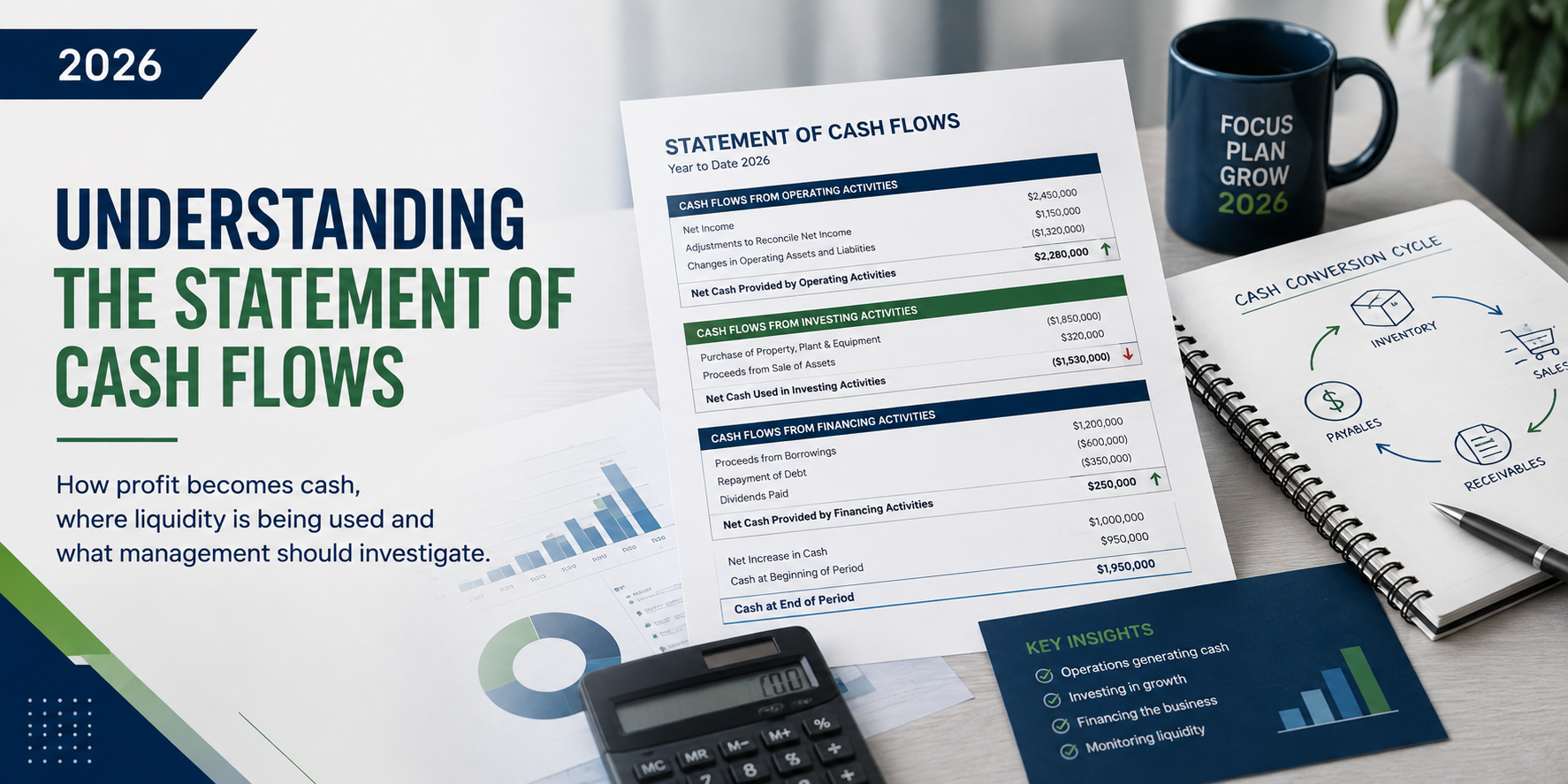
Suggested: finance manager reviewing a cash-flow statement and working-capital trends.
 –>
–>
Accounting Intermediate Practical Guide
Understanding the Statement of Cash Flows
How profit becomes cash, where liquidity is being used and what management should investigate
A profitable company can still run short of cash. Revenue may be recognized before customers pay, inventory can absorb cash, and borrowing can increase the bank balance without improving operations.
The statement of cash flows shows whether operations are generating cash, where cash is being invested, and how the business is being financed.
Net income is not cash. Read operating, investing and financing cash flows together, and compare operating cash flow with net income to judge the quality and sustainability of liquidity.
1. What the Statement Explains
The statement reconciles beginning cash to ending cash through operating, investing and financing activity. It should agree with the balance sheet and related cash, cash-equivalent and restricted-cash disclosures.
It explains what happened. A cash forecast helps management plan what happens next.
2. The Three Sections
| Section | Management Question | Typical Items | Interpretation |
|---|---|---|---|
| Operating | Does the core business generate cash? | Customer collections; payroll; vendors; taxes; changes in receivables, inventory, prepaids and payables. | Persistent weakness may signal collection, margin or working-capital pressure. One period requires context. |
| Investing | Where is cash being invested or recovered? | Equipment and other long-lived assets; acquisitions; asset sales; investment or loan principal. | Negative cash flow may be healthy when it reflects disciplined investment in productive capacity. |
| Financing | How is the company funded and how is capital returned? | Borrowings and principal repayments; owner contributions; share issuances or repurchases; dividends and distributions. | Shows reliance on debt or equity and whether cash is being returned to capital providers. |
Read the three sections together. Positive operating cash flow, negative investing cash flow from planned equipment purchases, and financing from a manageable loan can be a healthy growth pattern.
3. From Net Income to Operating Cash Flow
Under the indirect method, operating cash flow starts with net income and adjusts for noncash items and changes in operating assets and liabilities.
Net income + noncash expenses − noncash gains +/− working-capital changes = net cash provided by operating activities.
Working-capital changes often explain why earnings and operating cash flow differ:
- Accounts receivable increases: Revenue is recognized faster than customers pay, generally reducing operating cash flow.
- Inventory or prepaids increase: Cash is committed before the related expense or sale is recognized, generally using cash.
- Accounts payable or accruals increase: Expenses are recognized before payment, temporarily supporting cash.
- Deferred revenue increases: Cash is collected before revenue is earned, supporting cash now but creating a future obligation.
Cash generated from customer collections is generally more sustainable than cash preserved by delaying vendor payments. Focus on the direction, size and duration of each working-capital change.
4. Practical Example: Profit Without Equivalent Cash
| Indirect-Method Adjustment | Cash-Flow Effect |
|---|---|
| Net income | $300,000 |
| Increase in accounts receivable | ($220,000) |
| Increase in prepaid expenses | ($40,000) |
| Increase in accounts payable | $50,000 |
| Net cash provided by operating activities | $90,000 |
The company reports $300,000 of net income but only $90,000 of operating cash flow. The main driver is the $220,000 increase in receivables, which should prompt a review of aging, billing, credit terms and collections. Higher payables softened the shortfall, but delayed supplier payments are not a permanent source of liquidity.
5. How Management Should Read the Statement
Use three passes:
- Pass 1 — Operating cash conversion: Compare operating cash flow with net income and investigate recurring gaps caused by collections, inventory, payment timing, noncash items or one-time events.
- Pass 2 — Investment purpose: Review major capital spending, acquisitions and asset sales against budgets, strategy and expected returns.
- Pass 3 — Financing dependence: Determine whether operations fund the business or whether debt and equity are covering operating deficits or investment needs.
Watch for these signals:
- Positive operating cash flow + planned capital spending: the business may be funding growth from operations.
- Negative operating cash flow + new borrowing: external capital may be funding routine operations.
- Operating cash flow driven mainly by higher payables: the benefit may reverse when vendors are paid.
6. Important U.S. GAAP Presentation Points
- Classification: Under U.S. GAAP, interest paid, interest received and dividends received are generally operating; dividends paid are financing. Income taxes are generally operating unless specifically tied to investing or financing.
- Noncash transactions: Material investing or financing activities that do not use cash are excluded from the statement and disclosed separately.
- Restricted cash: Include required cash, cash equivalents and restricted cash in the beginning-to-ending reconciliation and tie the presentation to the balance sheet and notes.
- Free cash flow: Commonly calculated as operating cash flow less capital expenditures, but it is not a standardized U.S. GAAP measure. Define it consistently.
Unusual transactions require judgment. Document classification decisions, map accounts consistently and maintain review controls over noncash disclosures and balance-sheet reconciliation.
7. Common Preparation and Review Mistakes
- Bank balance only: Treating the change in cash as a substitute for a complete cash-flow statement.
- Misclassification: Incorrectly classifying debt principal, capital expenditures, asset sales or owner transactions.
- Raw balance-sheet changes: Ignoring acquisitions, foreign exchange, reclassifications or other noncash activity.
- No reconciliation: Failing to tie cash, cash equivalents and applicable restricted cash to the balance sheet.
8. Practical Checklist / What to Do Next
Work through these items when preparing or reviewing the statement.
0 of 5 complete
How PNJ Can Help
PNJ can help businesses prepare and review cash-flow statements, analyze working-capital drivers, reconcile cash flow to earnings, and connect historical results with budgets and forecasts.
Current Reference Points
- SEC: Beginners’ Guide to Financial Statements
- SEC: Improving the Quality of Cash-Flow Information
- FASB ASU 2016-15: Cash-Flow Classification
- FASB ASU 2016-18: Restricted Cash
Disclaimer
This article is for general informational purposes only and does not constitute accounting, tax or legal advice. Cash-flow presentation depends on the facts, the applicable reporting framework and current guidance. Consult a qualified adviser regarding your circumstances.