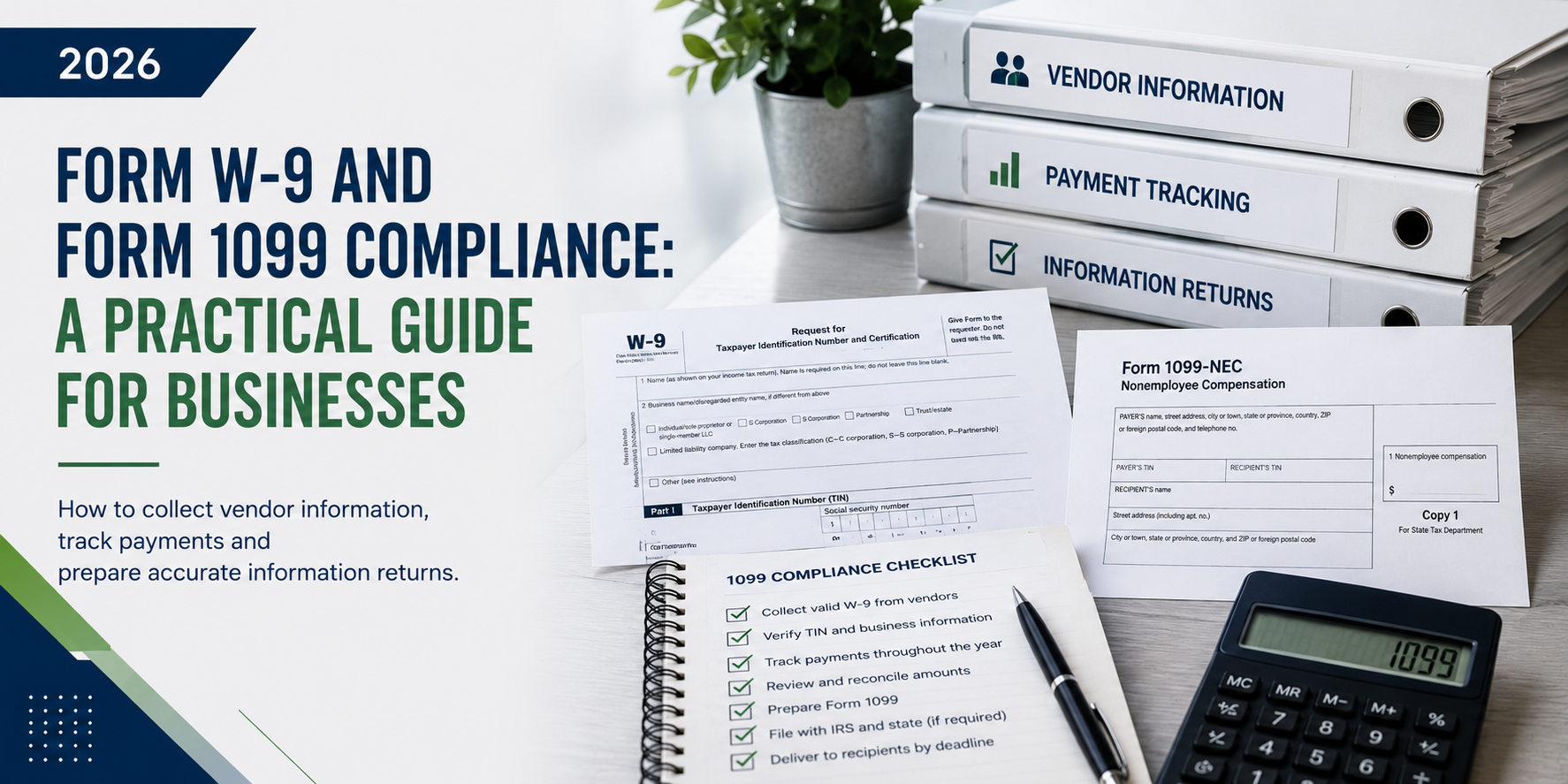
Suggested: business owner collecting a vendor’s Form W-9 during onboarding.
 –>
–>
Tax Compliance Foundation
Form W-9 and Form 1099 Compliance: A Practical Guide for Businesses
How to collect vendor information, track payments and prepare accurate information returns
Vendor payments can create federal information-reporting obligations. The best time to address them is during onboarding—not in January.
Collect the right tax form, verify the vendor, track payment type and method, determine whether reporting applies, and file on time.
Start Form 1099 compliance at vendor onboarding. Validate the legal name and TIN and track both what was paid and how it was paid.
What Forms W-9 and 1099 Do
- Form W-9. Collects a U.S. vendor’s legal name, tax classification, address and TIN. The business generally keeps it on file rather than filing it with the IRS.
- Form 1099-NEC. Generally reports qualifying nonemployee service payments to independent contractors and other service providers.
- Form 1099-MISC. Reports certain other payments, including rent, prizes, medical payments and certain attorney payments. Thresholds and rules vary by category.
2026 Reporting Threshold: What Changed
For calendar-year 2026, the general threshold for many payments previously subject to the $600 rule increased to $2,000. This affects many payments reported on Forms 1099-NEC and 1099-MISC.
Important: $2,000 is not a universal 1099 threshold. Some categories follow different rules. The threshold determines the payer’s filing obligation—not whether the income is taxable.
A Five-Step Compliance Process
- Request the tax form before payment. Use W-9 for applicable U.S. vendors and the appropriate W-8 for foreign persons.
- Verify vendor information. Confirm legal name, classification and TIN—not just the invoice name.
- Track payment method. Separate check/ACH/wire from card or third-party payments that may fall under 1099-K.
- Determine whether a 1099 is required. Review amount, payment type, vendor classification, payment method and exceptions.
- File on time. 1099-NEC is generally due January 31. Filing 10+ covered information returns in aggregate generally requires e-filing.
Simple Business Example
Assume ABC LLC made these 2026 vendor payments:
| Vendor | Payment | Method | Likely Treatment |
|---|---|---|---|
| Independent IT consultant | $8,000 | Check | Review for Form 1099-NEC; obtain W-9. |
| Office supply corporation | $5,000 | Check | Ordinary merchandise purchase generally not reported on Form 1099-NEC. |
| Corporate law firm | $4,000 | ACH | Review attorney-reporting rules; the corporate exemption may not apply. |
| Freelance designer | $1,500 | Check | Generally below the 2026 $2,000 threshold based on these facts; retain records. |
| Marketing contractor | $3,500 | Credit card | Review Form 1099-K treatment before issuing Form 1099-NEC. |
Common Mistakes
- Waiting until January for W-9s. Collect documentation during onboarding.
- Using the invoice name. Tax reporting should use the legal name tied to the TIN.
- Applying one threshold to every payment. The $2,000 threshold is broad, but exceptions remain.
- Ignoring payment method. Card and certain third-party payments may fall under Form 1099-K.
- Assuming corporations are always exempt. Certain legal and medical payments require separate review.
Practical Compliance Checklist
Work through these items at each stage of the vendor and filing lifecycle.
Vendor Onboarding
0 of 4 complete
During the Year
0 of 3 complete
Before Filing
0 of 4 complete
Practical Reporting Notes
- W-9 collection. Not every vendor will receive a 1099, but collecting the appropriate form during onboarding helps establish classification and TIN information early.
- Missing or incorrect TIN. Follow up promptly. Backup withholding and information-return penalties may apply in certain cases.
- No Form 1099 does not mean tax-free income. The reporting threshold affects the payer’s filing obligation—not whether the recipient’s income is taxable.
Special Situations Requiring Additional Review
Additional review may be needed for foreign vendors, attorneys, medical providers, new payment platforms, worker classification, and missing or incorrect TINs. The current federal backup-withholding rate is 24%.
How PNJ Can Help
PNJ can help with vendor documentation, tax classifications, year-end reconciliations, Form 1099-NEC and 1099-MISC preparation, corrected forms, backup withholding and foreign-vendor documentation.
Disclaimer
This article is intended for general informational purposes only and does not constitute tax, accounting or legal advice. Form W-9, Form 1099, withholding and information-reporting requirements depend on the payment type, recipient, payment method, tax year and other facts. Businesses should consult a qualified tax professional regarding their specific circumstances.
Official IRS References
- 2026 reporting-threshold guidance
- Information-return filing and e-filing requirements
- Form 1099-K guidance
- Backup-withholding guidance