Suggested: office manager organizing labeled document boxes and digital file archives.
 –>
–>
Tax Compliance Foundation
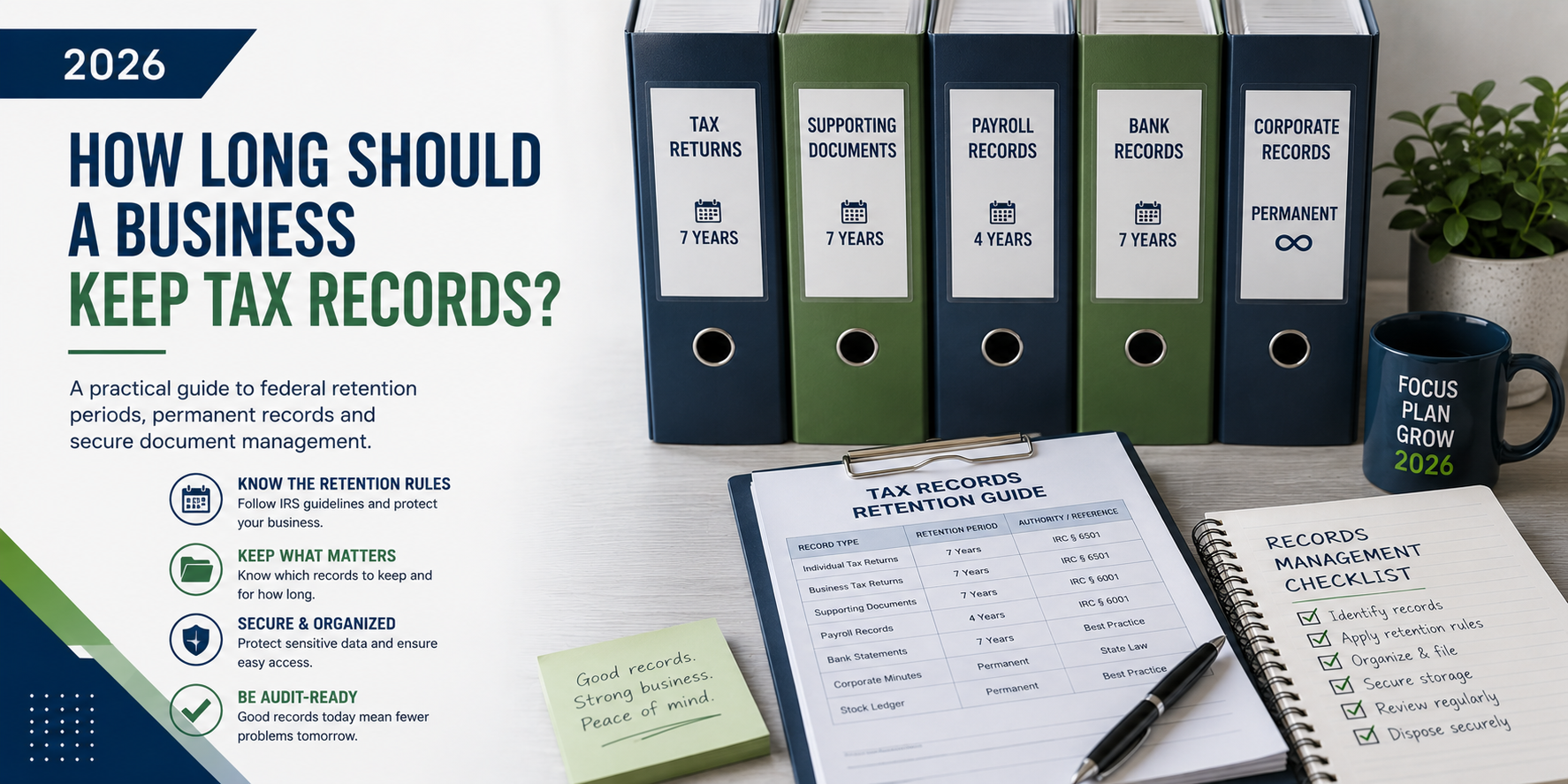
How Long Should a Business Keep Tax Records?
A practical guide to federal retention periods, permanent records and secure document management
“Keep tax records for three years” is only a starting point. Some records require 4, 6 or 7 years, while asset, ownership and unresolved-tax records may need much longer.
Retention depends on what the record supports and which rule applies. A good policy classifies records by purpose—not one destruction date for everything.
Three years is the general federal income-tax baseline—not a universal destruction date. Keep payroll, asset, ownership and permanent records under their longer rules, and never destroy records tied to an unresolved matter.
This guide summarizes general U.S. federal tax record-retention rules. State, payroll, legal, contractual and industry rules may require longer periods.
What Is a Tax Record?
A tax record is any document or electronic data that supports a return or tax position. Examples include invoices, receipts, bank statements, payroll records, Forms W-4/W-9, fixed-asset schedules, mileage logs, tax-payment confirmations and filed returns.
Why Record Retention Matters
- Substantiation: supports income, deductions, credits, payroll taxes and asset basis.
- Future filings: preserves elections, carryforwards, basis and prior-return information.
- Business operations: supports financing, due diligence, reporting and insurance claims.
- Efficient response: organized records reduce the cost and time of tax notices and examinations.
How the Federal Retention Rules Work
For income-tax records, keep support until the applicable period of limitations expires. A return filed before its due date is generally treated as filed on the due date.
| Minimum Period | When It Generally Applies | Typical Records |
|---|---|---|
| 3 years | Ordinary income-tax items when no extended limitation period applies | Sales support, expense receipts, bank statements and reconciliations |
| 4 years | Employment tax records, measured after the tax is due or paid, whichever is later | Payroll registers, Forms W-4, Forms W-2/W-2c, deposits and returns |
| 6 years | More than 25% of gross income shown on the return was omitted | Records supporting reported and potentially omitted revenue |
| 7 years | A claim involves a bad-debt deduction or loss from worthless securities | Loan documents, collection history, valuation and write-off support |
| No fixed limit | No return was filed or a fraudulent return was filed | Returns and all related supporting documentation |
| Through disposition + limitation period | Property, equipment or other assets remain owned or affect basis | Invoices, improvements, depreciation, exchanges and sale documents |
Important: These are general federal periods. Do not destroy records tied to an open examination, notice, refund claim, litigation or unresolved transaction.
Records That Commonly Need Longer Retention
Payroll and Employment-Tax Records
Keep employment-tax records for at least 4 years after the tax is due or paid, whichever is later. Retain payroll returns, wage/withholding data, deposits, Forms W-4 and Forms W-2/W-2c.
Assets, Depreciation and Basis
Keep property records through the disposal year plus the applicable limitation period. Preserve acquisition cost, improvements, Section 179 elections, depreciation, exchanges and sale records.
Returns, Ownership and Entity Records
Keep filed returns for future filings and amended-return work. PNJ recommends permanently archiving final federal and state returns when feasible, along with formation, ownership and capital records.
Common Record-Retention Mistakes
- Deleting everything after three years. Payroll, asset, bad-debt, ownership and special records may require longer retention.
- Keeping only the tax return. Retain the source documents and calculations that support reported amounts.
- Assuming electronic files are enough. They must remain readable, searchable and available for inspection.
- Relying entirely on accounting software. Maintain controlled exports and backups in case platform history is lost.
- Destroying records during a dispute. Place a hold on records tied to an examination, notice, claim, litigation or unresolved matter.
Practical Record-Retention Checklist
Work through these items when building or reviewing the retention policy.
0 of 8 complete
What Businesses Should Do Next
Inventory where records live—email, shared drives, payroll platforms, accounting software and third-party portals. Map each record type to its retention period, backup and owner before deleting older files. The goal is not to keep everything forever; it is to keep the evidence you may still need.
How PNJ Can Help
PNJ can help businesses build retention schedules, organize year-end files, identify missing support and coordinate accounting and payroll archives. We can also assist with documentation for notices, examinations and due diligence.
Disclaimer
This article is intended for general informational purposes only and does not constitute tax, accounting or legal advice. Retention requirements depend on the specific return, transaction, jurisdiction and applicable non-tax rules. Consult qualified tax and legal professionals before adopting a retention policy or destroying business records.
Official References
- IRS Publication 583: Starting a Business and Keeping Records
- IRS: Why should I keep records?
- IRS Publication 15: Employer’s Tax Guide
- IRS: Recordkeeping for businesses