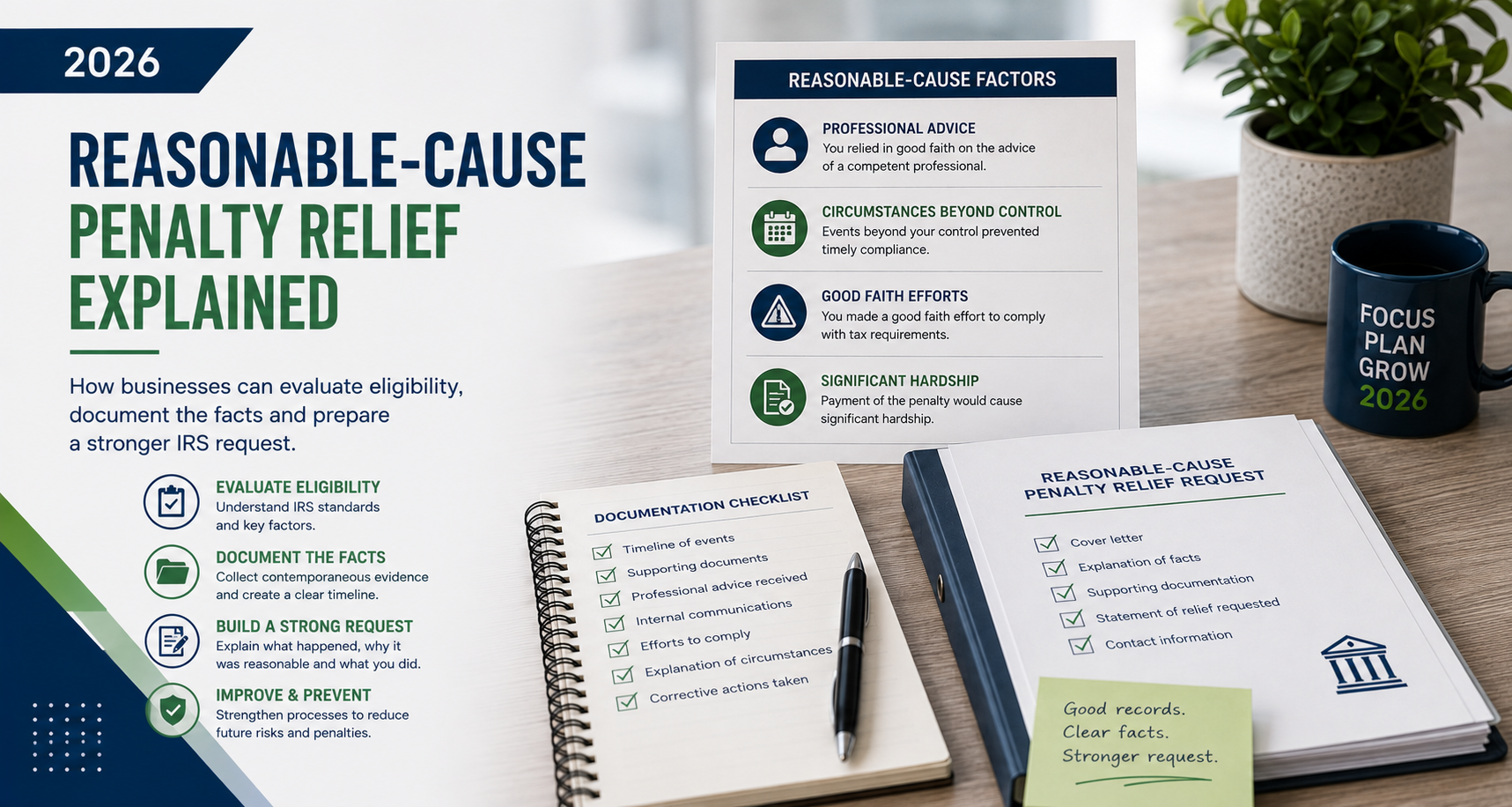
Suggested: business owner drafting a written penalty-relief request with supporting documents.
 –>
–>
Tax Compliance Intermediate Practical Guide
Reasonable-Cause Penalty Relief Explained
How businesses can evaluate eligibility, document the facts and prepare a stronger IRS request
An IRS penalty is not always final. Depending on the penalty and the taxpayer’s compliance history, relief may be available through an IRS administrative program, a statutory exception, or reasonable cause.
Reasonable cause requires more than showing that the business faced difficulty. The taxpayer should show ordinary business care, explain how a specific event prevented compliance, and document prompt correction.
A strong reasonable-cause request connects four elements: the triggering event, its direct effect on the tax obligation, the business’s efforts to comply, and the corrective action taken. A general statement such as “we were busy” or “our accountant missed it” is rarely enough.
1. What Reasonable Cause Means
Reasonable cause is a case-by-case standard that varies by penalty. For failure-to-file or failure-to-pay penalties, the IRS generally considers whether the taxpayer exercised ordinary care and prudence but still could not comply on time.
For businesses, identify who was responsible for the return, payment, or deposit; what controls existed; what disrupted them; whether a backup could have acted; and when the failure was corrected.
Reasonable cause does not apply in the same way to every penalty. Estimated-tax penalties generally use separate statutory waiver rules. Accuracy-related penalties require reasonable cause and good faith, while information-return penalties have their own responsible-manner and mitigating-factor requirements.
2. Check the Available Relief Path First
Before preparing a reasonable-cause request, first confirm that the penalty is correct and whether a simpler relief provision applies.
| Relief Path | How It Generally Works | Practical Point |
|---|---|---|
| AEP / FTA | Compliance-history relief for certain failure-to-file, failure-to-pay and failure-to-deposit penalties. | As of August 2026, the IRS is phasing in Automatic Exemption from Penalty (AEP). First Time Abate (FTA) remains relevant for older and transition periods. |
| Statutory or IRS-error relief | A specific law may provide a waiver, or relief may apply for qualifying erroneous written advice or IRS error or delay. | Use the procedure assigned to that relief; reasonable cause may not be the correct route. |
| Reasonable cause | Facts show ordinary care, a qualifying reason for noncompliance and prompt correction. | Available only when the particular penalty permits it and the evidence supports the required standard. |
AEP is automatic for eligible original returns meeting the compliance-history rules. IRS Publication 6171 explains that AEP is replacing FTA for eligible original returns due on or after January 1, 2027, while FTA remains relevant for earlier and transition periods. Taxpayers who do not qualify may still request reasonable-cause relief when permitted.
3. Which Facts Make a Request Stronger?
The event alone does not determine the result. The IRS considers the timeline, the taxpayer’s control over the situation, compliance history, mitigation efforts, and how quickly the failure was corrected.
Use the following evidence framework:
- Triggering event: State what happened, when it began and when it ended. Avoid vague descriptions.
- Direct causal link: Explain exactly why the event prevented the filing, payment, deposit or accurate reporting. The dates should align with the due date and period of delay.
- Ordinary business care: Describe the compliance calendar, responsible personnel, review controls, backup procedures and prior efforts to meet the obligation.
- Mitigation and correction: Identify attempts to obtain records, delegate authority, make a partial payment or contact an adviser, followed by the date the failure was corrected.
- Prevention: Explain the control change made afterward, such as a second EFTPS approver, backup system access or a documented tax-calendar review.
4. Facts That Usually Do Not Work by Themselves
- The business forgot, was too busy, experienced routine growth or misunderstood a recurring deadline.
- An employee, payroll provider or outside accountant was responsible, without evidence of the company’s own oversight and controls.
- The business lacked funds, without additional facts showing ordinary care, mitigation efforts and a qualifying inability to pay.
- It was the company’s first mistake. A clean history may support AEP or FTA, but it is not itself a reasonable-cause explanation.
- The business did not know the rule, without evidence that it reasonably sought advice or that the issue was unusually complex.
Professional advice can support relief for some substantive tax positions when the adviser was competent, received complete information and the taxpayer reasonably relied in good faith. It generally does not excuse missing a known filing deadline merely because the preparer failed to file.
5. How to Request Relief
Start with the IRS notice. Confirm the penalty, amount, tax form, period, response deadline, and permitted response method. Correct the underlying filing or payment issue first when possible.
Some requests may be handled by phone. Otherwise, follow the notice instructions for a written request or use Form 843 when appropriate. Form 843 is not required for every penalty and does not amend the underlying tax return.
A focused written request should include:
- Taxpayer name and identification number, notice number, penalty, form, period and amount.
- A direct request to abate or reduce the identified penalty under the applicable relief standard.
- A dated chronology explaining the event, causal connection, mitigation and correction.
- Evidence of ordinary business care before the failure and supporting documents matched to the timeline.
- The corrective and preventive actions taken, plus a signature and any declaration required by the notice or form.
Keep a complete copy and proof of submission. If relief is denied, review the IRS explanation, address the legal or factual weakness, and protect the appeal deadline.
6. Practical Checklist / What to Do Next
Work through these items when evaluating and preparing a penalty-relief request.
0 of 7 complete
How PNJ Can Help
PNJ can help businesses validate the penalty, identify the most efficient relief path, organize the supporting chronology, prepare a penalty-specific request, respond to an IRS denial and strengthen the control that caused the compliance failure.
Current Reference Points
- IRS: Reasonable-Cause Penalty Relief
- IRS Publication 6171: AEP
- IRS: Form 843 Instructions
- IRS: Penalty Appeals
Disclaimer
This article is for general informational purposes only and does not constitute tax, legal or accounting advice. Penalty-relief standards and procedures are penalty-specific, depend on the taxpayer’s facts, and may change. Review the complete IRS notice and consult a qualified adviser regarding your circumstances.