Suggested: business owner reviewing a close calendar with a fractional Controller.
 –>
–>
Business Insight Intermediate Practical Guide
When Should a Business Hire a Controller?
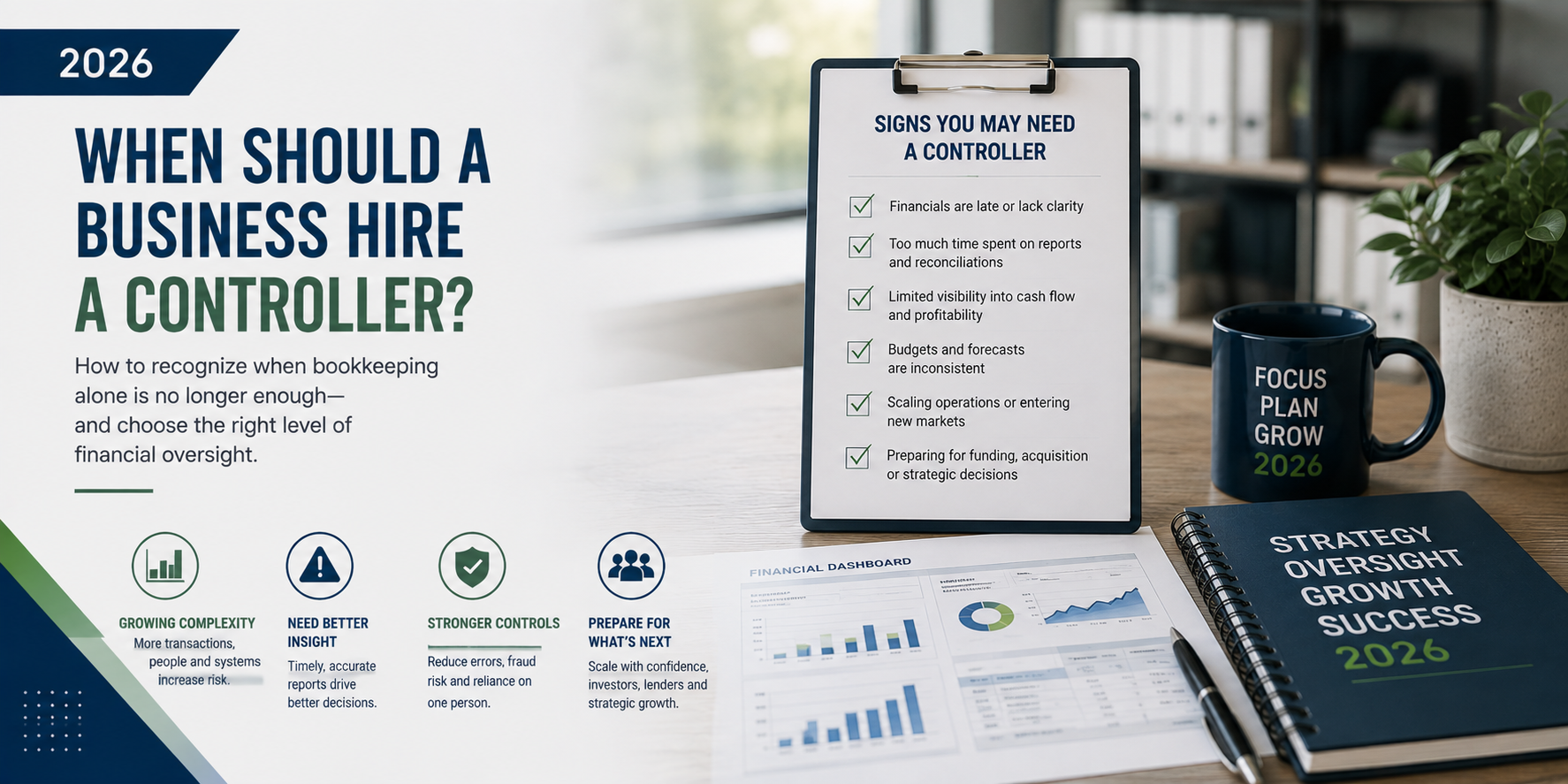
How to recognize when bookkeeping alone is no longer enough—and choose the right level of financial oversight
The better signal is financial complexity: more transactions, entities, employees, financing or reporting than the current process can reliably support.
If leadership keeps correcting reports, chasing unexplained balances or waiting on accounting, Controller-level support may already be needed.
Hire for the function—not the title. A Controller is needed when the business requires a disciplined close, reliable reporting, stronger controls and clear ownership of financial accuracy.
1. Definition
A Controller is the senior accounting leader responsible for financial integrity and accounting discipline. The role typically owns the close, reconciliations, financial statements, controls and review.
The Controller sits between transaction processing and strategic finance—turning accounting activity into dependable information.
| Finance Role | Primary Focus | Typical Questions Answered |
|---|---|---|
| Bookkeeper / Staff Accountant | Records transactions and maintains supporting schedules. | Were invoices, payments, payroll and bank activity recorded correctly? |
| Controller | Owns close quality, reporting, accounting policies, controls and review. | Can management trust the numbers, and what is driving results? |
| CFO / Financial Advisor | Leads financial strategy, capital planning and financing decisions. | Where should the business invest, and how should it finance growth? |
2. Why It Matters
As a company grows, weak accounting processes create greater risk. Errors compound when reconciliations, revenue, accruals, payroll, fixed assets and intercompany balances lack consistent review.
Controller oversight adds accountability, cash visibility and reliable management reporting—and gives auditors, lenders, tax advisers and investors a knowledgeable finance contact.
3. How It Works
Step 1: Look for Repeated Operating Signals
Repeated problems often signal a missing financial-management layer:
- Late or inconsistent close with repeated corrections.
- Unreconciled or unexplained balances and schedules that do not tie to the general ledger.
- Poor visibility into margins, profitability, cash burn, working capital or variances.
- Unclear ownership of approvals, reviews and close responsibilities.
- Financing, audit, due diligence, system conversion or rapid growth creating new reporting demands.
Step 2: Define the Controller Scope
Define the gaps the Controller must own: close, reporting, cash visibility, controls, team supervision and adviser coordination. Financing strategy may remain with the CFO or owners.
Step 3: Choose the Right Delivery Model
Use a fractional Controller when senior oversight is needed but not full-time. A full-time Controller fits businesses that need daily leadership, complex reporting or continuous stakeholder support.
| Model | Generally Fits When | Management Consideration |
|---|---|---|
| Fractional / Outsourced Controller | Recurring senior oversight is needed, but not a full-time workload. | Define responsibilities, meeting cadence, deliverables and team access. |
| Full-Time Controller | Daily leadership, complex reporting or continuous support is required. | Evaluate experience, industry knowledge and ability to build processes. |
| Project-Based Controller | Cleanup, system conversion, audit preparation or due diligence needs senior leadership. | Define the end state and transition plan. |
Step 4: Establish the First 90-Day Priorities
First stabilize the foundation: reconcile key accounts, establish the close calendar, assign preparers/reviewers and resolve material historical issues. Then improve forecasting, variance analysis and profitability reporting.
A Controller should not become the permanent fixer of every accounting problem. The role should build standards, accountability and review procedures so the team produces reliable work consistently.
4. Common Mistakes
Confusing Controller and CFO Needs
Fix unreliable books, delayed close and weak controls with Controller support first. Use CFO support for capital strategy, financing and long-range planning.
Using Revenue as the Hiring Trigger
There is no universal revenue threshold. Complexity, workload, risk and management information needs matter more.
Assuming Outsourced and Internal Teams Cannot Work Together
An internal bookkeeper can process transactions while an outsourced Controller owns review, close quality and reporting. Clear roles, deadlines and access are essential.
5. Practical Checklist / What’s Next
Work through these items to determine the right level of financial oversight.
0 of 7 complete
The right time to add a Controller is before accounting problems limit growth. Act when the business needs stronger financial ownership and visibility—not after an audit, financing request or cash problem exposes the gap.
How PNJ Can Help
PNJ can provide fractional Controller support or work alongside an internal accounting team to strengthen the month-end close, reconciliations, management reporting, controls and accounting oversight.
Disclaimer
This article is for general informational purposes only and does not constitute accounting, tax, legal, investment or employment advice. The appropriate finance structure depends on the company’s operations, risks, reporting requirements, systems, staffing and objectives. Businesses should evaluate their specific circumstances with qualified advisers.