Suggested: business owner comparing an in-house team and an outsourced accounting dashboard.
 –>
–>
Business Insights Intermediate Practical Guide
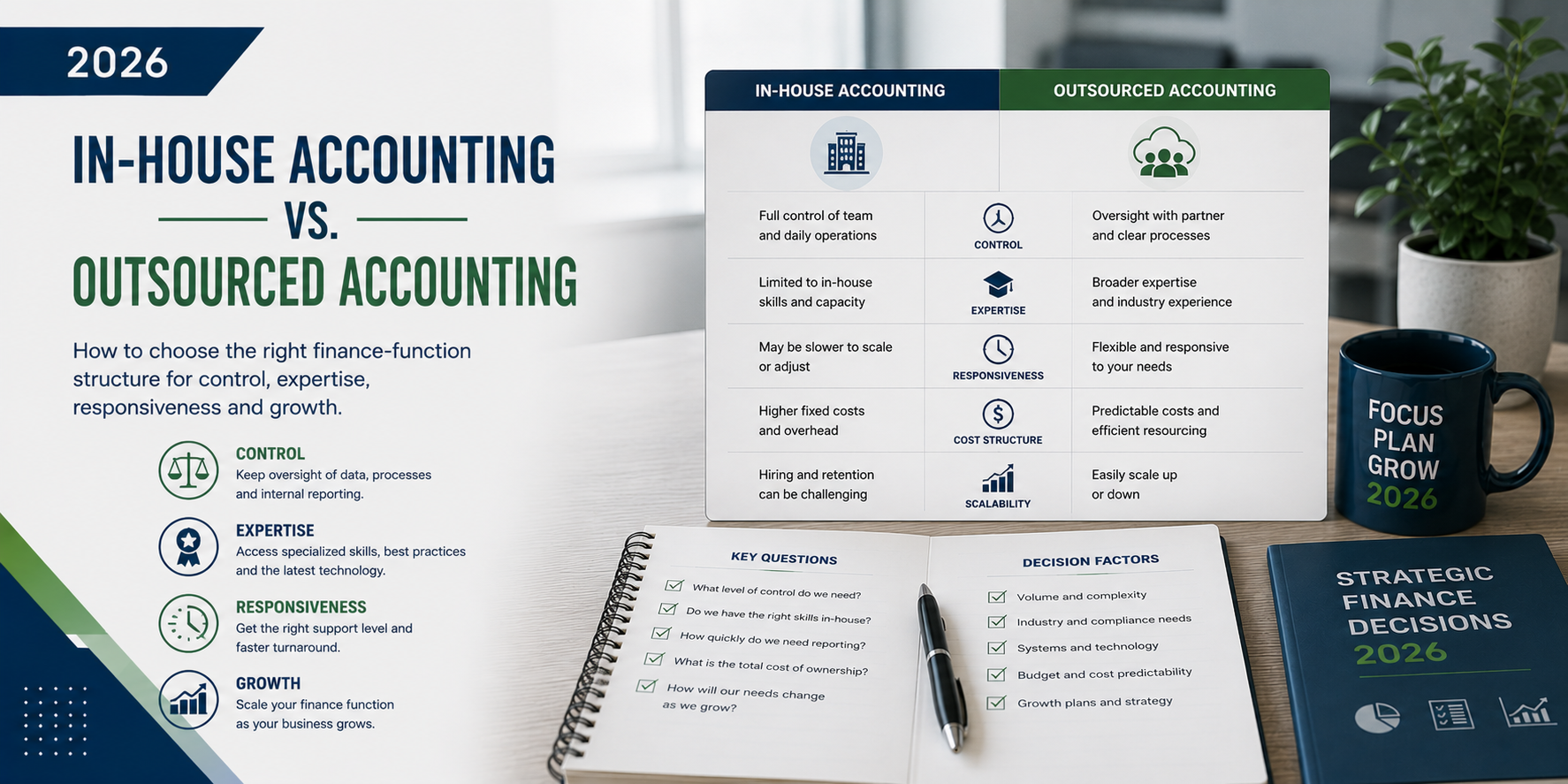
In-House Accounting vs. Outsourced Accounting
How to choose the right finance-function structure for control, expertise, responsiveness and growth
Choosing an accounting model is about more than salary versus provider fees. It affects accuracy, responsiveness, internal control, expertise, continuity, and scalability.
Businesses may use an in-house, outsourced, or hybrid model. The right structure depends on the work required, the skill level needed, and how closely finance must support daily operations.
The best model puts each responsibility at the right skill level, delivers timely and reliable information, protects company assets, and can scale as the business changes. In-house versus outsourced is usually a design decision—not an all-or-nothing choice.
1. Start With the Work the Business Actually Needs
Separate the finance function into three layers: transactional accounting (billing, AP, payroll coordination, reconciliations), Controller work (close, review, controls, variance analysis), and CFO work (forecasting, financing, capital planning, and decision support).
One person rarely performs every layer efficiently. The structure should match the company’s volume, complexity, and management needs.
2. Side-by-Side Comparison
| Factor | In-House Accounting | Outsourced Accounting |
|---|---|---|
| Availability | Usually available throughout company working hours and closely connected to daily operations. | Depends on agreed service levels, meeting cadence and communication channels. |
| Business knowledge | Can develop deep operational and institutional knowledge. | Can become highly knowledgeable, but requires disciplined onboarding and regular communication. |
| Expertise | Limited to the skills of the hired team unless additional specialists are engaged. | May provide bookkeeping, Controller, tax, systems and CFO capabilities through a layered team. |
| Cost structure | Salary, payroll taxes, benefits, recruiting, training, systems, supervision and turnover. | Fees based on scope, staffing level, transaction volume and work outside the agreed scope. |
| Control | Management directly controls people, schedules and priorities. | Management retains decision authority but must define scope, access, deadlines and accountability. |
| Scalability | Additional capacity generally requires hiring, training or role redesign. | Capacity or senior support may be added more quickly if the provider has appropriate resources. |
| Continuity | May depend heavily on one or two employees. | Can offer team coverage, but only when procedures and cross-training are real. |
Compare the total cost and service level required—not one salary against one monthly or hourly fee.
3. Compare the Full Economic Cost
For an internal team, include salary, payroll taxes, benefits, recruiting, training, technology, management time, and turnover—plus any senior review the team still needs.
For outsourcing, include implementation or clean-up, recurring fees, out-of-scope advisory work, and management coordination time. A low fee is not valuable if late reporting, rework, or weak communication creates more cost.
Compare equivalent outcomes: transaction processing, close completion, review level, reporting quality, coverage, and advisory access. The lowest visible price may not mean the lowest total cost or risk.
4. Evaluate the Operating Model, Not Just the Provider
- Responsiveness: Define routine and urgent response times, the primary contact, escalation path, and meeting cadence.
- Internal control: Keep approval rights clear for vendors, payments, material entries, reconciliations, and financial statements.
- Security: Confirm role-based access, MFA, secure file exchange, staff-access removal, subcontractor or offshore involvement, retention, and incident-response procedures.
- Continuity: Require documented procedures, shared schedules, cross-training, and company ownership of systems and credentials.
- Accountability: Use a responsibility matrix, close calendar, and shared task tracker so deadlines, owners, reviews, and approvals stay visible.
5. When Each Model Often Works Best
In-house may fit best when daily transaction complexity is high, finance is tightly integrated with operations, immediate support is essential, or the company can support specialized roles.
Outsourcing may fit best when the business needs more expertise than it can justify hiring full-time, wants scalable capacity, faces turnover, needs clean-up or system improvement, or requires Controller/CFO support.
A company can keep AP, billing, payroll coordination, and daily requests in-house while outsourcing reconciliations, close review, technical accounting, tax coordination, reporting, or fractional Controller/CFO support.
6. Decision Signals Management Should Monitor
- The month-end close is taking longer or repeatedly misses the reporting deadline.
- Financial statements require frequent corrections or do not explain business performance.
- The owner, CFO or operations leaders spend excessive time resolving routine accounting issues.
- The team cannot keep up with billing, payables, reconciliations, payroll coordination or audit requests.
7. Common Mistakes
- Lowest quoted fee — Selecting outsourcing only because the quoted fee appears lower than a salary.
- One person for every finance role — Hiring one person and expecting bookkeeping, Controller, tax and CFO capabilities from the same role.
- Undefined approvals — Outsourcing execution without defining internal approval, payment and decision responsibilities.
- Broad system or banking access — Granting broad banking or system access without role limits, review controls and access monitoring.
- Undocumented responsibilities — Failing to document responsibilities, deadlines, deliverables and escalation procedures.
- Never reassessing the model — Treating the accounting model as permanent instead of reassessing it as the company changes.
8. Practical Checklist / What to Do Next
Work through these items to design or reassess the finance-function structure.
0 of 7 complete
How PNJ Can Help
PNJ helps businesses design a finance function around actual needs—from fully outsourced accounting to a hybrid model with close support, Controller oversight, technical accounting, tax coordination, management reporting, or CFO advisory.
Practical Reference
The right structure depends on company size, transaction volume, staffing, systems, industry, reporting needs, and management’s operating model.
Disclaimer
This article is for general informational purposes only and does not constitute accounting, tax, legal, employment or cybersecurity advice. Each organization should evaluate its circumstances, risks and service agreements with qualified advisers.