Suggested: accountant preparing Schedule K-1 packages ahead of the September 15 deadline.
 –>
–>
Tax Update
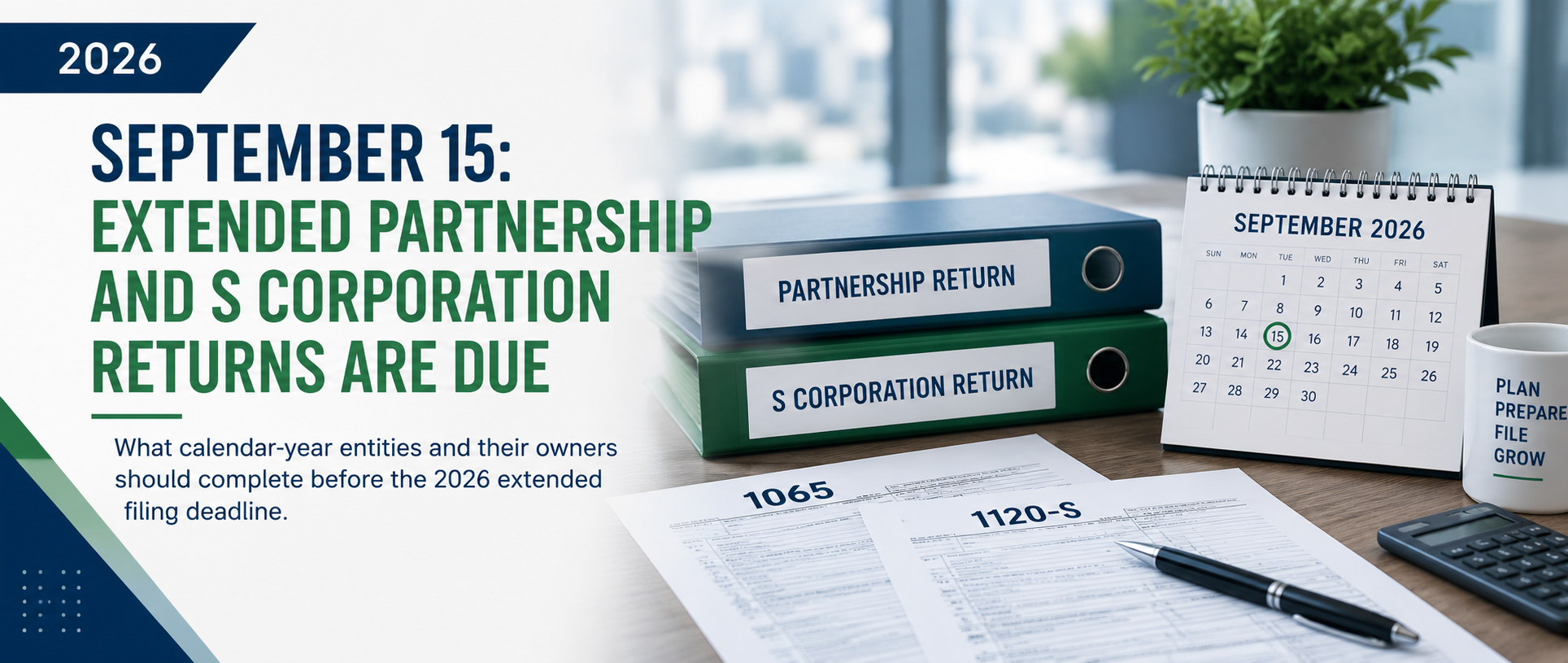
September 15: Extended Partnership and S Corporation Returns Are Due
What calendar-year entities and their owners should complete before the 2026 extended filing deadline.
Calendar-year partnerships and S corporations with a timely extension generally must file their 2025 federal returns by September 15, 2026. The return should be complete and accepted, and related Schedules K-1 should be delivered to owners by the due date.
1. What Is Due September 15?
September 15, 2026 is the extended federal filing deadline for most calendar-year partnerships and S corporations that timely filed Form 7004. It applies to the 2025 entity return—not every business or every fiscal-year entity.
| Entity | Federal Return | Owner Reporting |
|---|---|---|
| Partnership, including most multi-member LLCs taxed as partnerships | Form 1065 | Schedule K-1 for each person who was a partner during the year |
| S corporation, including an LLC with a valid S election | Form 1120-S | Schedule K-1 for each person who was a shareholder during the year |
An extension gives more time to file—not to pay. Entity-level tax, withholding, state tax, or other required amounts may still have been due on the original payment deadline.
2. Why the Deadline Matters
The return determines each owner’s share of income, deductions, credits, distributions, and other tax items reported on Schedule K-1. Late or incomplete filings can delay owners’ federal and state returns.
For returns due in 2026, the federal late-filing penalty for a return with no tax due is generally $255 per month or part of a month, per partner or shareholder, for up to 12 months. Separate penalties may apply to late, incomplete, or incorrect K-1s.
A two-owner entity filing one month late may face a $510 entity-return penalty before K-1 penalties, state penalties, tax, or interest.
3. How to Prepare for a Complete Filing
A complete filing starts with closed and reconciled books. Filing from incomplete records may create amended returns, corrected K-1s, and avoidable penalties.
Finalize the Accounting Records
- Reconcile: Bank, credit-card, loan, payroll, and major balance-sheet accounts through year-end.
- Review: AR, AP, fixed assets, owner contributions/distributions, and intercompany activity.
- Record year-end items: Accruals, cutoff adjustments, and any corrections needed to place revenue and expenses in the proper period.
Confirm Ownership and Allocation Data
- Owner information: Verify legal names, addresses, taxpayer IDs, and ownership dates.
- Partnerships: Confirm ownership changes, special allocations, guaranteed payments, liabilities, and tax-basis capital.
- S corporations: Confirm stock changes, shareholder loans, distributions, and reasonable compensation.
Complete Federal and State Reporting
- Schedule K-1: Prepare each K-1 and all supporting owner statements.
- International reporting: Determine whether Schedules K-2/K-3 or other disclosures are required.
- State compliance: Review state/local returns, composite filings, owner withholding, and separate deadlines.
- E-file completion: Obtain signatures or authorizations, transmit early, and retain the acceptance acknowledgment.
4. Common Mistakes
- Treating September 15 as a soft deadline: Pass-through status does not eliminate filing penalties.
- Filing before the books are final: Reconcile payroll, fixed assets, and owner transactions first.
- Using outdated owner data: Confirm ownership percentages, addresses, taxpayer IDs, and effective dates.
- Ignoring state requirements: Check state returns, withholding, composite filings, and separate payments.
- Sending incomplete K-1 packages: Include the supporting statements owners need to file.
- Assuming transmission equals acceptance: Confirm the IRS e-file acknowledgment.
Quick Answers
- Does every partnership or S corporation have a September 15 deadline? No. This update applies to calendar-year entities with a timely standard extension. Fiscal-year, short-year, disaster-relief, or specially governed returns may have different dates.
- Can the entity file now and correct K-1s later? A return should be complete and accurate when filed. Knowingly incomplete filings can create amended returns, corrected K-1s, owner-return changes, and possible penalties.
- What if information is still missing? Escalate it immediately. Determine whether reliable records support completion or whether a specific relief provision applies. Do not assume another automatic federal extension.
5. Practical Checklist: What’s Next
Work through these items before the September 15 deadline.
0 of 8 complete
PNJ Perspective
A timely filing is not enough if the return is incomplete. PNJ helps businesses connect year-end accounting, ownership data, Forms 1065 or 1120-S, Schedule K-1 reporting, and state compliance so the extended filing is complete, supported, and ready for owner reporting.
Technical Reference Points
- IRS: Tax Year 2025 Form 7004 Due-Date Chart
- IRS: 2025 Instructions for Form 1065
- IRS: 2025 Instructions for Form 1120-S
- IRS: E-filing Form 7004
Disclaimer
This article provides general educational information and is not tax, accounting, or legal advice. Filing requirements, relief provisions, penalty amounts, and state rules depend on the entity’s facts and may change. Consult a qualified adviser regarding your specific filing obligations.