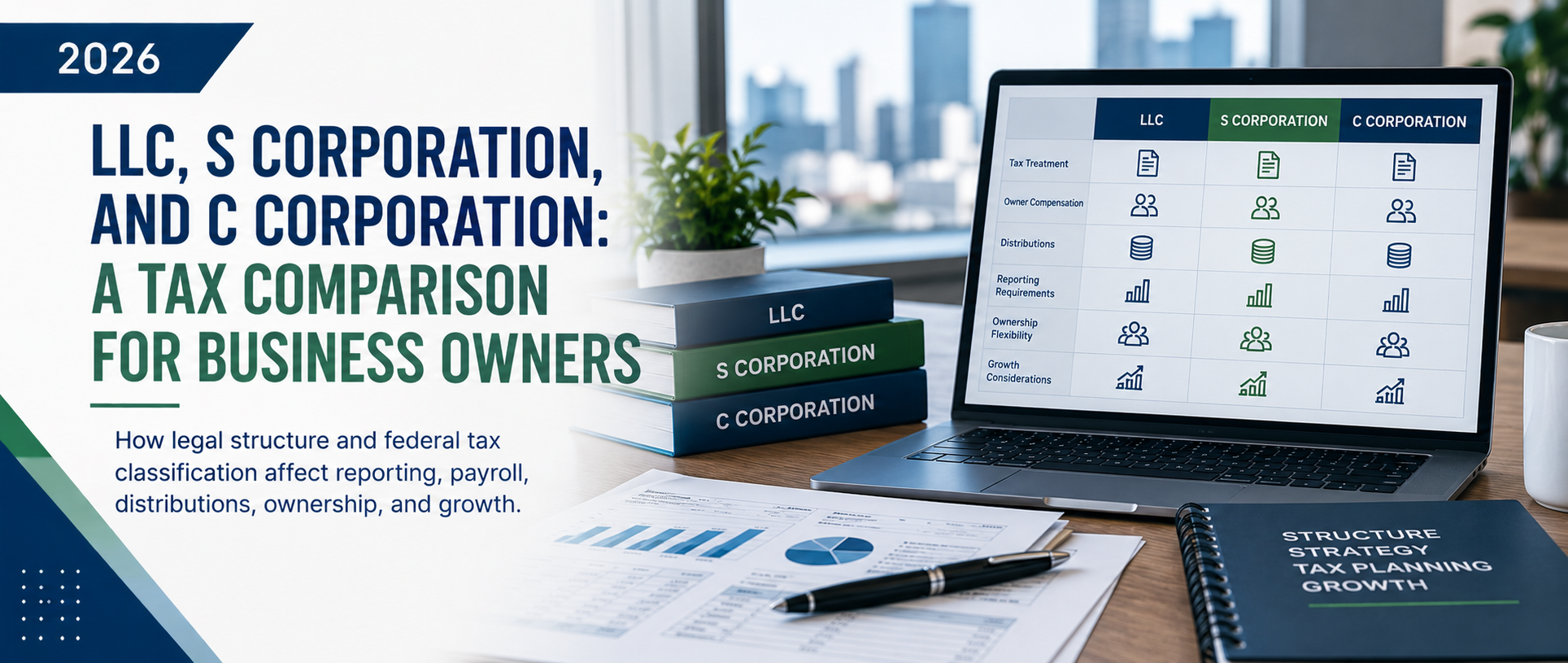
Suggested: business owner comparing LLC, S corp, and C corp structures with an adviser.
 –>
Tax Foundation
LLC, S Corporation, and C Corporation: A Tax Comparison for Business Owners
How legal structure and federal tax classification affect reporting, payroll, distributions, ownership, and growth.
“LLC” is a legal structure, not a complete tax classification. An LLC may be disregarded, taxed as a partnership, or elect S or C corporation treatment. Compare the total impact on owner pay, distributions, losses, state taxes, ownership plans, and compliance cost—not just the headline tax rate.
1. Definition
Legal structure vs. tax classification: State law governs the entity, ownership, liability, and governance; federal tax classification determines who reports the income and how it is taxed.
- LLC: A flexible state-law entity. A single-member LLC is generally disregarded; a multi-member LLC is generally a partnership unless corporate treatment is elected.
- S corporation: A federal tax election for a qualifying corporation or LLC. It generally requires eligible shareholders, no more than 100 shareholders, and one class of stock.
- C corporation: The default federal treatment of a corporation; an LLC may also elect C-corp taxation. It offers the greatest equity and investor flexibility.
2. Why It Matters
Entity choice changes owner compensation, cash distributions, losses, governance, and growth flexibility.
- Governance & liability: LLCs and corporations use different ownership and governance structures; liability protection still depends on proper legal and financial separation.
- Who pays tax: Default LLC and S-corp income generally passes through to owners; a C corporation generally pays its own federal income tax.
- Owner compensation: Active default-LLC owners may face self-employment tax; working S-corp shareholders generally need reasonable W-2 compensation.
- Losses & distributions: Pass-through losses are subject to owner-level limits, and distributions do not automatically equal taxable income or deductible compensation.
- Growth & state rules: S corporations have ownership restrictions; C corporations generally provide more equity flexibility. State taxes and entity fees can materially change the result.
3. How It Works
LLC Legal Structure and Default Taxation
Default-taxed LLC: A single-member LLC generally reports on Schedule C; a multi-member LLC generally files Form 1065 and Schedule K-1s. Active owner income may face self-employment tax, and owners may owe tax even when cash is retained.
S Corporation Taxation: Two Legal Paths
- Corporation with S election: Remains a corporation legally.
- LLC with S election: Remains an LLC legally, but its governing terms must satisfy S-corp eligibility and one-class-of-stock rules.
Both file Form 1120-S and issue Schedule K-1. Working owners generally receive reasonable W-2 wages; remaining profit generally passes through without self-employment tax. Basis still matters for losses and distributions.
C Corporation Taxation: Two Legal Paths
A C corporation files Form 1120 and generally pays federal tax at 21%. Losses remain with the corporation, retained earnings may stay inside the entity, and dividends can create a second level of tax. C corporations generally offer the most investor flexibility.
Quick Federal Comparison
| Factor | Default-Taxed LLC | S Corporation | C Corporation |
|---|---|---|---|
| Underlying legal form | LLC | Corporation or eligible LLC | Usually corporation; LLC may elect |
| Federal taxpayer | Owner(s) | Shareholder(s) | Corporation |
| Federal return | Schedule C or Form 1065 | Form 1120-S | Form 1120 |
| Owner pay | Draws or distributions; generally no owner W-2 for default individual/partnership treatment | Reasonable W-2 wage plus possible distributions | W-2 wage; possible dividends |
| Losses | May pass through, subject to limits | May pass through, subject to limits | Remain with corporation |
| Retained cash / distributions | Owners may owe tax even if cash is retained | Shareholders may owe tax even if cash is retained | Entity pays tax; dividends may create second tax layer |
| Ownership | Usually broad and flexible | Eligible shareholders; one class | Broadest; multiple classes possible |
| Typical tradeoff | Simpler, but active income may face self-employment tax | Potential payroll-tax efficiency with added compliance | Investor flexibility, but possible two-level tax |
4. Simple Example
Assume a single-owner consulting LLC earns $300,000 before owner compensation. The legal entity remains an LLC; only the federal tax classification changes.
- Default LLC: Profit generally flows to the owner and may be subject to income and self-employment tax. Draws do not reduce taxable profit.
- LLC taxed as S corporation: The owner receives a supportable W-2 salary; remaining profit passes through on Schedule K-1 and generally is not self-employment income.
- LLC taxed as C corporation: The entity pays corporate tax after deductible compensation. Retained earnings remain in the company; dividends may create shareholder-level tax.
A real comparison should include payroll taxes, QBI, benefits, state taxes, basis, cash needs, and compliance costs. Reasonable compensation must be supported by the facts.
5. Common Mistakes
The most common problems come from focusing on one tax benefit instead of the total economic and compliance result.
- Treating “LLC” as the tax answer: Confirm whether the LLC is disregarded, a partnership, an S corporation, or a C corporation.
- Electing S-corp status too early: Low or inconsistent profit may not justify payroll, tax-preparation, bookkeeping, and state-filing costs.
- Ignoring reasonable compensation: Working S-corp shareholders generally need supportable W-2 wages before non-wage distributions.
- Confusing distributions with taxable income: Pass-through owners may owe tax even when cash stays in the business; distributions do not automatically create deductions.
- Ignoring basis and loss limits: Losses and tax-free distributions may depend on sufficient stock, debt, or partnership basis.
- Comparing only the federal rate: Include self-employment tax, payroll tax, QBI, state and franchise taxes, benefits, and compliance costs.
- Ignoring ownership and growth plans: S-corp restrictions may conflict with foreign investors, multiple equity classes, institutional capital, or broader employee equity.
- Missing implementation and transition issues: Election deadlines, payroll setup, legal-document changes, and classification changes can create additional tax consequences.
6. Practical Checklist: What’s Next
Before forming a new entity or changing tax classification, focus on six decision areas:
6.1 Confirm the Structure
- Legal form and tax classification: LLC vs. corporation; disregarded, partnership, S-corp, or C-corp treatment.
- Documents and registrations: Review operating agreements/bylaws, prior elections, and state/local registrations.
6.2 Understand the Owners
Confirm eligibility and economics: ownership %, owner type, U.S./foreign status, work performed, expected compensation/distributions, and succession plans.
6.3 Project the Business Economics
Model more than one year: revenue, operating profit, owner compensation, distributions, retained cash, growth, capital spending, and financing needs.
6.4 Compare the Total Tax Result
Include: federal income tax, self-employment/payroll taxes, reasonable compensation, QBI, benefits, retirement plans, state taxes, dividends/distributions, basis, and loss limits.
Compare the total burden—not just the entity-level tax rate.
6.5 Review Growth and Ownership Plans
Consider future owners, foreign investors, preferred/multiple equity classes, institutional capital, employee equity, succession, and exit strategy.
The tax structure should support the company’s expected direction—not restrict it.
6.6 Evaluate Cost, Implementation, and Ongoing Fit
- Compliance cost: payroll, bookkeeping, tax filings, annual reports, franchise taxes, legal maintenance, and multi-state filings.
- Implementation: Confirm election forms, deadlines, payroll changes, governing-document updates, system changes, and transition tax effects.
Reassess when profitability, ownership, nexus, financing, cash needs, or exit plans change.
PNJ Perspective
The right entity choice is a business and tax decision. PNJ helps business owners compare LLC, S corporation, and C corporation treatment across owner compensation, cash flow, state taxes, compliance, and growth plans.
Technical Reference Points
- IRS: Limited Liability Company (LLC)
- IRS: S Corporations
- IRS: S Corporation Compensation
- IRS: Qualified Business Income Deduction
- IRS: Business Structures
- IRS: Forming a Corporation
Disclaimer
This article provides general educational information and does not constitute tax or legal advice. Entity selection depends on federal, state, and local law and the owner’s specific facts. Consult qualified tax and legal advisers before forming an entity, making an election, or changing tax classification.