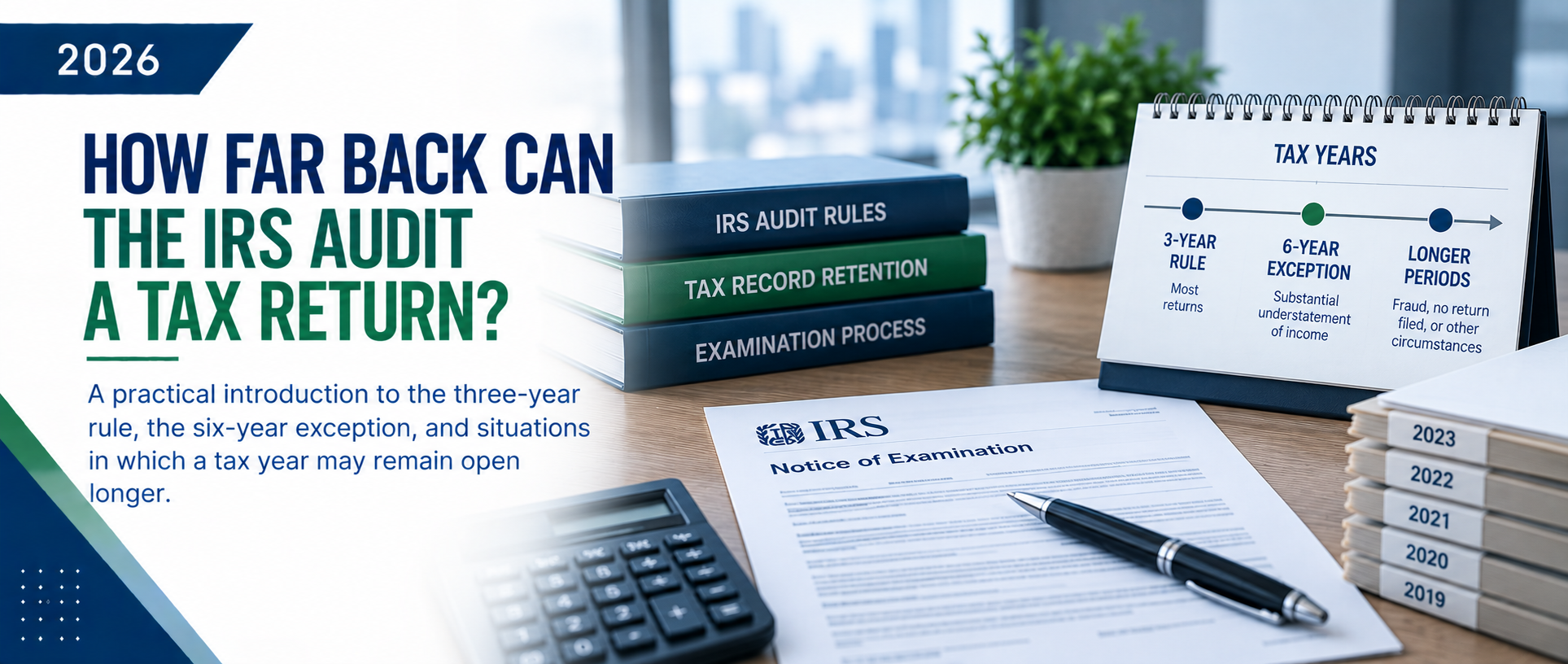
Suggested: business owner reviewing old tax returns and filing dates on a calendar.
 –>
–>
Tax Compliance Foundation
How Far Back Can the IRS Audit a Tax Return?
A practical introduction to the three-year rule, the six-year exception, and situations in which a tax year may remain open longer.
The 3-year rule is the general starting point—not a universal limit. A substantial omission, unfiled or fraudulent return, agreed extension, or other special rule can keep a tax year open longer.
1. Definition
An IRS audit reviews a tax return and supporting records. The key question is usually how long the IRS has to assess additional tax.
That deadline is the assessment statute of limitations, and its expiration date is often called the Assessment Statute Expiration Date (ASED). An audit may begin before that date, but assessment generally must occur within the applicable period.
| Situation | General Federal Period | Basic Meaning |
|---|---|---|
| Routine filed return | Usually 3 years | The normal assessment period applies when no exception changes it. |
| Qualifying substantial omission | Usually 6 years | A longer period may apply when the statutory omission test is met. |
| No valid return filed | No normal 3-year period begins | The year may remain open until a valid return is filed and the applicable period runs. |
| Fraudulent return | No normal time limit | The ordinary limitation does not apply when a false or fraudulent return is filed with intent to evade tax. |
2. Why It Matters
The IRS generally examines returns filed within the last 3 years and usually does not go back more than 6 years. Those are general audit practices—not a guarantee that every older year is closed.
Knowing which years remain open affects record retention, amended returns, audit responses, statute extensions, and carryforward items such as depreciation, basis, losses, and credits.
- Audit period: Which returns and issues the IRS is examining.
- Assessment period: How long the IRS generally has to assess additional tax.
- Collection period: How long the IRS may collect tax after assessment—a separate rule.
3. How It Works
The General Three-Year Rule
For most properly filed federal income tax returns, the IRS generally has 3 years to assess additional tax. An early-filed return is generally treated as filed on its original due date; a late-filed return generally starts the period when a valid return is filed.
The Six-Year Rule for Certain Omissions
The period may increase to 6 years when a taxpayer omits from gross income more than 25% of the gross income stated on the return, subject to statutory measurement rules. A large adjustment alone does not automatically trigger the six-year rule.
No Normal Limit for No Return or Fraud
If no valid required return was filed, the normal 3-year period generally never begins. Likewise, a false or fraudulent return filed with intent to evade tax generally has no normal assessment limit.
A mistake, weak documentation, or large adjustment is not automatically fraud. Fraud requires intent and is a serious legal conclusion.
An Agreed Extension Can Add Time
The IRS may ask the taxpayer to sign Form 872 or another consent extending the assessment period. Before agreeing, review the tax, period, expiration date, scope, and reason for the extension with a qualified adviser.
Other Special Rules
Other rules—such as international reporting failures, listed transactions, carrybacks, amended returns near expiration, court proceedings, and other statutory events—can extend or suspend the normal deadline. State rules may also differ.
4. Simple Example
Assume a calendar-year corporation timely files its 2025 return on April 15, 2026.
- Routine return: If no exception applies, the ordinary deadline generally ends April 15, 2029.
- Qualifying omission: If the statutory six-year rule applies, the period may extend to April 15, 2032.
- No valid return: If no valid required return was filed, the normal three-year period generally would not begin.
The actual date can change because of extensions, late filing, consents, notices, international issues, or other events. Calculate the deadline from the return and IRS records—not a rough calendar estimate.
5. Common Mistakes
- Assuming every audit is limited to 3 years: Exceptions can keep a year open longer.
- Treating any large adjustment as a 6-year omission: The statutory omission test must actually be met.
- Assuming an old unfiled return is closed: The normal limitation period generally does not begin until a valid return is filed.
- Signing an extension without review: Confirm the period, scope, expiration date, and reason first.
- Destroying long-term tax records too early: Asset basis, losses, credits, and carryforwards may affect later returns.
- Confusing assessment with collection: The 10-year collection rule is a different concept.
6. Practical Checklist: What’s Next
Work through these items when determining whether a tax year is still open.
0 of 6 complete
PNJ Perspective
Statute-of-limitations questions should be based on the actual filing history, tax form, issue, extensions, and procedural events—not simply the age of the return. PNJ helps businesses confirm filing records, identify potentially open years, preserve supporting records, and document the applicable ASED.
Sources and Professional Notes
- IRS: Audits—How Far Back the IRS Can Go
- IRS: Statutes of Limitations for Assessing and Collecting Tax
- IRS: How Long Should I Keep Records?
- U.S. Code: 26 U.S.C. Section 6501
Disclaimer
This article provides general educational information and is not tax or legal advice. Limitation periods depend on the tax form, filing history, issue, taxpayer, jurisdiction, and procedural events. Obtain professional advice before relying on a particular expiration date.