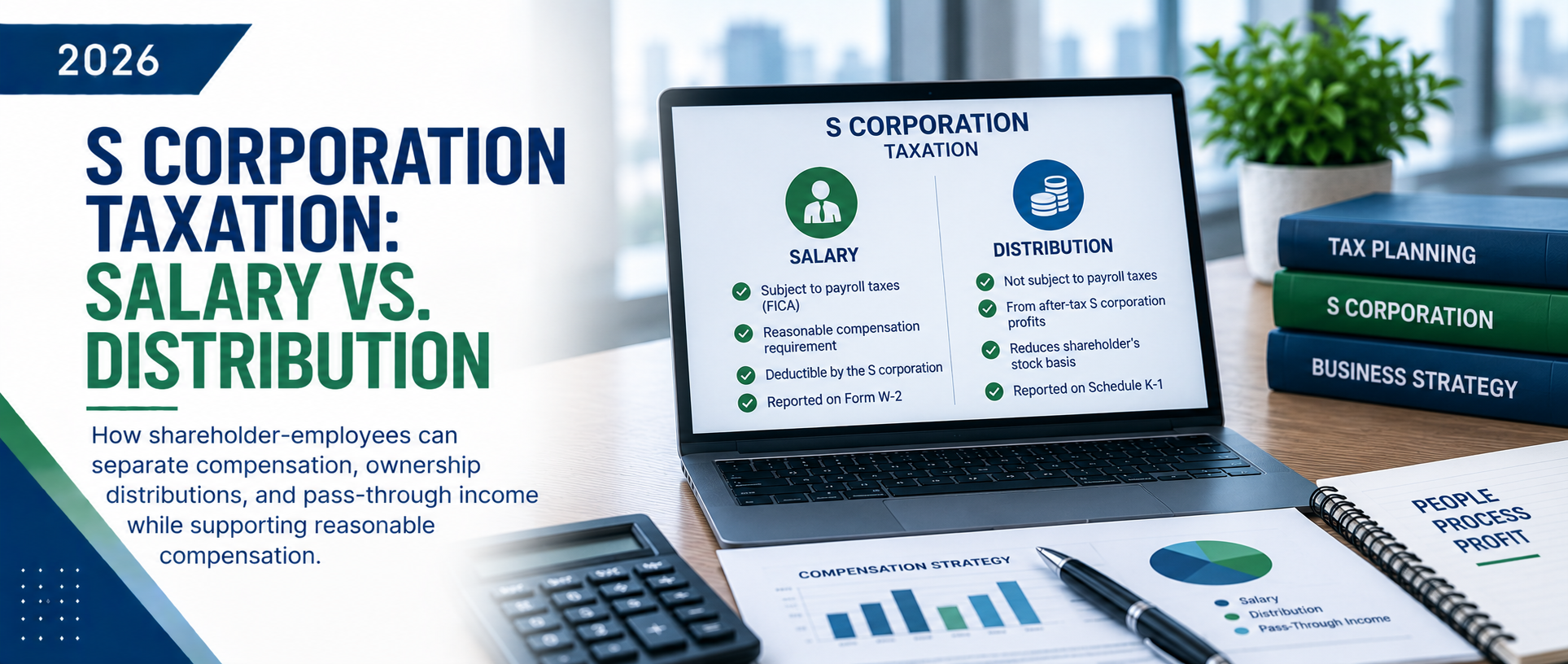
Suggested: S corporation owner reviewing payroll and a shareholder distribution worksheet.
 –>
Tax Practice Guide | Intermediate
S Corporation Taxation: Salary vs. Distribution
How shareholder-employees can separate compensation, ownership distributions, and pass-through income while supporting reasonable compensation.
The tax advantage is not simply “salary or distribution.” An active shareholder generally should receive reasonable W-2 compensation first. Additional cash may then be paid as a shareholder distribution when supported by profit, cash flow, corporate records, and stock basis.
1. Definition: Salary, Distribution, and K-1 Income
Salary, distributions, and K-1 income are different economic and tax events and should not be used interchangeably.
| Item | What It Represents | General Federal Treatment |
|---|---|---|
| W-2 salary | Payment for services performed as an employee | Deductible by the corporation when otherwise allowable; subject to withholding and employment taxes. |
| Shareholder distribution | Cash or property paid because of stock ownership | Not a compensation expense and generally not subject to payroll tax; income-tax treatment depends mainly on stock basis and the corporation’s tax history. |
| Schedule K-1 income | The shareholder’s allocated share of S corporation tax items | Generally subject to income tax whether or not cash is distributed; ordinary business income is generally not self-employment income. |
A distribution does not replace K-1 income. A shareholder may owe tax on allocated income even when the corporation retains the cash, while previously taxed cash may be distributed in a later year.
2. Why the Salary-Distribution Split Matters
W-2 wages are generally subject to income-tax withholding and Social Security and Medicare taxes. Qualifying non-wage distributions generally are not subject to payroll tax.
That difference can create legitimate payroll-tax efficiency—but only after reasonable compensation is addressed. If salary is too low, the IRS may reclassify distributions as wages, creating payroll tax, withholding adjustments, penalties, and interest.
Salary and employer payroll taxes are operating expenses. Shareholder distributions are equity transactions—not expenses. Misclassification distorts both tax reporting and financial statements.
3. How It Works: Reasonable Compensation Comes First
The IRS does not publish a universal salary percentage or safe-harbor ratio. Reasonable compensation depends on the facts, circumstances, and value of the shareholder’s services.
Build the Analysis Around the Work Performed
- Role and responsibility: Training, credentials, experience, duties, and decision-making authority.
- Time and activities: Client work, sales, operations, management, and administration.
- Market compensation: Comparable pay for similar roles, industries, and locations.
- Company economics: Size, complexity, revenue, profitability, and financial condition.
- Revenue source: Owner services versus employees, systems, capital, or equipment.
- Compensation history: Agreements, non-shareholder pay, and prior wages and distributions.
One owner may perform several roles. A blended market-compensation analysis for significant responsibilities is generally stronger than relying on a title such as “CEO” alone.
Document the conclusion before year-end: job duties, estimated time by role, market data, calculation, approval, and reasons for material changes. Reassess when duties or business economics change.
Stock Basis Still Controls Distribution Taxability
Schedule K-1 reports the distribution, but stock basis determines its taxability. A nondividend distribution is generally tax-free up to available stock basis and may create gain when it exceeds basis. Debt basis does not increase tax-free distribution capacity.
4. Simple Example
Assume an owner-operated S corporation earns $250,000 before shareholder salary. Based on duties, time, geography, industry, and market data, the company supports $130,000 of W-2 compensation.
| Illustrative Item | Amount | What It Means |
|---|---|---|
| Profit before owner salary | $250,000 | Starting business income before shareholder compensation. |
| Reasonable W-2 salary | $130,000 | Compensation expense subject to payroll withholding and employment taxes. |
| Remaining corporate profit | About $120,000 before employer payroll tax and other adjustments | Generally passes through on Schedule K-1 and is taxable whether distributed or retained. |
| Cash distribution | Based on available cash, approvals, and stock basis | Not deductible by the corporation and not automatically equal to K-1 income. |
5. Common Mistakes and Quick Answers
Common Mistakes
- Too much distribution, too little salary: Active owners should not take substantial cash while reporting little or no W-2 compensation.
- Using a fixed ratio: A 50/50 or 60/40 formula does not replace a facts-and-circumstances analysis.
- Confusing K-1 income with cash: Taxable pass-through income and shareholder distributions are separate.
- Ignoring stock basis: Update basis before large distributions or loss deductions.
- Misclassifying distributions: Distributions are equity transactions, not operating expenses.
- Ignoring payroll and benefit rules: Payroll deposits, state registrations, health insurance, and retirement-plan rules still matter.
Can the Business Skip Salary When Cash Is Tight?
Cash flow matters, but it does not automatically eliminate compensation requirements. A company should not make substantial distributions to an active owner while claiming it could not pay wages. Coordinate payroll, shareholder loans, distributions, and cash forecasts before payments are made.
How Do Health Insurance and Retirement Plans Affect the Decision?
More-than-2% shareholder-employees have special health-insurance reporting rules. Eligible premiums may be included in Box 1 of Form W-2, and retirement-plan contributions generally depend on W-2 compensation—not distributions.
Do State Rules Change the Result?
Yes. State-level entity taxes, franchise taxes, payroll rules, shareholder withholding, and S-corporation treatment can materially change the overall benefit.
6. Practical Checklist: What’s Next
Work through these items when setting or reviewing shareholder-employee pay.
0 of 8 complete
PNJ Perspective
The strongest S corporation process does not begin with a target distribution percentage. It begins with reasonable compensation, clean payroll, stock-basis tracking, cash planning, and consistent accounting. PNJ helps businesses connect those areas so the salary/distribution strategy is defensible, practical, and aligned with the company’s economics.
Technical Reference Points
- IRS: S Corporation Compensation and Medical Insurance Issues
- IRS: S Corporation Stock and Debt Basis
- IRS: S Corporation Employees, Shareholders, and Officers
- IRS: Retirement Plan FAQs for S Corporations
Disclaimer
This article provides general educational information and is not tax, accounting, legal, payroll, or retirement-plan advice. Reasonable compensation, distribution treatment, basis, benefits, and state requirements depend on the facts and may change. Consult qualified advisers regarding your specific situation.