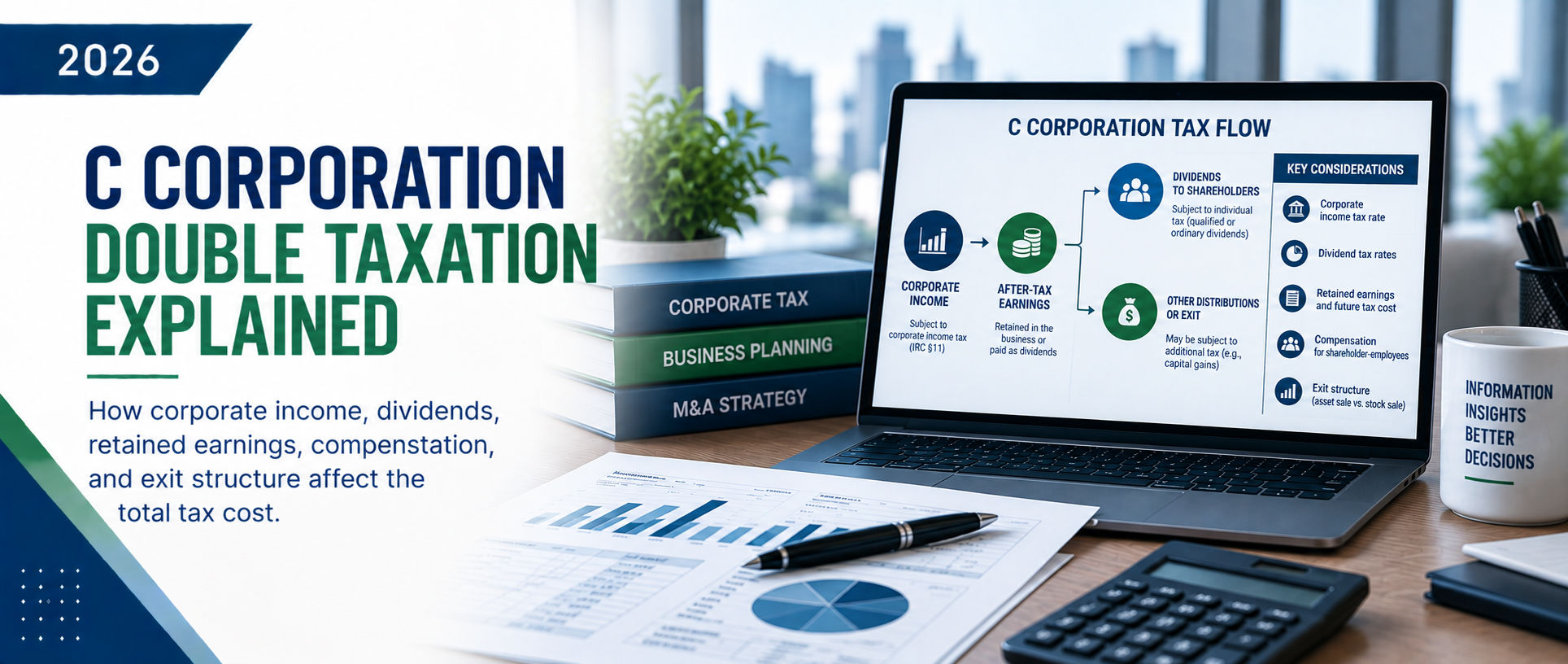
Suggested: C corporation owner reviewing dividend, retained earnings, and exit-strategy projections.
 –>
Tax Practice Guide | Intermediate
C Corporation Double Taxation Explained
How corporate income, dividends, retained earnings, compensation, and exit structure affect the total tax cost.
A C corporation pays tax on its taxable income, and a second tax layer may arise when after-tax earnings are distributed to shareholders. Double taxation is therefore a lifecycle issue involving operations, distributions, compensation, retained earnings, and exit structure—not just the 21% corporate rate.
1. Definition: What Double Taxation Means
A C corporation is a separate federal taxpayer that files Form 1120 and generally pays 21% federal income tax on taxable income. State corporate or franchise taxes may also apply.
Double taxation generally involves two layers:
| Tax Layer | Who Pays | When It Generally Applies |
|---|---|---|
| 1. Corporate tax | The C corporation | When the corporation earns taxable income. |
| 2. Shareholder tax | The shareholder | When after-tax earnings are distributed as a dividend or when the shareholder recognizes taxable gain. |
The shareholder-level tax is not necessarily immediate. If after-tax earnings remain in the business, no dividend tax generally arises merely because the corporation earned profit. The timing and form of later payments determine whether another tax layer applies.
2. Why It Matters to Business Owners
The 21% corporate rate is only one part of the decision. Consider cash distributions, shareholder tax profile, state taxes, payroll costs, reinvestment needs, and exit strategy.
- Potentially attractive when: Profits will be reinvested, institutional capital is expected, multiple stock classes are useful, or earnings need to remain in the business for expansion.
- Potentially less attractive when: Owners expect to withdraw most earnings, a future asset sale is likely, or losses are expected—because C corporation losses generally stay at the corporate level.
3. How the Two Tax Layers Work
Dividends and Earnings and Profits
A corporate payment is not classified only by its label. A distribution is generally a dividend to the extent of current or accumulated earnings and profits (E&P). The corporation does not deduct dividends.
Distributions beyond E&P generally reduce stock basis first; any excess may create taxable gain. Tax E&P is not the same as GAAP retained earnings, so separate records may be required.
Salary, Bonuses, and Shareholder Payments
Reasonable compensation for actual services is generally deductible by the corporation and taxable as wages, with applicable payroll taxes and withholding. Compensation should be supported by duties, time, experience, company performance, and market data.
Avoid two opposite risks:
- Excessive compensation: The IRS may reclassify an unreasonable portion as a dividend.
- Constructive dividends: Personal expenses, below-market transfers, shareholder use of corporate property, or unreasonable rent may create dividend treatment even without a formal declaration.
Retaining Earnings
Retaining earnings may defer shareholder-level tax, but it does not automatically eliminate it. Document credible business needs such as working capital, equipment, hiring, debt service, acquisitions, or expansion and connect retained amounts to forecasts or approved plans.
Large unexplained cash balances can create risk. Accumulating earnings beyond reasonable business needs to avoid shareholder tax may trigger the accumulated earnings tax.
4. Simple Example
Assume a C corporation has $500,000 of federal taxable income before dividends, ignoring state tax and other adjustments.
| Illustrative Step | Amount | Explanation |
|---|---|---|
| Corporate taxable income | $500,000 | Income subject to corporate tax. |
| Federal corporate tax at 21% | $105,000 | The first tax layer. |
| After-tax earnings | $395,000 | Cash potentially retained or distributed. |
| Dividend tax at an assumed 20% | $79,000 | Illustrative second layer if all after-tax earnings are distributed. |
| Combined federal tax | $184,000 | An illustrative 36.8% combined rate. |
At a 21% corporate rate, federal corporate tax is $105,000, leaving $395,000 after tax. If all $395,000 is distributed and the shareholder dividend rate is assumed to be 20%, the second layer is $79,000, for combined federal tax of $184,000 (36.8%). The combined rate is not 41% because the dividend tax applies to the after-corporate-tax amount. Actual results may differ due to dividend rates, NIIT, state taxes, holding period, and other factors.
5. Common Mistakes and Quick Answers
Common Mistakes
- Focusing only on 21%: Include later dividends and exit taxes in the analysis.
- Misclassifying shareholder withdrawals: Determine whether payments are wages, loans, reimbursements, dividends, or returns of capital.
- Using unsupported compensation: Document market-based compensation and operate payroll correctly.
- Confusing retained earnings with E&P: Maintain tax E&P and stock-basis records separately.
- Accumulating cash without support: Document reasonable business needs for significant reserves.
- Assuming a stock sale: Model an asset sale too, because buyers may prefer that structure.
Why Does Exit Structure Matter?
In a stock sale, shareholders generally recognize gain on their shares. In an asset sale, the corporation may recognize gain on the assets and shareholders may face a second tax when proceeds are distributed. Because buyers often favor asset purchases, model the after-tax outcome before signing an LOI.
Can Qualified Small Business Stock Change the Result?
Potentially. Section 1202 may exclude some gain from qualifying C corporation stock, but it does not exclude operating income or dividends. Strict company, issuance, business, asset, and holding-period requirements apply, and rules differ for stock acquired after July 4, 2025. Evaluate eligibility at issuance and monitor it over time.
6. Practical Checklist: What’s Next
Work through these items when modeling the full C corporation tax lifecycle.
0 of 7 complete
PNJ Perspective
The C corporation decision should be modeled across the full business lifecycle—not just the 21% corporate rate. PNJ helps businesses connect corporate tax, dividends, compensation, E&P, retained earnings, shareholder transactions, and exit structure so management can evaluate the true after-tax outcome.
Technical Reference Points
- IRS: Instructions for Form 1120
- IRS Publication 542: Corporations
- IRS Publication 550: Investment Income and Expenses
- IRS: Business Provisions and Qualified Small Business Stock
Disclaimer
This article provides general educational information and is not tax, accounting, legal, investment, or transaction advice. Corporate tax, dividends, E&P, compensation, Section 1202, state taxes, and exit consequences depend on the facts and may change. Consult qualified advisers regarding your specific situation.