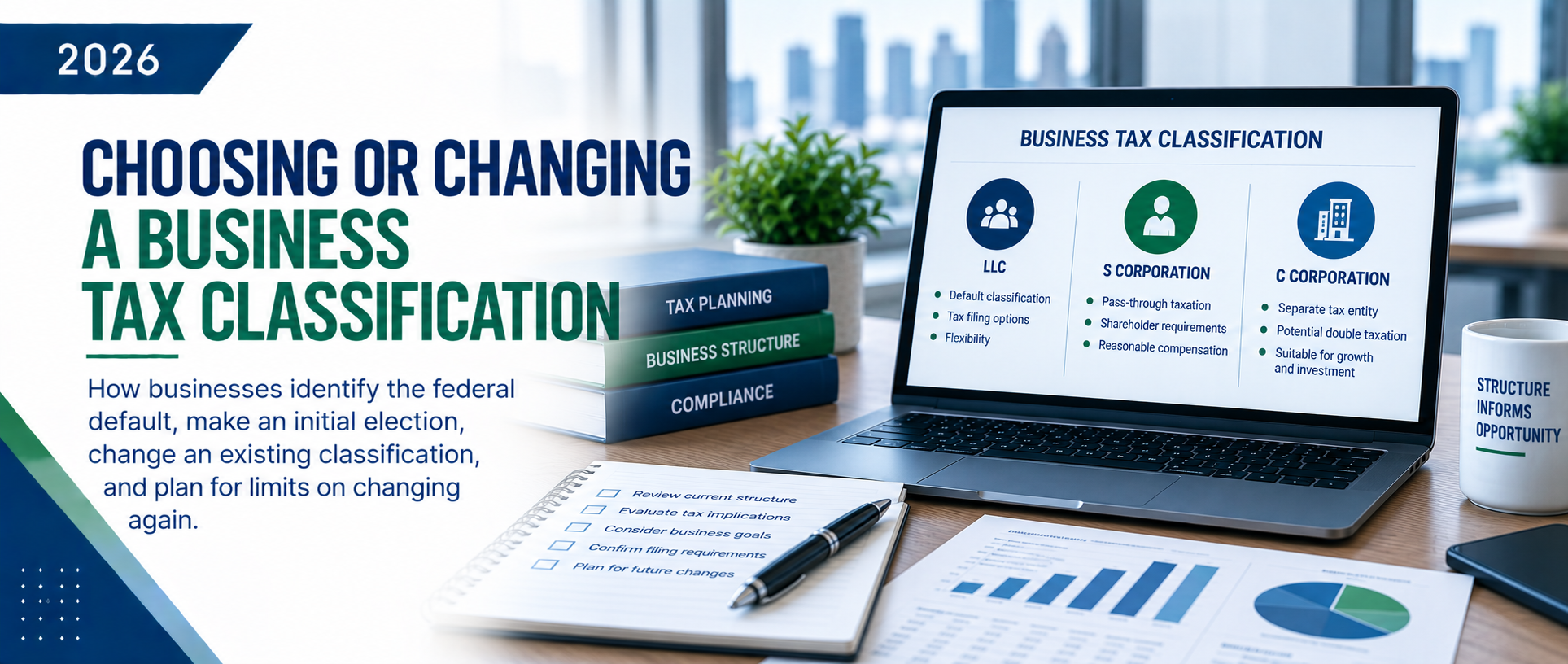
Suggested: business owner comparing Form 8832 and Form 2553 election options with an adviser.
 –>
Tax Practice Guide | Intermediate
Choosing or Changing a Business Tax Classification
How businesses identify the federal default, make an initial election, change an existing classification, and plan for limits on changing again.
Every eligible business starts with a default federal tax classification unless it makes a valid election. The decision is whether to keep the default, make an initial election, change an existing classification, or change again later. Each path can affect tax returns, payroll, owner taxation, state obligations, deemed transactions, and future restructuring options.
1. Definition: What Tax Classification Means
Tax classification is the business’s federal income-tax treatment. Depending on ownership and elections, a business may be treated as a disregarded entity, partnership, C corporation, or S corporation.
A business generally reaches its classification in three ways:
- Default: Applies automatically when no valid election changes it.
- Initial election: Selects a permitted alternative—generally using Form 8832 or, for S corporation status, Form 2553.
- Later change: Moves the business from its current classification and may trigger transition rules, deemed transactions, and limits on changing again.
2. Why Choosing or Changing Matters
The question is not simply which classification has the lowest rate. The choice affects who reports income, payroll requirements, losses and distributions, basis tracking, investor eligibility, state obligations, and restructuring flexibility.
- Keep the default: Often simpler and avoids unnecessary election administration.
- Elect S corporation status: May improve payroll-tax efficiency but adds payroll, eligibility, basis, and distribution rules.
- Elect C corporation treatment: May support reinvestment or investors, but dividends can create a second tax layer.
Base the decision on the expected long-term business model—not one unusually profitable year. Evaluate recurring earnings, owner services, distributions, assets, liabilities, state taxes, investors, and exit plans together.
3. How the Classification Rules Work
Step 1: Identify the Default Classification
If no election is made, the federal default generally applies automatically. A business keeping its default treatment normally does not file Form 8832 merely to confirm it.
| Business Situation | Federal Default if No Election Is Made | Common Alternative |
|---|---|---|
| Eligible domestic entity with one owner | Disregarded for federal income tax | C corporation or, if eligible, S corporation |
| Eligible domestic entity with two or more owners | Partnership | C corporation or, if eligible, S corporation |
| Entity classified as a corporation under federal rules | C corporation | S corporation if all requirements are met |
Step 2: Make an Initial Election Different From the Default
- Form 8832: An eligible entity generally uses it to elect corporate treatment. The effective date generally may be no more than 75 days before filing and no more than 12 months after filing; required owners must consent.
- Form 2553: A qualifying business uses it to elect S corporation status. A timely election generally is due within 2 months and 15 days after the start of the effective tax year, or during the preceding tax year. A timely LLC S election generally does not require a separate Form 8832 for the same effective date.
- Formation-date point: A qualifying election effective on formation generally is not treated as a change for the Form 8832 repeat-election limit. Plan and document the effective date carefully.
Step 3: Change an Existing Classification
Before changing, confirm the current classification, how it arose, prior elections, IRS acceptance, ownership changes, and effective dates. A later election may create a deemed tax transaction.
- Partnership → corporation: Deemed contribution of assets and liabilities for stock, followed by partnership liquidation.
- Disregarded → corporation: Deemed owner contribution of assets and liabilities for stock.
- Corporation → partnership/disregarded: Deemed corporate liquidation that may create gain.
Owner-count changes can also alter a default without Form 8832: a partnership becoming single-owner generally becomes disregarded; a disregarded entity adding an owner generally becomes a partnership, unless a corporate election remains effective.
Step 4: Check Whether Another Change Is Permitted
After an eligible entity changes classification by election, it generally cannot make another classification election for 60 months after the effective date. Limited exceptions or IRS consent may apply. A formation-date election generally is not treated as a change for this rule.
- S corporation re-election: After termination or revocation, IRS consent generally is needed for another S election before the fifth tax year following the first effective termination year. This is separate from Form 8832’s 60-month rule.
Step 5: Coordinate Timing, Consequences, and Acceptance
- Model before filing: Review basis, liabilities, appreciated assets, losses, payroll, estimated taxes, transition returns, owner reporting, and state treatment.
- Keep proof: Retain evidence of timely filing and IRS acceptance. If a deadline is missed, determine promptly whether late-election relief may apply.
4. Simple Examples
Initial Election at Formation
A new single-owner consulting business defaults to disregarded treatment. After comparing recurring profit with payroll and compliance costs, it timely files Form 2553 effective on formation. That formation-date election generally is not treated as a change for the Form 8832 60-month rule.
Later Change From Partnership to Corporation
A partnership-classified business considering Form 8832 corporate treatment before admitting investors should first model the deemed contribution, basis and liabilities, appreciated assets, transition returns, state taxes, and 60-month restriction.
5. Common Mistakes and Quick Answer
- Not confirming the current classification: Check IRS records, prior returns, and prior elections first.
- Filing Form 8832 unnecessarily: If the desired default still applies, an election may not be needed.
- Treating formation and later changes alike: A formation-date election may receive different repeat-election treatment.
- Choosing an effective date in isolation: Consider deadlines, payroll, transition returns, state treatment, and deemed transactions.
- Assuming annual flexibility: The 60-month rule and separate S re-election rule can restrict another change.
- Can a business change classification whenever it wants? Generally, no. The business must be eligible, timely, prepared for transition consequences, and clear of any 60-month or S re-election restriction.
6. Practical Checklist: Choose the Correct Path
Find the situation that matches your business and work through that path.
Keep the Default Classification
0 of 2 complete
Make an Initial Election
0 of 2 complete
Change an Existing Classification
0 of 2 complete
Consider Changing Again
0 of 2 complete
PNJ Perspective
The best tax classification is not simply the one with the lowest current rate. PNJ helps businesses compare the default, initial elections, later changes, deemed tax consequences, repeat-change limits, payroll, state taxes, and future ownership plans so the classification supports the business model over time.
Technical Reference Points
- IRS: Limited Liability Company Classification
- IRS Form 8832 and Instructions
- IRS: Instructions for Form 2553
- IRS: Late Election Relief
Disclaimer
This article provides general educational information and is not tax, accounting, legal, payroll, or investment advice. Eligibility, deemed transactions, effective dates, late-election relief, and state treatment depend on the facts and may change. Consult qualified advisers before selecting or changing a classification.