Suggested: business owner reviewing operating, investing, and financing cash-flow sections.
 –>
–>
Accounting Foundation
How to Read a Statement of Cash Flows
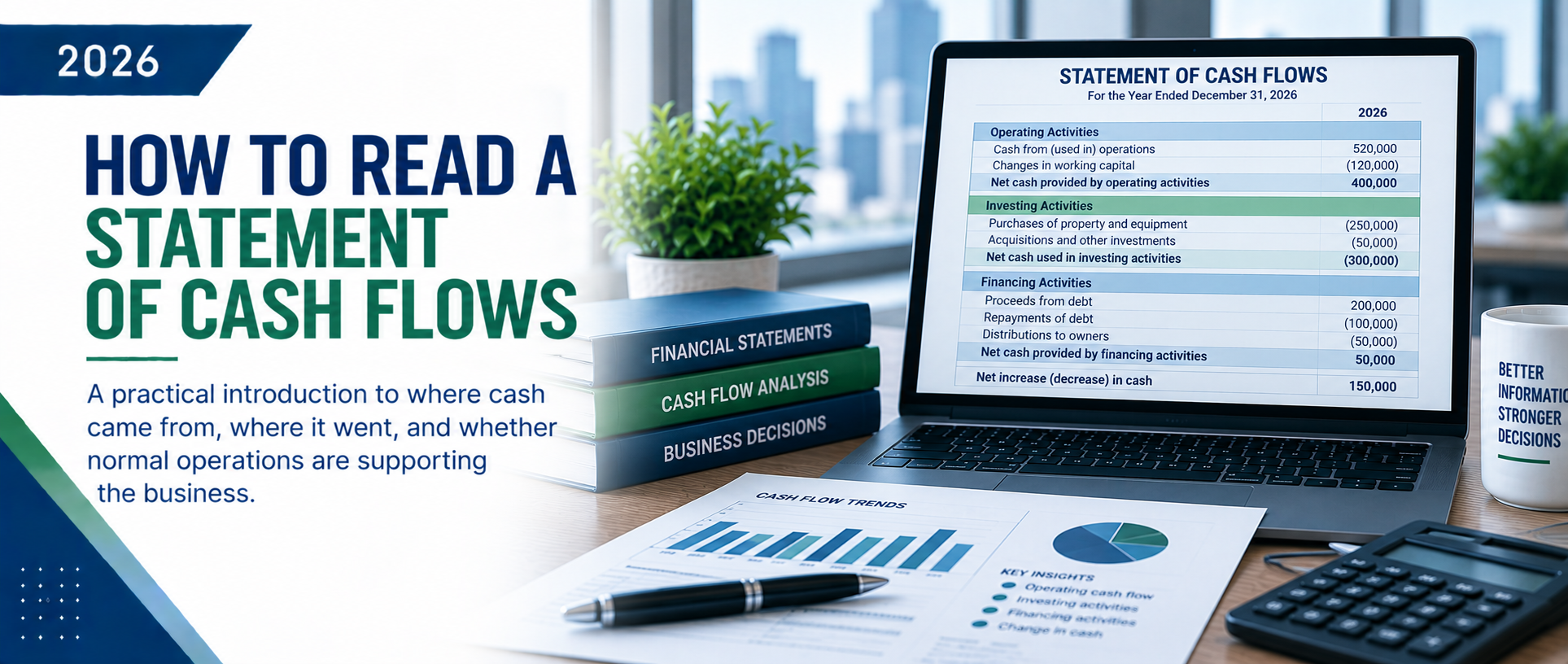
A practical introduction to where cash came from, where it went, and whether normal operations are supporting the business.
Profit and cash are not the same. Read the Statement of Cash Flows by separating operating, investing, and financing activities, then ask whether core operations are generating enough cash to support obligations and growth.
1. Definition
A Statement of Cash Flows explains why cash changed during a period. It starts with beginning cash, summarizes cash from operating, investing, and financing activities, and reconciles those movements to ending cash.
The income statement explains profit or loss; the balance sheet shows what the business owns and owes; the Statement of Cash Flows explains why the cash balance changed.
Operating Cash Flow + Investing Cash Flow + Financing Cash Flow = Net Change in Cash
| Section | What It Generally Shows | Question to Ask |
|---|---|---|
| Operating | Cash generated or used by normal business activity | Are operations producing cash? |
| Investing | Purchases and sales of long-term assets or investments | Where is the business investing? |
| Financing | Borrowing, debt repayment, owner funding, and distributions | How is the business funded? |
2. Why It Matters
A profitable business can still run short of cash because of slow collections, inventory purchases, equipment spending, or debt payments.
The reverse is also possible: cash can rise because of borrowing or owner funding even when operations are weak. A higher cash balance does not automatically mean the business improved.
- Liquidity: Can the business pay payroll, taxes, debt, and vendors on time?
- Profit conversion: Is accounting profit turning into cash—or staying in receivables and inventory?
- Funding: Is growth supported by operations, borrowing, or owner capital?
- Investment: Is cash being used for assets expected to create future value?
3. How It Works
Step 1: Confirm the Period and Cash Balance
Confirm the reporting period and verify that beginning cash + net change = ending cash. If it does not agree with the balance sheet, investigate restricted cash, missing accounts, or preparation errors.
Step 2: Read Operating Activities First
Start with operating activities. Under the commonly used indirect method, net income is adjusted for noncash items and changes in operating assets and liabilities.
- AR increased: Sales were recorded faster than customers paid, generally reducing operating cash.
- Inventory increased: Cash was used to buy products not yet sold.
- AP increased: Recorded costs were paid later, temporarily increasing operating cash.
Positive operating cash flow is generally encouraging, but test whether it is sustainable. Repeated negative operating cash flow means the business must rely on cash reserves or outside funding.
Step 3: Review Investing Activities
Investing activities include purchases or sales of equipment, property, software, and other long-term assets. Negative investing cash flow is not automatically bad if the spending is planned and expected to create future value.
Step 4: Review Financing Activities
Financing activities show cash moving between the business and lenders or owners. Borrowing and owner contributions provide cash; debt principal, dividends, and owner distributions use cash. Repeated borrowing to cover operating shortfalls may signal pressure.
Step 5: Interpret the Pattern
Do not judge the statement by the total cash change alone. A stronger pattern is usually positive operating cash flow supporting investment and debt service. A weaker pattern may show operations consuming cash while debt or owner funding keeps ending cash positive.
The Statement of Cash Flows is historical—not a forecast. It explains what happened; a cash-flow forecast estimates future collections and payments.
4. Simple Example
Assume a business reports the following annual cash-flow summary:
| Cash-Flow Item | Amount | Basic Interpretation |
|---|---|---|
| Net income | $120,000 | Accounting profit for the year |
| Operating cash flow | $50,000 | Profit converted only partly into cash |
| Investing cash flow | $(90,000) | Cash used mainly for equipment |
| Financing cash flow | $70,000 | New borrowing exceeded repayments |
| Net increase in cash | $30,000 | Ending cash rose by $30,000 |
The company earned $120,000 of net income but generated only $50,000 of operating cash flow. It used $90,000 for investing and received $70,000 from financing, producing a net cash increase of $30,000.
Management should ask why profit converted into only $50,000 of operating cash, whether the equipment investment was planned, and whether future operations can support the new debt.
5. Common Mistakes and Quick Answers
Common Mistakes
- Looking only at net cash change: Understand whether cash came from operations, investing, or financing.
- Treating borrowing as operating strength: Debt can increase cash even when operations are weak.
- Assuming negative investing cash flow is bad: Asset purchases may support future growth.
- Ignoring working capital: Receivables, inventory, payables, and deferred revenue can materially affect operating cash.
- Reading one statement in isolation: Compare prior periods, budget, and the income statement and balance sheet.
Quick Answers
- Why can profit exceed operating cash flow? Customers may not have paid, inventory may have increased, or profit may include noncash items.
- Is positive cash flow always good? No. Cash may rise because of borrowing or owner funding while operations continue to consume cash.
6. Practical Checklist: What’s Next
Work through these items when reviewing the statement of cash flows.
0 of 6 complete
PNJ Perspective
A useful cash-flow statement should connect profit, working capital, capital spending, debt, and owner funding in one picture. PNJ helps businesses strengthen the close and explain where cash came from, where it went, and whether operations are truly supporting the business.
Technical Reference Points
- SEC: Beginners’ Guide to Financial Statements
- FASB: Summary of Statement No. 95—Statement of Cash Flows
Disclaimer
This article provides general educational information and is not accounting, tax, legal, or investment advice. Presentation and interpretation depend on the company’s accounting framework, industry, and specific facts. Consult qualified advisers before acting.