Suggested: accountant reviewing a SaaS contract, allocation schedule, and deferred revenue balance.
 –>
–>
Accounting Practice Guide | Intermediate
Revenue Recognition: When Is Revenue Earned?
How businesses apply ASC 606 to contracts, performance obligations, pricing, timing, and contract balances.
Revenue is earned when—or as—a business satisfies a performance obligation by transferring control of a promised good or service. Invoice and cash dates do not determine revenue by themselves; the analysis starts with the contract and actual performance.
1. Definition
Revenue recognition determines when and how much revenue appears in the financial statements. Under ASC 606, revenue reflects the transfer of promised goods or services for the consideration the business expects to receive.
Billing, cash, and revenue are different events: billing creates an amount due, cash records payment, and revenue records performance. They may occur together in a simple sale but often differ for subscriptions, service contracts, bundles, milestones, and advance payments.
| Event | What Happened | Typical Accounting Effect |
|---|---|---|
| Invoice issued | The customer was billed | May create accounts receivable; not automatically revenue |
| Cash collected | The customer paid | Increases cash; may settle AR or create a contract liability |
| Revenue earned | A promised good or service transferred | Revenue is recognized for the satisfied obligation |
2. Why It Matters
Revenue timing affects profit, assets and liabilities, taxes, forecasts, commissions, lender reporting, and performance measures. Recognizing revenue too early can overstate performance; recognizing it too late can understate results and misstate contract balances.
Risk increases as contracts become more complex. Implementation fees, usage charges, discounts, refunds, service credits, renewals, and modifications can make an “invoice equals revenue” process unreliable.
- Reliable reporting: Revenue and margins should reflect the period’s actual performance.
- Operational alignment: Accounting should agree with contracts, billing, delivery, and customer acceptance.
- Scalable controls: Standard contract types need documented recognition rules and monthly reconciliations.
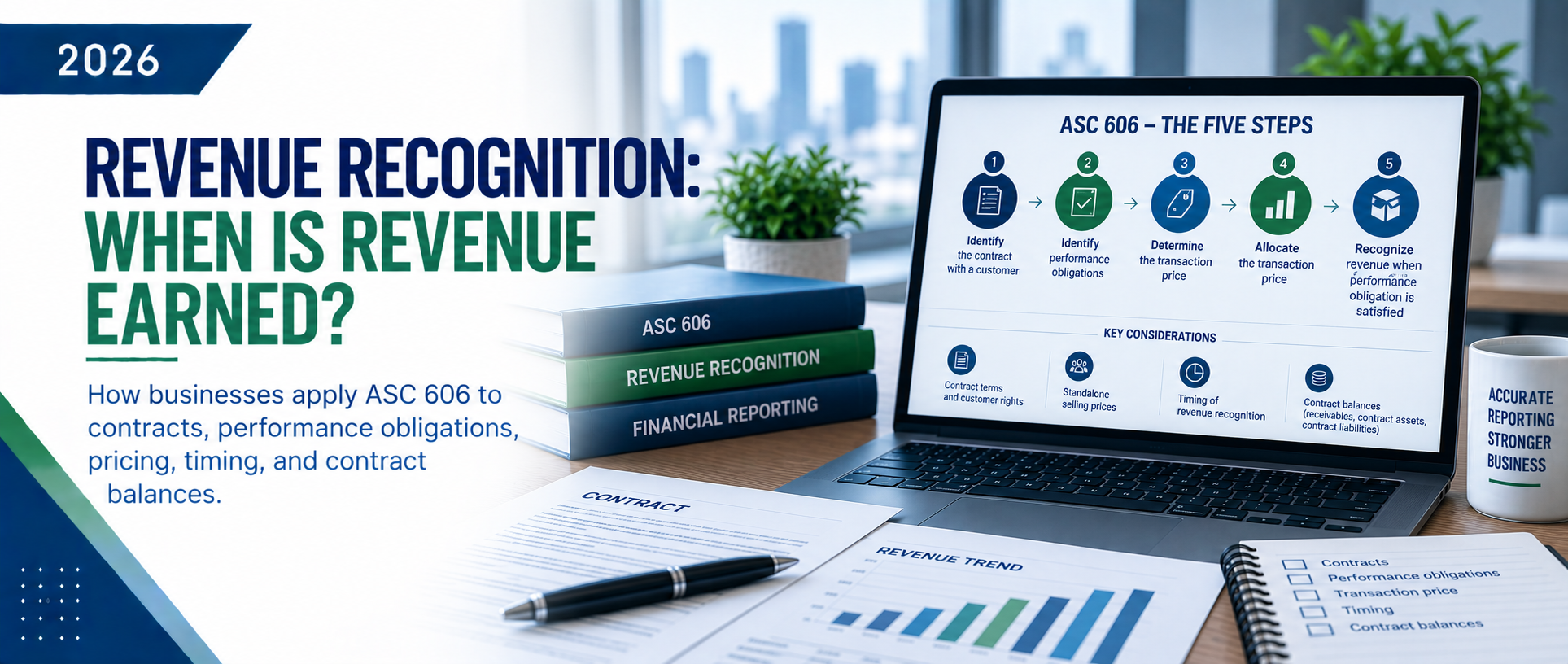
3. How It Works: The ASC 606 Model
| Step | Requirement | Practical Question |
|---|---|---|
| 1 | Identify the contract | Is there an enforceable customer arrangement? |
| 2 | Identify performance obligations | What distinct goods or services were promised? |
| 3 | Determine the transaction price | How much does the company expect to receive? |
| 4 | Allocate the transaction price | How much belongs to each performance obligation? |
| 5 | Recognize revenue | When or as does control transfer? |
Step 1: Identify the Contract
A contract exists for ASC 606 when the arrangement has approval, enforceable rights, identifiable payment terms, commercial substance, and probable collection of the consideration expected for transferred goods or services.
Cash received before those criteria are met is not automatically revenue. It may remain a deposit or liability until recognition requirements are satisfied.
Step 2: Identify Performance Obligations
A performance obligation is a promise to transfer a distinct good or service—or a qualifying series—to the customer. A promise is generally distinct when the customer can benefit from it and it is separately identifiable in the contract.
Bundled arrangements require judgment. Subscription, implementation, equipment, installation, and support may be separate obligations or may need to be combined, which changes allocation and timing.
Step 3: Determine the Transaction Price
The transaction price is the consideration the company expects to receive, including fixed fees and estimated variable amounts such as usage charges, rebates, refunds, service credits, discounts, or concessions.
Include variable amounts only to the extent it is probable that a significant revenue reversal will not occur. Support the estimate with history, possible outcomes, customer rights, and relevant external factors.
Step 4: Allocate the Transaction Price
For multiple performance obligations, allocate the transaction price generally using relative standalone selling prices. Invoice line prices may not equal the accounting allocation. Use observable prices when available and document reasonable estimates otherwise.
Step 5: Recognize Revenue When or As Control Transfers
First determine whether the obligation is satisfied over time. This may apply when the customer receives benefits as performance occurs, controls an asset as it is created, or the asset has no alternative use and the company has an enforceable right to payment for work completed.
For over-time recognition, use a measure of progress that faithfully reflects performance—such as time, units, labor hours, or costs. Otherwise, recognize revenue at the point in time control transfers based on indicators such as payment rights, title, possession, risks and rewards, and customer acceptance.
Contract Assets, Receivables, and Contract Liabilities
- Accounts receivable: Payment is unconditional except for the passage of time.
- Contract asset: Revenue is recognized, but payment depends on another condition, such as a billing milestone.
- Contract liability / deferred revenue: Cash was collected or billed before the related performance obligation was satisfied.
Reconcile these balances monthly. Aged deferred revenue, unsupported unbilled amounts, unusual credits, or large manual entries are common signs that the revenue process needs review.
4. Simple Example
Assume a 12-month SaaS contract is priced at $27,000 paid upfront. Standalone prices are $24,000 for the subscription and $6,000 for distinct implementation. The $3,000 discount is allocated proportionately.
| Performance Obligation | Relative Allocation | Recognition Pattern |
|---|---|---|
| Subscription | $21,600 (80%) | $1,800 per month over 12 months |
| Implementation | $5,400 (20%) | When the distinct implementation is completed |
| Total contract | $27,000 | Based on satisfaction of each obligation |
If implementation is completed in January and one month of subscription is delivered, January revenue is $7,200 ($5,400 + $1,800). The remaining $19,800 is a contract liability for future service. If implementation is not distinct, the recognition pattern may differ.
5. Common Mistakes and Quick Answers
Common Mistakes
- Recognizing from billing or cash: Evaluate performance before recording revenue.
- Ignoring distinct obligations: Bundled contracts may require separate recognition patterns.
- Using invoice prices as allocation: Use relative standalone selling prices when required.
- Overstating variable consideration: Apply the revenue-reversal constraint.
- Leaving contract balances unsupported: Reconcile deferred revenue and contract assets monthly.
- Treating changes as routine billing: Contract modifications, refunds, and gross-vs.-net questions may require accounting analysis.
Quick Answers
- Does issuing an invoice mean revenue is earned? No. An invoice may create AR, but revenue depends on whether the related performance obligation is satisfied.
- Can advance cash be recognized immediately? Not when goods or services remain to be transferred. It is generally recorded as a contract liability and recognized as performance occurs.
6. Practical Checklist: What’s Next
Work through these items when evaluating or reviewing a revenue arrangement.
0 of 7 complete
PNJ Perspective
Revenue recognition works best when contract terms, billing, delivery evidence, pricing, and contract balances are connected in one controlled process. PNJ helps businesses document revenue policies, evaluate complex arrangements, and strengthen monthly reconciliation and cutoff controls.
Technical Reference Points
- FASB ASU 2014-09: Revenue from Contracts with Customers
- FASB ASU 2016-08: Principal-versus-Agent Considerations
Disclaimer
This article provides general educational information and is not accounting, tax, legal, or investment advice. Revenue conclusions depend on enforceable contract terms, facts, judgments, industry guidance, and the applicable reporting framework. Complex arrangements should be reviewed before financial statements are issued.