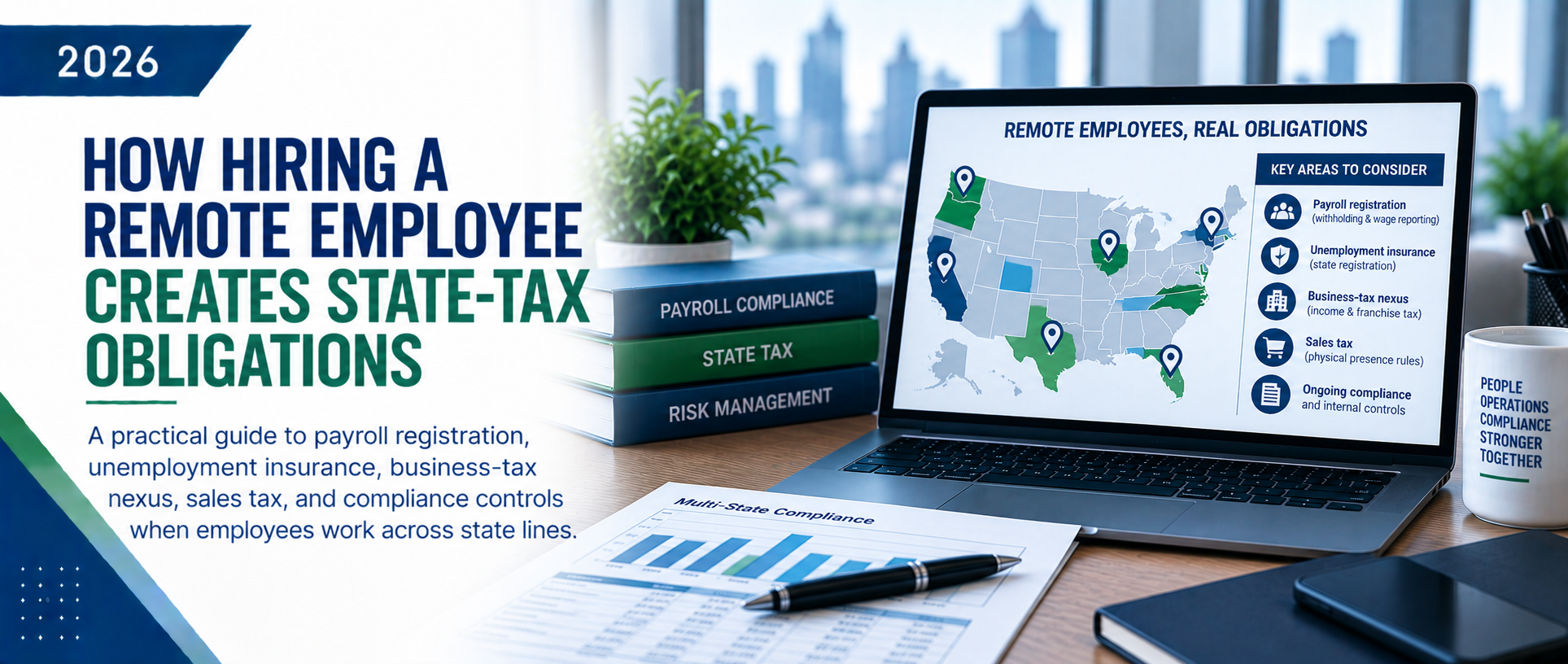
Suggested: HR and payroll team reviewing a new remote employee’s work-state paperwork.
 –>
–>
Tax Compliance Practice Guide | Intermediate
How Hiring a Remote Employee Creates State-Tax Obligations
A practical guide to payroll registration, unemployment insurance, business-tax nexus, sales tax, and compliance controls when employees work across state lines.
A remote employee can create a company tax footprint in the state where the employee actually works—even if the company has no office or customers there. Review the new state before the employee starts or relocates for withholding, unemployment insurance, business-tax nexus, sales tax, local requirements, and employer registrations.
1. Definition
For state-tax purposes, the employee’s physical work location often matters more than the company’s legal address or assigned office.
The employee’s home does not need to be leased by the company to create risk. Regular work from a new state may create physical presence, payroll obligations, business registrations, and tax-return requirements.
2. Why It Matters
- More than payroll: Correct withholding does not automatically resolve unemployment insurance, business-tax nexus, sales tax, or local registration.
- Late discovery is costly: The company may face retroactive registrations, amended payroll returns, catch-up payments, penalties, and prior-year business-tax filings.
- Best control: Require coordinated approval by HR, Payroll, Accounting, Tax, and appropriate legal/HR advisers before a new remote state is approved.
3. How It Works
There is no single national remote-work rule. States differ on wage sourcing, unemployment coverage, nexus, thresholds, and local requirements. Use a workstream-by-workstream review.
| Compliance Area | Primary Question | Typical Action |
|---|---|---|
| Wage withholding | Where are the employee’s services performed? | Register and configure state or local withholding when required |
| Unemployment insurance | Under which state’s localization rules are wages covered? | Open or update the correct unemployment account |
| Business taxes | Does the employee create income, franchise, or other tax nexus? | Determine registration, return, apportionment, and payment duties |
| Sales and use tax | Does physical presence create or accelerate sales-tax nexus? | Review permit, taxability, direct sales, and filing requirements |
| Related compliance | What non-tax employer rules follow the work location? | Coordinate workers’ compensation, leave programs, new-hire reporting, and licenses |
Step 1: Confirm the Actual Work Location
Confirm the actual physical work state, effective date, temporary/permanent status, expected travel, and multistate work. There is no universal number of “tax-free” remote-work days.
Treat an employee relocation like a new remote hire. After a permanent move, payroll should not continue using the former work state simply because the employee’s role did not change.
Step 2: Set Up Wage Withholding
Wages are generally sourced to where services are performed, subject to the states involved. The employer may need withholding accounts, payroll-system changes, state/local tax calculations, and new filing calendars. Reciprocity may modify the result.
Watch for convenience-of-the-employer rules. For example, New York may treat certain out-of-state telework days as New York workdays, creating multistate withholding and resident-credit issues.
Step 3: Determine Unemployment-Insurance Coverage
Unemployment insurance uses a separate localization framework. Review, in order, where work is localized, the employee’s base of operations, where work is directed or controlled, and—if needed—where the employee resides and performs service.
A permanent move can change the covered state. The key point is that unemployment coverage may change even when the employer stays in the same state.
Step 4: Review Business-Tax Nexus
A remote employee may create physical presence for income tax, franchise tax, margin tax, or another business-activity tax. The result depends on the state, entity type, duties, payroll, sales, property, and any threshold or exception.
P.L. 86-272 is not a general remote-employee exemption. It is limited to certain sellers of tangible personal property and protected solicitation activities, and it does not protect non-net-income taxes.
Step 5: Review Sales Tax and Related Registrations
Employee physical presence can create sales-tax nexus before an economic threshold is reached. Review taxability, direct sales, permit requirements, marketplace activity, and filing obligations separately.
Complete the broader employer review too: business qualification, local payroll taxes, workers’ compensation, leave/disability programs, new-hire reporting, licenses, and employment-law requirements.
4. Simple Example
Assume a Texas consulting company with no California office or customers hires a full-time employee who will work entirely from California. Before the start date, review:
- Payroll: Register as required and configure California wage withholding and payroll-tax reporting.
- Unemployment/state programs: Determine California coverage and applicable employer/employee programs.
- Business tax: Evaluate California filing and minimum-tax obligations created by the employee’s activity.
- Sales tax: Review only if the company makes taxable sales; nexus and taxability are separate tests.
- Related compliance: Confirm workers’ compensation, new-hire reporting, business registration, and employment requirements.
If the move is reported late, the company may need to correct payroll and determine when each additional obligation began. A documented preapproval process prevents that uncertainty.
5. Common Mistakes and Quick Answers
Common Mistakes
- Assuming no office means no nexus: A remote employee can create physical presence.
- Fixing withholding only: Unemployment, business tax, sales tax, and local requirements need separate review.
- Allowing unapproved relocations: Require HR, Payroll, Accounting, and Tax review before a move.
- Using sales thresholds as the only test: Employee physical presence can create nexus independently.
- Overrelying on P.L. 86-272: Its protection is narrow and does not cover every role or tax.
- Expecting the payroll provider to solve everything: Management remains responsible for the broader state footprint.
- Waiting until year-end: Review location changes promptly to avoid multiple quarters of exposure.
Quick Answers
- Can temporary remote work create obligations? Yes. Some states have limited thresholds or exceptions; others may require withholding or registration from the first day. Review duration, duties, and the states involved.
- Does using a payroll provider solve the issue? No. A provider can process accounts identified by the employer, but management remains responsible for work-location facts and broader tax/registration obligations.
6. Practical Checklist: What’s Next
Work through these items before an employee starts or relocates to a new state.
0 of 7 complete
PNJ Perspective
Remote-work compliance should begin before the employee starts or relocates. PNJ helps businesses coordinate work location, payroll withholding, unemployment insurance, business-tax nexus, sales tax, and related state registrations so a hiring decision does not become a retroactive compliance project.
Technical Reference Points
- U.S. Department of Labor: Localization of Work Provisions
- California EDD: State Payroll Taxes Overview
- New York Department of Taxation and Finance: Telecommuting and Convenience Rule
- Multistate Tax Commission: P.L. 86-272 Statement of Information
Disclaimer
This article provides general educational information and is not tax, payroll, employment, or legal advice. State and local withholding, unemployment, nexus, registration, leave, licensing, and employment requirements vary by jurisdiction and facts. Current rules should be confirmed before an employee begins working in a new state.