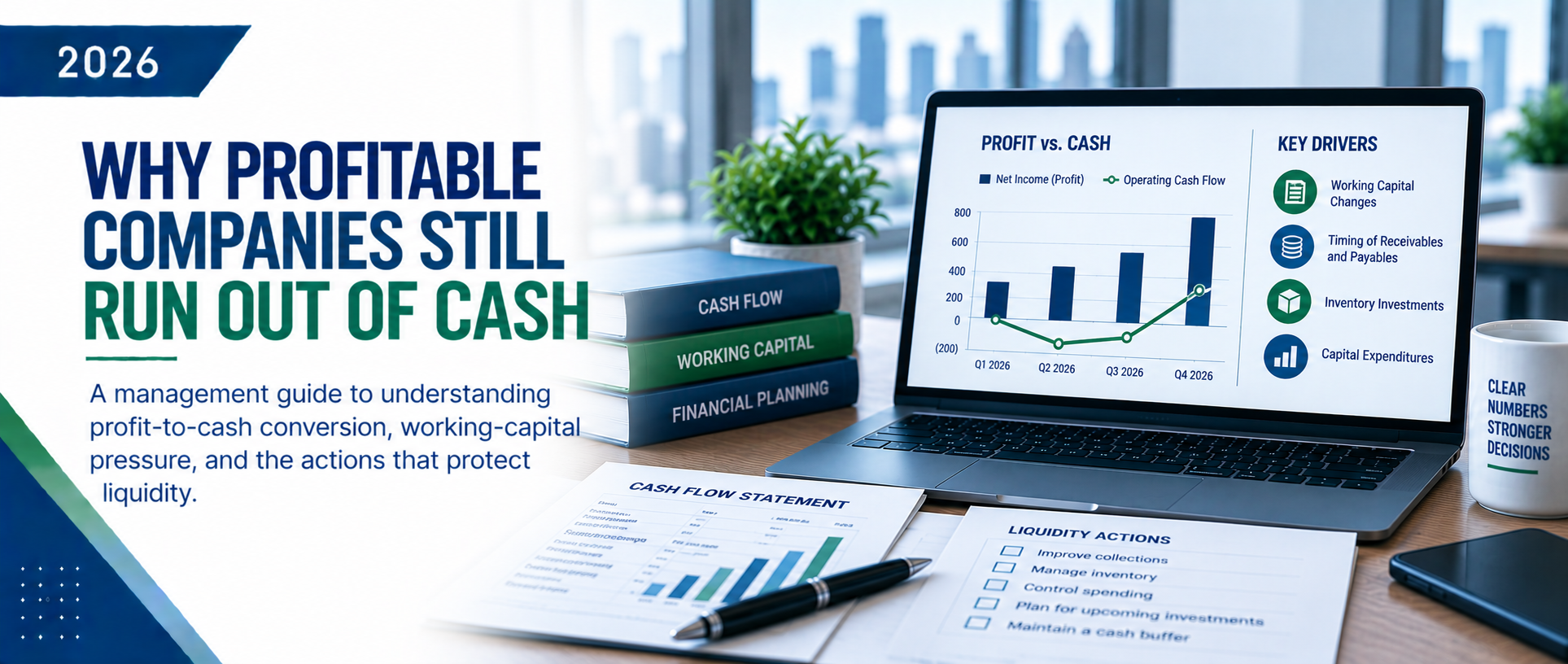
Suggested: business owner reviewing a profit-to-cash reconciliation and 13-week forecast.
 –>
–>
Business Insight Practical Guide | Intermediate
Why Profitable Companies Still Run Out of Cash
A management guide to understanding profit-to-cash conversion, working-capital pressure, and the actions that protect liquidity.
Profit measures performance; cash pays employees, vendors, lenders, and taxes. A profitable company can still run short when collections lag, working capital absorbs cash, or debt principal, capex, taxes, and distributions use cash. Management must track both profit and the timing of cash movement.
1. Definition
Under accrual accounting, profit does not equal cash received. Revenue may be recognized before collection, while some cash uses are not current-period expenses.
Liquidity is the ability to meet obligations when due. A profitable company can still lack cash on a specific payroll or payment date—a profit-to-cash timing problem.
2. Why It Matters
- Liquidity risk: A cash shortage can cause missed payroll, delayed taxes, supplier pressure, covenant breaches, or expensive emergency financing.
- Growth can increase pressure: More sales may require inventory, labor, deposits, and vendor payments before customer cash arrives.
- Management question: How much profit is converting to cash, when will it arrive, and what commitments will use it?
3. How It Works
Start with net income and trace the items that explain the cash difference. Use the statement of cash flows for history and a short-term cash forecast for what may happen next.
| Cash Driver | Why Cash Moves Differently From Profit | Management Focus |
|---|---|---|
| Accounts receivable | Revenue may be recorded before the customer pays | Billing speed, disputes, aging, DSO, and collection ownership |
| Inventory | Cash is paid before the product is sold and expensed | Purchasing discipline, turnover, lead times, and obsolete stock |
| Accounts payable | Later payment temporarily preserves cash | Supplier terms, aging, late fees, and critical-vendor risk |
| Debt principal | Repayment reduces debt, not operating profit | Debt calendar, covenants, balloon payments, and refinancing |
| Capital expenditures | Cash may leave now while expense is recognized over time | Approval thresholds, return on investment, and financing plan |
| Taxes and distributions | Payment timing or owner withdrawals may not match book expense | Tax reserves, distribution policy, and minimum liquidity |
Working Capital Can Absorb Profitable Growth
Accounts receivable: Profit may appear before cash. When collections slow or AR grows faster than revenue, the company is effectively financing its customers.
Inventory: Cash may be paid well before sale. Excess purchases, supplier minimums, and slow-moving stock can lock cash in inventory even when margins remain healthy.
Accounts payable: Supplier terms can temporarily preserve cash, but stretching overdue balances to fund payroll is a warning sign, not sustainable financing.
Some Cash Uses Never Reduce Current Profit
Some cash uses do not reduce current operating profit:
- Debt principal reduces the liability, not operating profit.
- Capital expenditures use cash now while expense is recognized over time.
- Owner distributions reduce equity, not earnings.
Timing pressure also comes from estimated taxes, payroll deposits, sales-tax remittances, annual renewals, and seasonal inventory builds. Annual profitability can hide a severe weekly liquidity gap.
Use the Cash Conversion Cycle as a Diagnostic
The cash conversion cycle estimates how long cash is tied up in operations:
DSO + DIO − DPO. A longer cycle generally means the business must finance more working capital.
A longer cycle is not automatically bad, but it must be funded. Compare it with prior periods, customer and supplier terms, growth plans, and available credit—not a single benchmark.
4. Simple Example
Assume a growing distributor reports $300,000 of net income but experiences the cash movements shown below.
| Profit-to-Cash Reconciliation | Illustrative Cash Effect |
|---|---|
| Net income | +$300,000 |
| Increase in accounts receivable | -$250,000 |
| Increase in inventory | -$120,000 |
| Increase in accounts payable | +$70,000 |
| Equipment purchased | -$150,000 |
| Debt principal repaid | -$80,000 |
| Approximate net cash change | -$230,000 |
The company earned $300,000 but cash fell by about $230,000. The main drivers were higher AR, more inventory, equipment purchases, and debt repayment. A profit-to-cash reconciliation makes the shortage visible before it becomes a surprise.
5. Common Mistakes and Quick Answers
Common Mistakes
- Managing from the income statement alone: Also review the balance sheet, cash-flow statement, AR/AP aging, debt schedule, and forecast.
- Treating revenue or AR as available cash: A sale cannot fund payroll until it is collected.
- Assuming growth fixes liquidity: Growth may consume more working capital before it generates cash.
- Using overdue vendors as financing: This can create fees, supply interruptions, and reputation damage.
- Confusing EBITDA with cash flow: EBITDA excludes working capital, capex, debt principal, taxes, and distributions.
- Making distributions from accounting profit alone: Also consider forecast cash, tax obligations, debt terms, and a minimum liquidity reserve.
Quick Answers
- Does positive operating cash flow mean the company is safe? Not by itself. Large capex, debt payments, taxes, or distributions can still create a shortage.
- Should management focus on the bank balance? The bank balance shows today. A rolling forecast connects available cash with next week’s collections and payments.
- Is borrowing always a bad sign? No. Planned financing can support a normal working-capital cycle or investment. The concern is repeated emergency borrowing without a clear repayment source.
6. Practical Checklist: What’s Next
Work through these items to protect liquidity while managing for profit.
0 of 7 complete
PNJ Perspective
Profitability is only one part of financial health. PNJ helps management connect profit, working capital, AR/AP aging, debt, capital spending, taxes, and a rolling 13-week forecast so leaders can see why cash is moving, where pressure is building, and what action is needed.
Technical Reference Points
- SEC: Beginners’ Guide to Financial Statements
- SEC: The Statement of Cash Flows—Improving the Quality of Cash-Flow Information
- U.S. Small Business Administration: Plan Your Business
Disclaimer
This article provides general educational information and is not accounting, tax, legal, lending, or investment advice. Cash requirements vary by business model, accounting method, customer and supplier terms, seasonality, debt structure, capital plans, taxes, and growth strategy. Management should evaluate its own facts with qualified advisers.