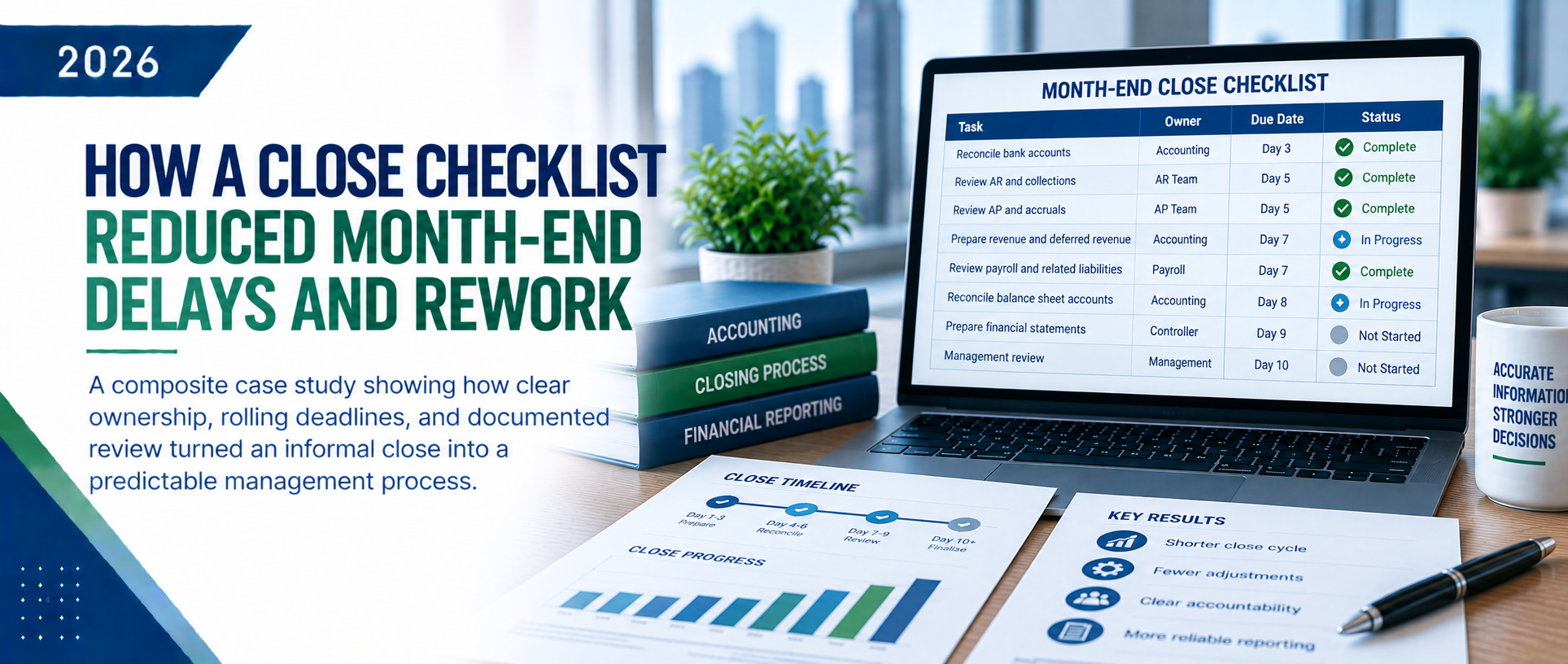
Suggested: finance team reviewing a close checklist dashboard with named owners and due dates.
 –>
–>
Case Study | Controllership
How a Close Checklist Reduced Month-End Delays and Rework
A composite case study showing how clear ownership, rolling deadlines, and documented review turned an informal close into a predictable management process.
A close checklist creates value only when every task has an owner, realistic due date, completion evidence, and independent review. In this composite example, those controls reduced the close from 12 to 7 business days and reopened entries from 4–6 to 1–2 per month within 90 days.
1. Case Background: The Close Was Busy but Not Controlled
This composite case reflects recurring patterns in growing finance teams. The team had a checklist, but it functioned mainly as a list of accounts and entries with one “done” column.
The close took about 12 business days, and 4–6 entries were commonly reopened after reporting because balances lacked support, late items were missed, or review was rushed.
The issue was not effort. The process lacked clear preparer/reviewer ownership, task timing, required evidence, and a consistent definition of completion.
2. What Was Causing the Delays and Rework?
- Unclear ownership: Some accounts were duplicated while others were missed.
- One hard deadline: More than 30 tasks converged on the same day, creating reviewer bottlenecks.
- No separation of preparation and review: Tasks could be marked complete before independent review.
- No standard for “complete”: Support quality varied significantly across reconciliations.
- No learning loop: The same missing schedules, delayed inputs, and corrections returned each month.
The team therefore redesigned the checklist as a control document—not just a task list—making responsibility, evidence, deadlines, and review visible.
3. The 90-Day Implementation Timeline
| Timing | Change Introduced | Control Purpose |
|---|---|---|
| Before Month 1 | Baseline the close: list every task, dependency, due date, and reopened entry | Identify bottlenecks and establish starting metrics |
| Month 1 | Assign one preparer and one reviewer to every reconciliation and close entry | Make ownership and segregation of duties visible |
| Month 2 | Replace the single deadline with a rolling calendar based on data availability | Move work earlier and protect reviewer capacity |
| Month 3 | Require standard support, reviewer sign-off, and an exception log | Improve completion quality and prevent repeated issues |
| After Each Close | Review delays, reopened entries, and unresolved reconciling items | Use results to refine the next calendar |
Month 1: Put a Name Beside Every Task
Every task received a named preparer, named reviewer, and due date. No item could disappear inside a shared spreadsheet, and no one approved their own work.
Ownership also improved escalation: when data was missing or work stalled, the manager could immediately see the owner, blocker, and next action.
Month 2: Replace One Deadline With a Rolling Calendar
The team moved eligible work before month-end based on data availability—such as fixed assets, prepaids, recurring accruals, intercompany activity, and selected reconciliations.
Remaining work was staggered across business days 1–7. Defined review windows reduced last-minute queues and protected reviewer capacity without weakening review.
Month 3: Define Evidence and Make Review Mandatory
Each task linked to its reconciliation, journal-entry support, and reviewer sign-off. Higher-risk or material entries required Controller approval. “Complete” now meant prepared, supported, reviewed, and cleared.
Reviewers used five consistent questions:
- Does the balance agree to the GL and independent support?
- Are reconciling items explained, dated, and assigned?
- Are unusual variances understood?
- Is documentation complete?
- Was preparer sign-off recorded before review?
4. Results After 90 Days
| Measure | Before | After 90 Days |
|---|---|---|
| Close duration | 12 business days | 7 business days |
| Tasks with named preparer and reviewer | Approximately half | All close tasks |
| Reopened entries after close | 4–6 per month | 1–2 per month |
| Reviewer sign-off | Informal and inconsistent | Required and documented |
| Reconciliation timing | Concentrated at period-end | Staggered across the month |
The most important result was not just the five days saved. Reopened entries fell to 1–2 per month, showing that issues were being resolved before management reporting.
The Controller also gained real-time visibility into overdue work, blocked dependencies, reviewer workload, and unresolved exceptions without requesting separate status updates.
These results are illustrative composite results—not a guarantee. Actual outcomes depend on the starting process, transaction volume, systems, staffing, data availability, and management follow-through.
5. Why the Checklist Worked
- Visible accountability: Every item had one preparer and one reviewer.
- Earlier execution: Tasks moved to the earliest responsible date instead of waiting for period-end.
- Protected review time: Rolling deadlines reduced approval queues and time pressure.
- Standard completion evidence: The same minimum support and review expectations applied across accounts.
- Continuous improvement: Delays and reopened entries were logged and used to improve the next close.
The principle is simple: reliable reporting requires defined controls, assigned responsibility, evidence, and ongoing monitoring. Software can support the workflow, but it cannot replace those decisions.
6. Practical Checklist: What’s Next
Work through these items to build or strengthen a close control process.
0 of 7 complete
PNJ Perspective
A faster close matters only when the numbers stay closed. PNJ helps finance teams connect task ownership, rolling deadlines, reconciliation standards, review evidence, and exception tracking so management gets financial reporting that is both faster and more reliable.
Technical Reference Points
- COSO: Internal Control—Integrated Framework and related guidance
Disclaimer
This composite case study is provided for general educational purposes and is not accounting, audit, legal, or business advice. It does not describe an actual PNJ client engagement. Close procedures should be designed for the company’s reporting requirements, risks, systems, transaction volume, staffing, and control environment.