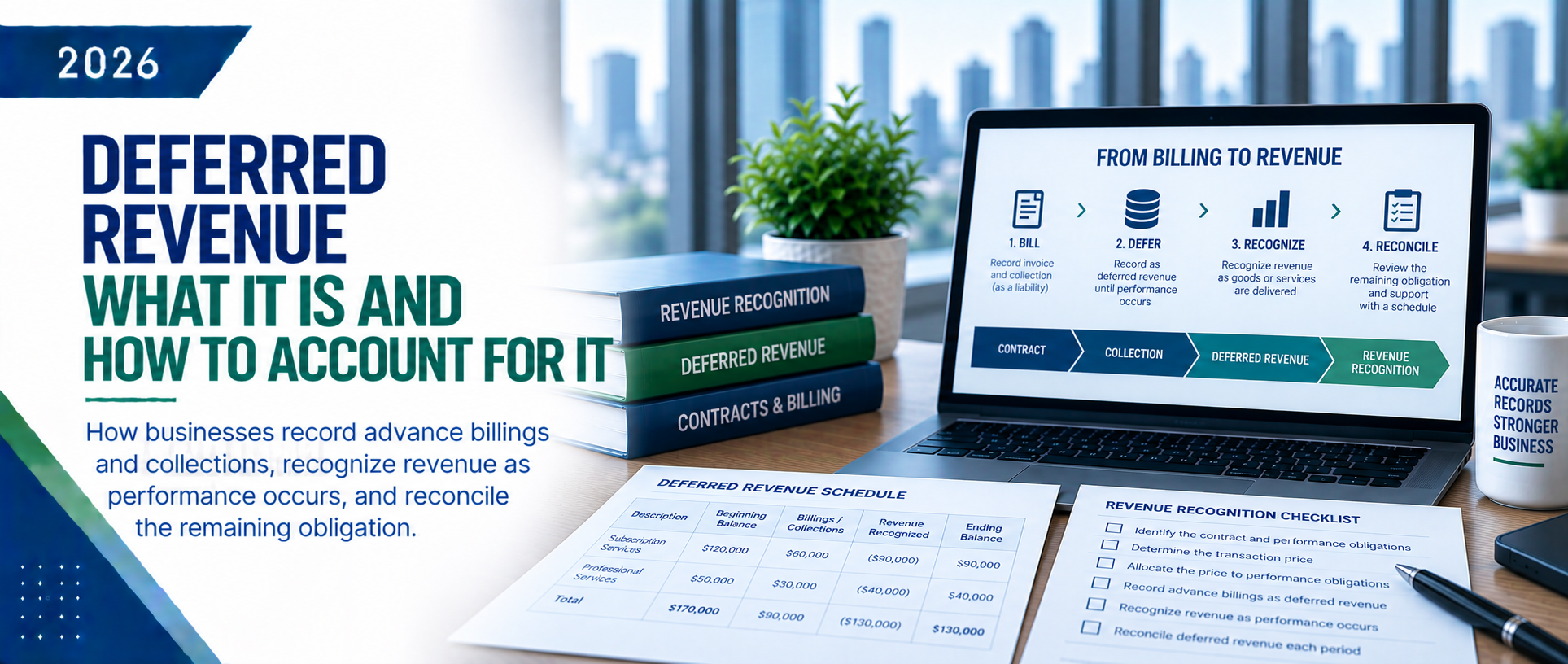
Suggested: accountant reviewing a deferred revenue schedule and SaaS billing records.
 –>
–>
Accounting Practice Guide | Intermediate
Deferred Revenue: What It Is and How to Account for It
How businesses record advance billings and collections, recognize revenue as performance occurs, and reconcile the remaining obligation.
Cash collection and revenue recognition are separate events. When a customer pays or owes consideration before promised goods or services transfer, the amount is generally recorded as a contract liability. Revenue is recognized only as the related performance obligation is satisfied.
1. Definition
Deferred revenue is consideration billed or collected before performance. Under ASC 606, it is generally a contract liability because the company still owes goods or services. “Unearned revenue” is another common account name.
The liability usually represents future performance—not cash owed back. Common examples include annual SaaS subscriptions, prepaid maintenance, memberships, retainers, and undelivered training or implementation services.
Deferred revenue is not automatically the same as a customer deposit. Refund terms, contract terms, and the status of the arrangement determine classification; the invoice label alone does not.
2. Why It Matters
- Financial reporting: Premature recognition overstates revenue and profit and understates liabilities; delayed recognition has the opposite effect.
- Cash flow vs. profit: Upfront cash can improve operating cash flow before revenue is earned. The company still owes future performance and may incur delivery, support, or refund costs.
- Forecasting and control: A reliable deferred revenue schedule shows beginning balance, new billings, revenue recognized, credits/modifications, and the remaining obligation.
3. How It Works
Apply the Revenue Model Before Building the Schedule
Apply ASC 606 before building the schedule. Identify the contract and performance obligations, determine and allocate the transaction price, and recognize revenue when or as control transfers. Billing and payment timing do not replace this analysis.
| Balance | What It Represents | Typical Presentation |
|---|---|---|
| Accounts receivable | An unconditional right to customer consideration; only the passage of time is required before payment. | Current asset unless a longer collection period is expected. |
| Contract asset | Recognized revenue for which the right to payment still depends on something other than time. | Asset, separate from receivables when material. |
| Contract liability | Consideration received or due before the related goods or services are transferred. | Current or noncurrent liability based on expected satisfaction timing. |
| Revenue | Consideration recognized as the related performance obligation is satisfied. | Income statement. |
Record Billing and Cash Separately
If payment is unconditional before performance, record accounts receivable and a contract liability when billed. Cash collection then reduces AR. If cash arrives before an unconditional receivable exists, debit cash and credit the appropriate liability.
Recognize Revenue as Performance Occurs
Reduce the contract liability and recognize revenue as performance occurs. Stand-ready services may be recognized ratably when benefits transfer evenly; point-in-time deliverables are recognized when control transfers. Do not use straight-line recognition automatically when the performance pattern differs.
Update the Schedule for Contract Changes
Update the schedule for refunds, credits, cancellations, upgrades, extensions, and added products. Setup or implementation fees require special analysis: if the activity is not a distinct performance obligation, recognition may occur with the related service rather than when setup work is completed.
Present and Reconcile the Liability
Classify as current the amount expected to be recognized within one year or the operating cycle; present the remainder as noncurrent when material. Reconcile the contract-level schedule monthly to the general ledger, billing system, CRM, AR, cash, and recognized revenue.
4. Simple Example
Assume a customer signs a $24,000 annual SaaS contract beginning July 1. The company invoices the full amount on July 1, the right to payment is unconditional, and the customer pays July 15. The service is a single stand-ready obligation satisfied evenly over 12 months.
| Date and Event | Debit | Credit |
|---|---|---|
| July 1 annual invoice | Accounts receivable $24,000 | Deferred revenue $24,000 |
| July 15 cash received | Cash $24,000 | Accounts receivable $24,000 |
| Each monthly service entry | Deferred revenue $2,000 | Subscription revenue $2,000 |
At December 31, the deferred revenue balance represents six months of service still owed. Cancellations, credits, or expansions require the schedule and accounting to be updated under the contract terms and ASC 606 modification guidance.
5. Common Mistakes and Quick Answers
Common Mistakes
- Recognizing every invoice or cash receipt as revenue: Billing and cash do not determine when revenue is earned.
- Using invoice descriptions instead of contract terms: Performance obligations come from the arrangement, not the invoice label.
- Using straight-line recognition automatically: Match recognition to the actual transfer pattern.
- Recognizing setup or implementation fees upfront: First determine whether the activity is distinct.
- Ignoring contract changes: Refunds, credits, cancellations, extensions, and modifications can change the liability.
- Using only a GL balance: Maintain a customer- or contract-level schedule.
- Leaving stale balances or classifying everything as current: Resolve expired items and classify by expected recognition timing.
Is Deferred Revenue the Same as Accounts Receivable?
No. Accounts receivable is an asset representing an unconditional right to payment; deferred revenue is a liability representing remaining performance. Both may arise from the same advance invoice.
Can Deferred Revenue Be Recognized Before Cash Is Collected?
Yes. If the customer owes consideration before performance and the right to payment is unconditional, the company may record AR and a contract liability before cash is collected.
Does Upfront Billing Mean the Business Earned More Revenue?
No. Upfront billing changes AR, cash, and the contract liability. Revenue depends on the transfer of promised goods or services—not the billing schedule.
6. Practical Checklist: What’s Next
Work through these items to build or strengthen a deferred revenue process.
0 of 8 complete
PNJ Perspective
Deferred revenue should tell one consistent story across the customer contract, billing system, general ledger, revenue schedule, and financial statements. PNJ helps businesses document revenue policies, build contract-level schedules, evaluate complex fees and modifications, and strengthen monthly reconciliations so management can see what was billed, what has been earned, and what is still owed to customers.
Technical Reference Points
- FASB ASU 2014-09, Revenue from Contracts with Customers
- FASB Revenue Recognition Implementation Resources
Disclaimer
This article provides general educational information and is not accounting, tax, legal, or financial-reporting advice. Revenue recognition depends on contract terms, performance obligations, payment rights, modifications, materiality, and the applicable reporting framework. Consult qualified advisers regarding specific arrangements.