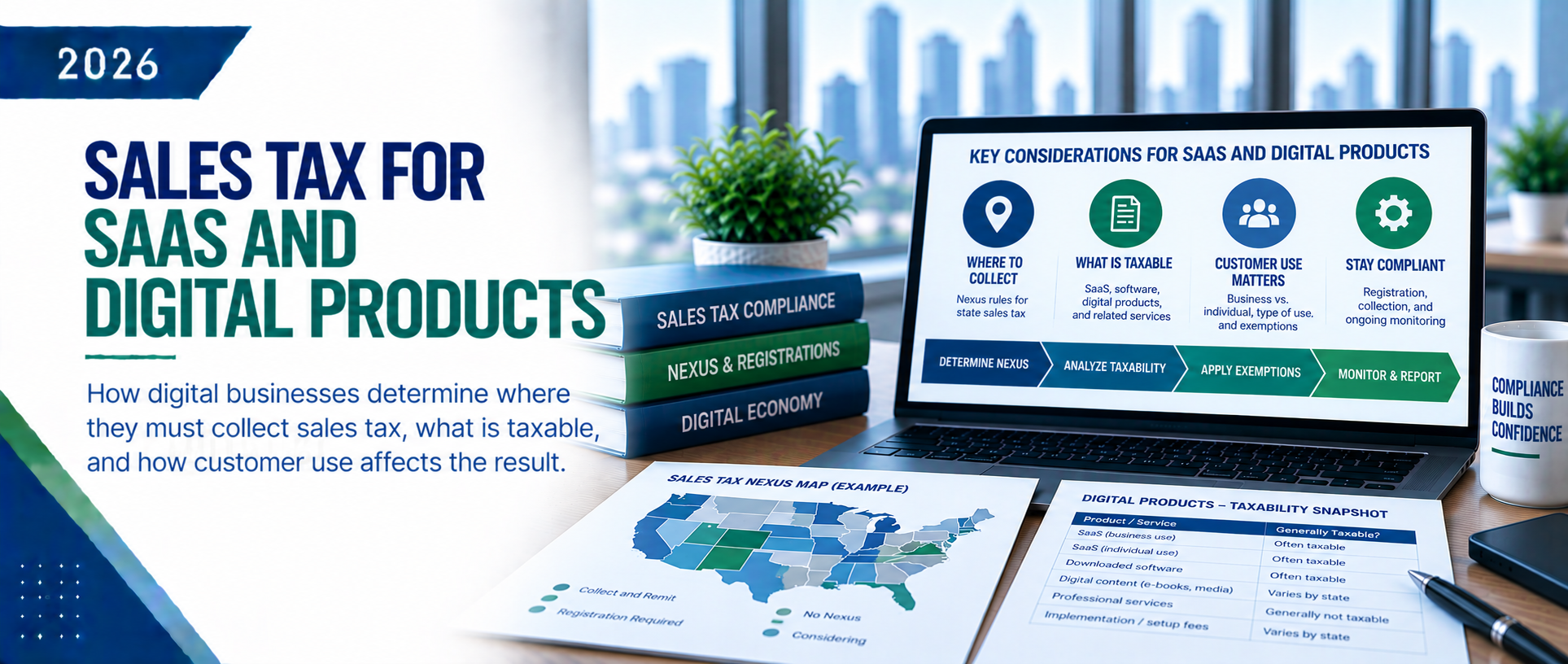
Suggested: SaaS company reviewing a state-by-state sales tax taxability matrix.
 –>
–>
Tax Compliance Practice Guide | Intermediate
Sales Tax for SaaS and Digital Products
How digital businesses determine where they must collect sales tax, what is taxable, and how customer use affects the result.
SaaS and digital products do not receive one nationwide sales-tax treatment. A business must separately determine nexus, product taxability, sourcing, and exemptions. The final position should connect to contracts, SKUs, billing codes, tax-engine settings, exemption records, and filed returns.
1. Definition
SaaS generally gives customers online access to hosted software. Digital products are broader and may include downloadable software, apps, eBooks, images, video, databases, online courses, data feeds, storage, and platform access.
Taxability depends on state law and the actual product. A state may treat the same offering as prewritten software, remotely accessed software, data processing, an information service, a digital good, or a nontaxable service. Contract wording alone does not control; the analysis should reflect what the customer actually receives and can do.
2. Why It Matters
- Digital delivery does not prevent sales-tax exposure. Employees, contractors, inventory, or other in-state activity can create physical nexus, while sales volume can create economic nexus.
- Errors can become the seller’s cost: If tax should have been collected but was not, the seller may owe tax, penalties, and interest. Overcollection can create refund and filing problems.
3. How It Works
Separate Nexus From Taxability
Keep nexus and taxability separate. Nexus asks whether the seller has a state collection or filing obligation. Taxability asks whether that state taxes the particular product. A seller may have nexus while selling an exempt product—or sell a taxable product before nexus creates a collection duty.
| Question | What to Determine | Required Evidence |
|---|---|---|
| Nexus | Where registration and collection duties exist | Sales by state, employees, contractors, offices, inventory, marketplace activity |
| Taxability | Which products and services are taxable | Product functionality, delivery method, contracts, separately stated charges |
| Sourcing | Which jurisdiction receives the sale | Billing address, user or seat location, service-use data, state hierarchy |
| Exemption | Whether a statutory exemption applies | Valid exemption or resale certificate and supporting records |
Classify Each Product Before Configuring Tax
Create a product inventory covering subscriptions, add-ons, downloads, APIs, data feeds, storage, and related services. For each SKU, document functionality, delivery method, customer rights, and included implementation/training/support.
Bundled charges need special attention. Combining taxable and nontaxable elements may affect the tax result depending on state law. Separately stating a service does not automatically make it exempt, but it may support separate treatment when the law allows it.
Apply State Specific Taxability Rules
Do not apply one state conclusion nationally. Build a dated, product-specific state taxability matrix and update it when the product or law changes.
Determine Where the Customer Uses the Product
Sourcing determines which state and local jurisdiction receives the sale. Billing address may work under some rules, but enterprise SaaS may require user, seat, or service-use location data.
For multistate use, apply a supportable allocation method. Collect location data during onboarding, define how missing data is handled, update material changes, and retain the calculation.
Connect the Analysis to Billing and Filing
Map the legal conclusion to the SKU, invoice line, sourcing rule, exemption setting, and effective date. Test sample invoices before go-live. A tax engine calculates based on configuration—it does not decide the law.
After registration, maintain the full compliance cycle: monitor nexus, preserve certificates, file required returns, reconcile tax collected to the sales-tax payable account and returns, and document credits, refunds, overrides, and product-code changes.
4. Common Mistakes and Quick Answers
Common Mistakes
- Assuming all SaaS is taxable—or all exempt: Taxability is state- and product-specific.
- Using billing address in every state: Sourcing rules may require user, seat, or service-use location.
- Assuming B2B sales are automatically exempt: A specific statutory exemption and valid documentation may be required.
- Bundling software and services without analysis: Evaluate each component and the state’s bundled-transaction rules.
- Letting the tax engine decide taxability: Document the legal position first, then configure the system.
- Watching only economic nexus: Remote employees or other physical presence may create obligations earlier.
Are Business to Business Sales Exempt?
Not automatically. B2B treatment depends on the specific product, state law, and any applicable exemption. Resale, governmental, nonprofit, or industry exemptions generally require proper documentation.
What If the Company Registered Late?
Prospective registration does not erase historical exposure. Determine when nexus began, analyze historical taxability and sourcing, calculate tax by period, review contracts, and evaluate penalties, interest, voluntary disclosure, or another remediation process before contacting a state when appropriate.
5. Practical Checklist: What’s Next
Work through these role-based items when reviewing sales tax on SaaS and digital products.
0 of 7 complete
PNJ Perspective
Sales-tax compliance for SaaS and digital products should connect the legal analysis to the transaction—from nexus and product taxability through sourcing, exemption documentation, billing configuration, and return reconciliation. PNJ helps businesses build that connection so the tax result is consistent from contract through remittance.
Technical Reference Points
- New York State Department of Taxation and Finance: Computer Software (including remotely accessed software)
- Texas Comptroller: Taxable Services and Data Processing Services Are Taxable
- California Department of Tax and Fee Administration: Publication 109, Internet Sales (rev. July 2026)
Disclaimer
This article provides general educational information and is not tax or legal advice. Sales-tax nexus, product taxability, sourcing, exemptions, registration dates, and remediation options vary by state and can change. Confirm the law and administrative guidance applicable to the specific product, customer, transaction, and period.