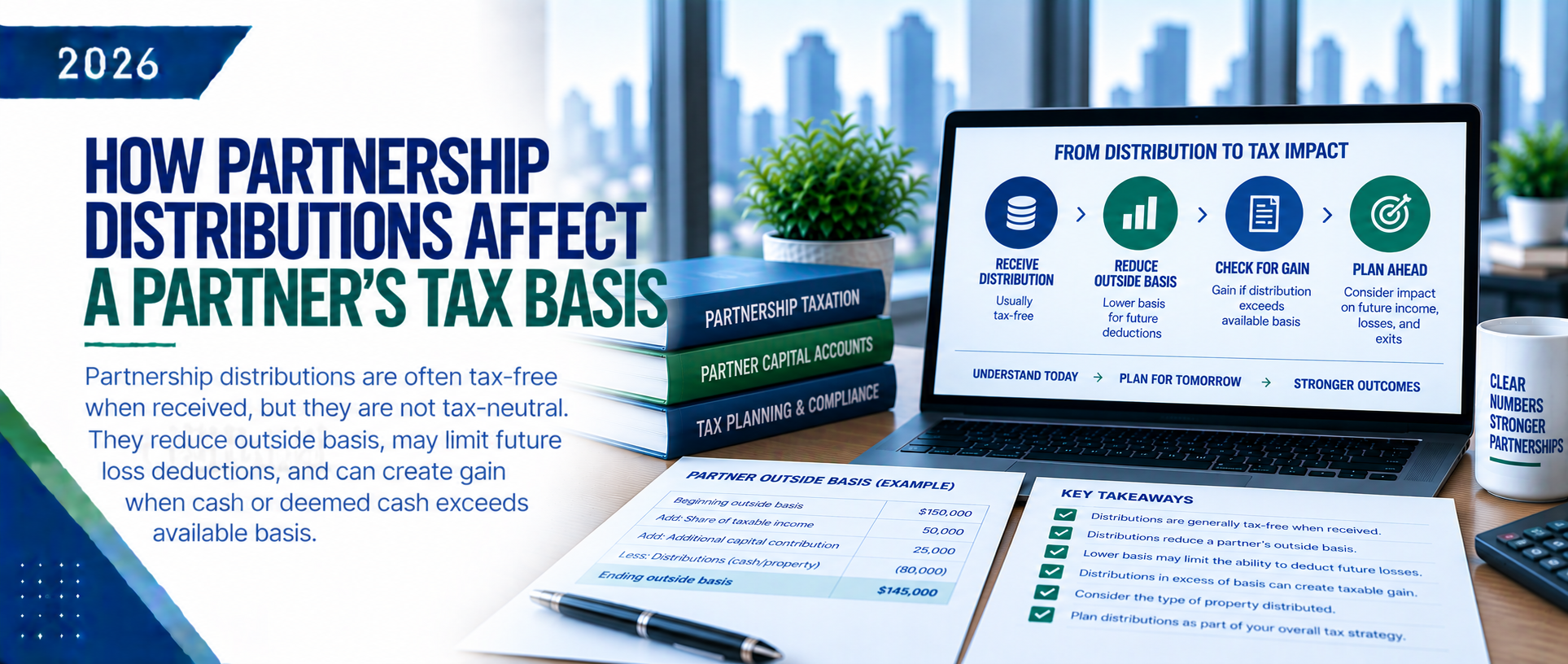
Suggested: tax adviser updating a partner’s outside-basis schedule before a distribution.
 –>
–>
Tax Practice Guide | Advanced Complexity
How Partnership Distributions Affect a Partner’s Tax Basis
Partnership distributions are often tax-free when received, but they are not tax-neutral. They reduce outside basis, may limit future loss deductions, and can create gain when cash or deemed cash exceeds available basis.
Before a distribution, update the partner’s outside tax basis. Cash, debt relief, and certain marketable securities may trigger gain if treated as money above basis, while property distributions generally defer gain but reduce outside basis and determine the property’s tax basis. Special rules may apply.
1. Definition
A partnership distribution is a transfer of cash, property, or other value to a partner in the partner’s capacity as an owner.
Common distributions include:
- Cash withdrawals or profit distributions
- Property transferred to a partner
- Partial or complete redemptions
- Certain decreases in the partner’s share of partnership debt
The key measurement is outside basis—the partner’s adjusted tax basis in the partnership interest.
Outside basis generally starts with contributed cash/property basis or acquisition cost and changes for income, losses, contributions, distributions, and partnership-liability changes.
2. Why It Matters
A distribution does not automatically create taxable income. The result depends on the partner’s available outside basis immediately before the distribution.
Accurate basis records help determine:
- Taxable gain: whether cash or deemed cash exceeds basis.
- Remaining basis: how much tax basis remains after the distribution.
- Loss deductions: whether future partnership losses may be deductible.
- Property basis: the partner receives a tax basis in the distributed property.
- Exit tax: gain or loss on a sale, redemption, or liquidation of the partnership interest.
Schedule K-1 may show distributions and tax-basis capital, but K-1 capital is not outside basis. Outside basis may also include partnership liabilities and partner-specific purchase, inheritance, or transfer adjustments.
The partner is responsible for maintaining outside basis, so a separate basis schedule should be updated every year.
3. How It Works
Start With the Partner’s Basis Before the Distribution
Before analyzing a distribution, update basis for the year’s relevant activity.
Basis generally increases for:
- Additional cash or property contributions
- Taxable partnership income
- Tax-exempt income
- Increases in qualifying partnership liabilities
Basis generally decreases for:
- Cash and property distributions
- Decreases in partnership liabilities
- Partnership losses and deductions
- Certain nondeductible expenses
The order of adjustments matters. Current-year income and other increases may add basis before distributions are applied, while losses are generally tested after distributions and other required reductions.
Cash Distributions Reduce Basis Dollar for Dollar
Cash generally reduces outside basis dollar for dollar.
If cash does not exceed available basis, there is generally no immediate gain; the partner simply has less basis remaining.
If cash exceeds basis, the excess is generally taxable gain, and outside basis cannot fall below zero.
Example: $40,000 basis + $55,000 cash distribution:
- $40,000 reduces basis to zero.
- $15,000 excess is generally taxable gain.
Marketable securities may also be treated as money under special rules.
A Reduction in Partnership Debt Can Be Treated Like Cash
A decrease in a partner’s share of partnership liabilities is generally treated as a deemed cash distribution.
This can create gain even when the partner receives no actual cash.
Example: a $25,000 decrease in allocated partnership debt may be treated as a $25,000 distribution for basis and gain purposes.
Review liability allocations before significant refinancings, partner admissions, redemptions, property transfers, or distributions.
Property Distributions Follow Different Rules
A property distribution generally does not create immediate gain merely because fair value exceeds tax basis.
Generally:
- Property basis: the partner receives a tax basis in the distributed property.
- Outside basis: reduced by the basis assigned to that property.
- Built-in appreciation: generally recognized later when the property is sold.
For a nonliquidating distribution, property basis generally starts with the partnership’s adjusted tax basis, but cannot exceed the partner’s remaining outside basis after any cash received in the same transaction.
Property distributions may also require Form 7217, Partner’s Report of Property Distributed by a Partnership. The form generally applies to property distributions beginning with the 2024 tax year, subject to its instructions and exceptions.
Special Distributions Require Additional Review
Special review is needed for:
- Previously contributed appreciated property
- Inventory or unrealized receivables
- Marketable securities
- Payments connected with services
- Complete liquidation of a partner’s interest
- Disproportionate distributions
These transactions can create immediate gain, ordinary income, additional reporting, or basis adjustments. Review them before cash or property is transferred.
4. Simple Example
Assume Maria begins with $70,000 outside basis.
During the year, her share of partnership income is +$25,000 and her share of partnership debt increases by +$10,000, giving her $105,000 basis before distribution.
| Basis Activity | Amount |
|---|---|
| Beginning outside basis | $70,000 |
| Share of partnership income | +$25,000 |
| Increase in share of partnership debt | +$10,000 |
| Basis before distribution | $105,000 |
| Cash distribution | –$45,000 |
| Ending outside basis | $60,000 |
A $45,000 cash distribution does not exceed her $105,000 basis, so she generally recognizes no gain.
Her ending outside basis is $60,000, which can affect future loss deductions and gain on a later sale.
If cash and deemed cash instead totaled $120,000, the distribution would exceed basis by $15,000. Maria would generally recognize $15,000 of gain and end with zero outside basis.
5. Common Mistakes and Quick Answers
Common Mistakes
- Using K-1 capital as outside basis: Maintain a separate outside-basis schedule.
- Tracking only actual cash: A decrease in partnership debt can create deemed cash.
- Assuming all distributions are tax-free: Cash or deemed cash above basis can create gain.
Does a Partner Pay Tax Twice on Distributed Profit?
Generally no. A partner is usually taxed on distributive share whether or not cash is distributed. That income normally increases outside basis, and a later distribution reduces basis, which helps prevent the same income from being taxed again solely because it is distributed.
Can a Distribution Create a Deductible Loss?
A current distribution generally does not create a deductible loss. Loss recognition may be possible in limited complete-liquidation situations, subject to specific rules.
6. Practical Checklist: What’s Next
Before approving a distribution, work through these role-based items.
0 of 7 complete
Plan distributions using current financial records and updated outside-basis information—not simply available cash. A pre-distribution review can prevent unexpected gain, unsupported loss deductions, and difficult corrections after K-1s are issued.
PNJ Perspective
Partnership distributions should be evaluated using updated outside basis, current liability allocations, and the type of cash or property being distributed. PNJ helps partnerships maintain basis schedules, reconcile capital and debt activity, and review planned distributions so the accounting and tax reporting remain consistent.
Technical Reference Points
- IRS Publication 541, Partnerships
- IRS Partner’s Instructions for Schedule K-1 (Form 1065)
- IRS Form 7217 and Instructions
Disclaimer
This article provides general educational information and is not tax, legal, or accounting advice. Partnership-distribution rules are fact-specific and may depend on outside basis, liability allocations, property type, liquidation status, and other transaction details. Consult a qualified adviser regarding specific circumstances.