Suggested: tax adviser mapping basis, at-risk, and passive-activity loss limitations.
 –>
–>
Tax Technical Guide | Advanced
How Business Loss Limitations Work
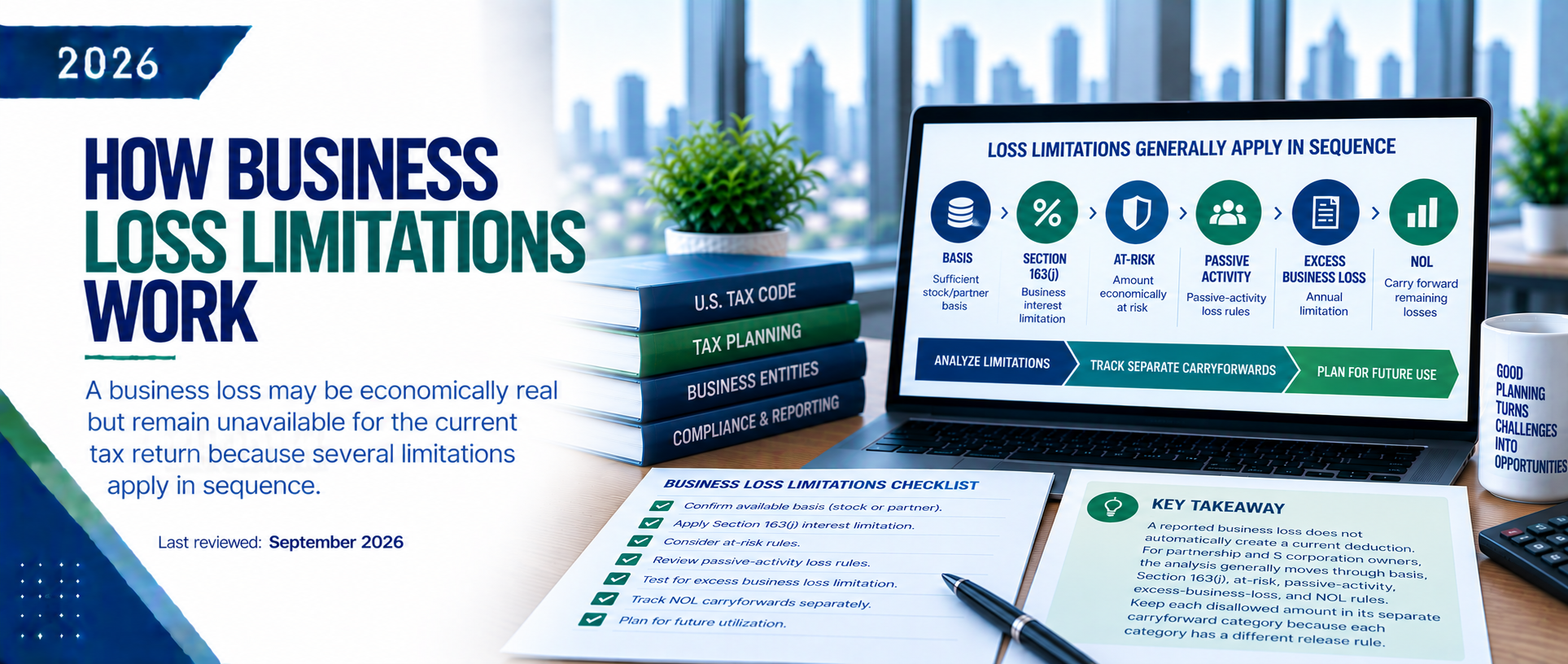
A business loss may be economically real but remain unavailable for the current tax return because several limitations apply in sequence.
A reported business loss does not automatically create a current deduction. For partnership and S corporation owners, the analysis generally moves through basis, Section 163(j), at-risk, passive-activity, excess-business-loss, and NOL rules. Keep each disallowed amount in its separate carryforward category because each category has a different release rule.
1. Definition
A business loss limitation controls when and how much of an otherwise recognized loss may be deducted. A loss may be suspended until the owner adds basis, assumes qualifying economic risk, earns the required type of income, disposes of an activity, or has future taxable income.
Suspension usually means deferral—not permanent disallowance. Workpapers should identify the Code section, entity/activity, beginning carryforward, current-year change, amount released, and ending balance.
| Layer | Primary Rule | Question Answered |
|---|---|---|
| Owner basis | Sections 704(d) and 1366(d) | Does the partner or shareholder have enough tax basis? |
| At risk | Section 465 | Does the taxpayer bear the required economic risk? |
| Passive activity | Section 469 | Can the loss offset the taxpayer’s other income? |
| Excess business loss | Section 461(l) | Does an otherwise allowable aggregate business loss exceed the annual limit? |
| Net operating loss | Section 172 | How much of the resulting NOL can be used in another year? |
2. Why It Matters
- Different rules answer different questions: A loss may fail the basis test first, then the at-risk test, then the passive-activity test before reaching the taxpayer-level excess-business-loss calculation.
- Keep carryforwards separate: Combining basis, at-risk, passive, Section 163(j), excess-business-loss, and NOL amounts can cause the wrong loss to be released, duplicated, or forecast as deductible too early.
3. How It Works
Apply the Owner Basis Limitation
- Partnerships – Section 704(d): Losses are generally deductible only to the extent of adjusted outside basis at year-end. Outside basis may include qualifying partnership liabilities under Section 752. Schedule K-1 Item L capital is not outside basis.
- S corporations – Section 1366(d): Losses are generally limited to stock basis plus basis in bona fide debt owed directly by the corporation to the shareholder. A shareholder guarantee of third-party debt does not by itself create debt basis. Maintain Form 7203 and supporting stock/debt schedules.
| Basis Issue | Partnership | S Corporation |
|---|---|---|
| Owner basis measure | Outside basis in partnership interest | Stock basis plus direct shareholder debt basis |
| Entity borrowing | May increase basis through Section 752 allocation | Generally does not create shareholder basis |
| Primary form or schedule | Partner-maintained basis schedule | Form 7203 and supporting records |
| Suspended loss | Carries forward until basis permits use | Carries forward until stock or debt basis permits use |
Apply Any Separate Business Interest Limitation
Section 163(j) can separately defer business interest expense. Under the source article’s sequencing, it is applied after basis limitations and before the at-risk, passive-activity, and excess-business-loss rules. Partnership excess business interest expense requires separate entity- and partner-level tracking.
Apply the At Risk Limitation
Section 465 limits a loss to the amount the taxpayer is at risk. Cash invested and qualifying recourse debt may increase both basis and at-risk amount, while nonrecourse financing may increase partnership basis without increasing at-risk amount unless an exception applies. Form 6198 tracks the limitation by activity.
Keep the at-risk schedule current even in profitable years. If the amount later becomes negative after prior deductions, recapture may apply.
Apply the Passive Activity Limitation
Section 469 generally prevents passive losses from offsetting wages, portfolio income, or income from activities in which the taxpayer materially participates. Rental activities are generally passive unless a specific exception applies.
Passive losses generally carry forward by activity and may offset future passive income. They may also be released on a fully taxable disposition of the entire interest to an unrelated person, subject to detailed disposition rules.
Apply the Excess Business Loss Limitation
Section 461(l) applies to noncorporate taxpayers after the earlier limitations. For tax years beginning in 2026, the source article states thresholds of $256,000 or $512,000 for a joint return. Form 461 performs the taxpayer-level computation.
The excess amount is disallowed for the current year and treated as an NOL carryover to the next year. Employee wages are not treated as trade-or-business income for this calculation.
Apply the Net Operating Loss Rules
An allowable business loss may create an NOL, and an excess business loss becomes part of the following year’s NOL carryover. For many post-2017 NOLs, the Section 172 deduction is generally limited to 80% of taxable income under the statutory rules, with most such NOLs carried forward indefinitely.
C corporations follow a different stack. They generally do not use the same owner-level basis and Section 461(l) rules. Their analysis often centers on Section 172 and, after certain ownership changes, Section 382. Financing rounds, acquisitions, restructurings, and recapitalizations can restrict annual use of pre-change NOLs.
4. Integrated Example
Assume a single taxpayer receives a $700,000 partnership loss, has $500,000 outside basis, only $420,000 at risk, materially participates, and has no other business income or loss.
| Calculation Step | Amount Allowed at Step | Separate Carryforward |
|---|---|---|
| Partnership loss reported | $700,000 | Starting loss |
| Section 704(d) basis limit | $500,000 | $200,000 basis suspended |
| Section 465 at-risk limit | $420,000 | $80,000 at-risk suspended |
| Section 469 passive limit | $420,000 | None because activity is nonpassive |
| Section 461(l) limit | $256,000 | $164,000 treated as an NOL carryover |
Current-year usable loss: $256,000. The remaining $444,000 stays in three separate categories: $200,000 basis-suspended, $80,000 at-risk-suspended, and $164,000 carried forward under the NOL rules. Future income does not release all three amounts in the same way.
5. Common Mistakes and Quick Answers
Common Mistakes
- Using K-1 capital as partnership outside basis: Maintain a separate partner-level basis schedule.
- Treating an S corporation debt guarantee as basis: A guarantee alone generally does not create shareholder debt basis.
- Applying passive rules too early: Apply basis, Section 163(j), and at-risk rules first.
- Combining carryforwards: Keep basis, at-risk, passive, Section 163(j), excess-business-loss, and NOL balances separate.
- Ignoring Section 461(l) or Section 382: Test the applicable taxpayer- or corporate-level limitation before forecasting loss utilization.
Does Business Debt Always Create Deductible Loss Basis?
No. Partnership debt may increase outside basis only when properly allocated under Section 752, and it may still fail to increase the at-risk amount. S corporation debt generally creates shareholder debt basis only when the corporation is directly indebted to the shareholder.
Does Material Participation Make the Entire Loss Deductible?
No. Material participation addresses only the passive-activity limitation. The taxpayer must still satisfy basis, Section 163(j), at-risk, excess-business-loss, and other applicable rules.
What Happens When a Suspended Loss Is Released?
A released loss reenters the tax computation for that year and may face another limitation. A basis-suspended loss released after basis is restored may still be limited by at-risk, passive-activity, or excess-business-loss rules.
6. Practical Checklist: What’s Next
Work through these role-based items when applying the loss-limitation stack.
0 of 5 complete
PNJ Perspective
Business-loss planning requires more than identifying the total unused loss. PNJ helps taxpayers maintain separate basis, Section 163(j), at-risk, passive, excess-business-loss, and NOL schedules so each deduction is released under the correct rule and in the correct year.
Technical Reference Points
- IRS Publication 925, Passive Activity and At-Risk Rules
- 2025 Instructions for Form 461
- IRS S Corporation Stock and Debt Basis Guidance
- Revenue Procedure 2025-32
Disclaimer
This article provides general educational information and is not tax or legal advice. Business loss limitations are fact-specific and may depend on entity type, financing, participation, activity grouping, ownership changes, prior-year carryforwards, and current federal and state law.