Suggested: consolidation team reconciling intercompany balances before close.
 –>
–>
Accounting Technical Guide | Advanced
Intercompany Transactions: The Basics
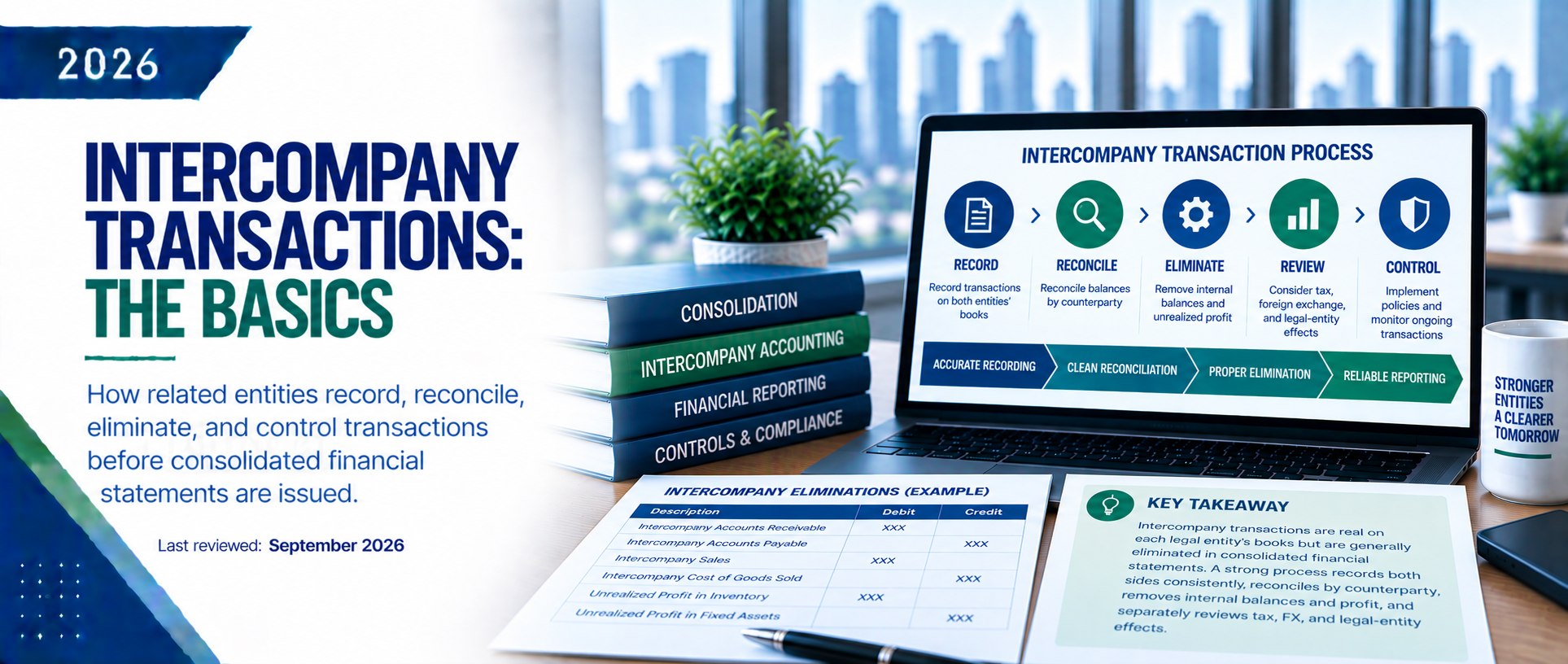
How related entities record, reconcile, eliminate, and control transactions before consolidated financial statements are issued.
Intercompany transactions are real on each legal entity’s books but are generally eliminated in consolidated financial statements. A strong process records both sides consistently, reconciles by counterparty, removes internal balances and profit, and separately reviews tax, FX, and legal-entity effects.
1. Definition
Intercompany transactions occur between entities under common control. Common examples include product sales, shared services, loans, interest, reimbursements, royalties, dividends, and fixed-asset transfers.
Each entity records its own legal activity. On consolidation, amounts created only within the group are eliminated so the group is presented as one economic entity. Transactions with outside parties remain.
| Transaction | Separate-Entity Accounting | Consolidation Focus |
|---|---|---|
| Inventory sale | Seller records revenue and cost; buyer records inventory or expense | Eliminate internal sale, cost, balances, and unrealized profit |
| Service charge | Provider records revenue; recipient records expense or asset | Eliminate reciprocal revenue and expense; assess allocation support |
| Intercompany loan | Lender records receivable and interest; borrower records payable and interest | Eliminate principal and reciprocal interest; analyze FX and tax |
| Fixed-asset transfer | Buyer records asset at transfer price; seller may record gain or loss | Restore group carrying amount and correct depreciation |
2. Why It Matters
- Financial reporting: Unreconciled intercompany activity can overstate revenue, expenses, assets, liabilities, and profit and delay the close.
- Tax and legal effects remain: A consolidation elimination does not cancel the legal transaction or its tax consequences. Cross-border and multistate activity may still require transfer-pricing, withholding, indirect-tax, and local reporting analysis.
3. How It Works
Record Both Sides Under a Common Policy
Define the transaction type, counterparty, currency, pricing basis, period, accounts, and required support before posting. Both entities should use the same reference number and period, with agreements supporting services, loans, repayment, interest, or pricing terms.
Reconcile by Counterparty Before Consolidation
Reconcile intercompany balances by entity pair, invoice, currency, and aging. Assign differences to an owner and resolve them before consolidation.
- Timing: one entity records the transaction in a different period.
- Currency: different exchange rates or remeasurement dates.
- Classification: one side records a service fee while the other records a reimbursement or asset.
- Scope: one side includes tax, freight, or markup that the other excludes.
- Completeness: an entry, credit memo, or cash receipt is missing on one side.
Post and Document Consolidation Eliminations
Remove Profit Not Yet Earned from Outside Parties
Internal profit must also be removed while transferred assets remain inside the group. For inventory, eliminate unrealized profit in ending inventory. For fixed assets, restore the group carrying amount and correct depreciation.
Analyze Foreign Currency and Cash Flow Separately
Foreign-currency balances can create FX gains, losses, or translation effects under ASC 830. Long-term balances treated as part of a net investment require documented support.
Internal cash movements are eliminated from consolidated cash flow, but FX effects, bank fees, taxes, and third-party financing remain. Reconcile changes in intercompany balances to settlements, noncash entries, and currency effects.
Complete a Separate Tax Review
Tax review remains separate. Section 482 generally requires arm’s-length pricing. Review pricing methods, allocation keys, loan terms, interest, withholding, indirect tax, Section 267 timing, and state/foreign reporting. These rules do not necessarily follow the book elimination entry.
4. Integrated Example
Assume Parent sells inventory to Subsidiary for $500,000 at a group cost of $350,000—a 30% internal margin. At year-end, Subsidiary still holds $200,000 of that inventory. Parent also has a $1,000,000 intercompany loan and a $25,000 management fee.
| Consolidation Step | Amount | Purpose |
|---|---|---|
| Eliminate internal sale and purchase/cost | $500,000 | Remove internal revenue and corresponding buyer-side amount |
| Eliminate unrealized inventory profit | $60,000 | $200,000 ending inventory × 30% internal margin |
| Eliminate loan receivable and payable | $1,000,000 | Remove reciprocal internal principal |
| Eliminate management-fee revenue and expense | $25,000 | Remove internal service activity |
The key inventory adjustment is $60,000 of unrealized profit ($200,000 × 30%), which reduces consolidated inventory and profit until the goods are sold externally. The loan and fee eliminations do not remove the need for agreements, settlement controls, transfer-pricing support, or tax analysis.
5. Common Mistakes and Quick Answers
Common Mistakes
- Eliminating only AR/AP: also remove internal revenue, expense, interest, and unrealized profit where applicable.
- Using plug entries: resolve the underlying timing, currency, classification, or completeness difference.
- Missing counterparty coding: use consistent entity and reference identifiers.
- Forgetting fixed-asset follow-through: continue depreciation adjustments after an internal transfer.
- Assuming elimination settles the legal/tax issue: book elimination does not cancel the transaction or tax consequence.
- Leaving old balances unresolved: review settlement terms, impairment, enforceability, and recurring exceptions.
Should Intercompany Accounts Always Net to Zero?
At consolidation, reciprocal amounts should eliminate only after valid differences are understood. A zero plug is not evidence the underlying records are correct.
Can One Entity Record a Shared-Cost Allocation Without an Agreement?
A journal entry may be possible, but unsupported allocations create accounting, tax, and governance risk. Document the service/cost pool, beneficiaries, allocation key, markup policy, period, approval, and supporting records.
6. Practical Checklist: What’s Next
Work through these role-based items to manage intercompany transactions.
0 of 6 complete
Next step: standardize intercompany policies and counterparty coding, set a monthly confirmation deadline, assign exception owners, and maintain one reviewed elimination schedule. Cross-border groups should coordinate accounting and tax before new charges or funding arrangements begin.
How PNJ Can Help
PNJ can help design intercompany policies, counterparty tracking, reconciliations, elimination schedules, and control workflows, while coordinating accounting records with tax advisers for a faster close and traceable consolidated reporting.
Official References
- FASB: Foreign Currency Translation guidance
- IRS: Transfer Pricing
- IRS: Transfer-Pricing Documentation Best Practices
Disclaimer
This article provides general educational information and is not accounting, tax, or legal advice. Intercompany accounting and tax treatment depend on the entities, agreements, jurisdictions, reporting framework, and specific facts. Consult qualified advisers before implementing a policy or transaction.