Suggested: accounting team reviewing year-end reconciliations and adjusting entries.
 –>
–>
Accounting Technical Guide | Advanced
Year-End Journal Entries Every Business Should Review
A technical guide to the entries, estimates, reconciliations, and review controls that support complete year-end financial statements.
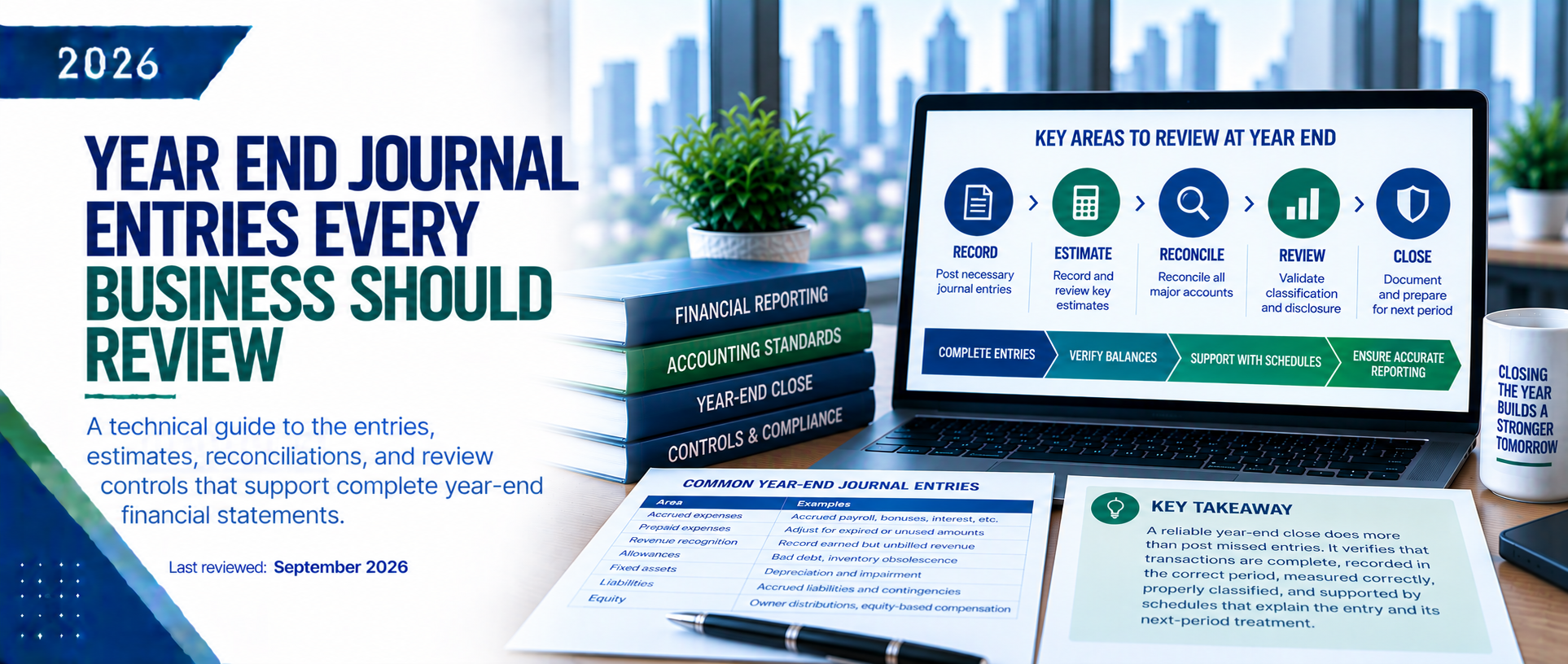
A reliable year-end close does more than post missed entries. It verifies that transactions are complete, recorded in the correct period, measured correctly, properly classified, and supported by schedules that explain the entry and its next-period treatment.
1. Definition
A year-end journal entry adjusts the financial statements as of the annual reporting date. Common purposes include recognizing unrecorded activity, updating estimates, correcting cutoff, reclassifying balances, and eliminating consolidation-only activity.
Not all year-end entries behave the same:
- Accruals may reverse when the underlying invoice or payroll posts.
- Reserves and allowances usually roll forward and are remeasured.
- Reclassifications may not affect net income.
- Consolidation entries belong in the consolidation layer, not the legal-entity books.
| Entry Type | Purpose | Typical Next Period Treatment |
|---|---|---|
| Accrual | Recognize an expense or revenue in the period earned or incurred | Often reverses when the invoice, payroll, or billing entry posts |
| Estimate or reserve | Measure an uncertain balance using current information | Rolls forward and is reassessed rather than fully reversed |
| Reclassification | Present an existing balance in the correct financial statement category | Usually remains until facts or classification change |
| Consolidation entry | Remove internal balances, transactions, or unrealized profit | Maintained in the consolidation layer and updated each period |
2. Why It Matters
- Correct amount is not enough: An entry can still be wrong if it uses the wrong period, accounting model, entity, classification, or reversal logic.
- Do not simply copy last year: New contracts, financing, employees, leases, entities, product lines, disputes, or tax positions can create new adjustments. Start with the current trial balance, subledgers, contracts, close calendar, and business changes.
3. How It Works
Test Completeness and Cutoff
Test whether all activity through year-end is recorded in the correct period. Review post-year-end invoices and payments, vendor statements, open POs, receiving records, legal bills, utilities, commissions, freight, and services performed before year-end.
Payroll cutoff should separately review unpaid wages, payroll taxes, bonuses, commissions, compensated absences, severance, and deferred compensation. Accrue bonuses only when year-end facts create a present obligation.
Revenue should follow the applicable recognition model—not billing or cash timing. Under ASC 606, review unbilled receivables, contract assets/liabilities, refund liabilities, variable consideration, and contract modifications. Manual entries should tie to contracts, performance evidence, billing data, and the subledger.
Reconcile Assets and Liabilities to Supporting Schedules
Reconcile key balances to external statements or controlled subledgers. A reconciliation should explain differences; a plug does not resolve the underlying error.
- Prepaids / deferred costs: service periods, amortization, and remaining benefits.
- Inventory: quantities, ownership, goods in transit, cutoff, landed cost, shrinkage, and obsolescence.
- Fixed assets: additions, placed-in-service dates, transfers, disposals, depreciation, impairment, and CIP.
- Leases: new agreements, modifications, renewals, terminations, discount rates, and current/noncurrent balances under ASC 842.
- Debt: principal, accrued interest, fees, repayments, covenants, maturities, and classification changes.
Update Estimates and Valuation Adjustments
Evaluate receivables and contract assets under the applicable credit-loss model using history, current conditions, and reasonable forecasts. Specific write-offs are separate from the allowance estimate, and tax bad-debt rules should not automatically be used as the book policy.
Other estimates may include inventory reserves, warranty/refund liabilities, impairment, litigation, guarantees, and contingencies. Each estimate should document the population, method, assumptions, data source, and review.
Review Technical and Entity Level Entries
Foreign-currency balances may require remeasurement or translation under ASC 830. Separate transaction gains/losses, remeasurement effects, and translation adjustments rather than posting one unexplained FX true-up.
Confirm intercompany balances by entity pair before consolidation. Eliminate reciprocal balances, internal revenue/expense, loans, interest, dividends, and unrealized profit in a traceable consolidation layer without erasing legal-entity records.
The year-end tax provision may include current tax, deferred tax assets/liabilities, valuation allowances, and uncertain tax positions under ASC 740. Reconcile it to book-tax differences, tax attributes, enacted rates, estimated payments, and jurisdiction workpapers.
Complete Classification and Subsequent Event Review
Review presentation items including current/noncurrent classification, contra accounts, restricted cash, debt maturities, accrued liabilities vs. AP, operating vs. nonoperating items, and equity activity.
Also review subsequent events. New information about conditions existing at year-end may require adjustment; events arising afterward may require disclosure. Document the conclusion even when no entry is recorded.
Control the Journal Entry Lifecycle
Every material year-end entry should document accounting basis, calculation, source support, legal entity, accounts, preparer, reviewer, posting date, and reversal/rollforward treatment. Give extra scrutiny to manual revenue, reserves, tax provisions, intercompany entries, unusual items, and late close entries.
4. Integrated Example
Example: During the January review of December 31 financial statements, accounting identifies five items that belong to the year just ended.
| Year-End Fact | Entry or Accounting Result | Review Evidence |
|---|---|---|
| $40,000 December legal work billed in January | Dr Legal expense; Cr Accrued liabilities $40,000 | Terms, invoice, service dates |
| $120,000 annual software payment began October 1 | Recognize $30,000 expense; retain $90,000 prepaid | Contract, payment, prepaid schedule |
| $75,000 invoice covers January services | Retain a $75,000 contract liability at December 31 | Contract, invoice, service period |
| $200,000 receivable pool has a 4 percent expected-loss rate | Dr Credit loss expense; Cr Allowance $8,000, adjusted for the existing allowance | Aging, method, history, current conditions |
| $60,000 asset in the equipment balance was disposed of | Remove cost and accumulated depreciation; record gain or loss | Asset register, approval, proceeds |
Do not approve these as one net true-up. Each item requires different evidence and next-period treatment: the legal accrual may reverse; the prepaid and allowance roll forward; the contract liability is released as service is provided; and the disposal updates the asset register.
5. Common Mistakes and Quick Answers
Common Mistakes
- Copying prior-year entries: confirm the underlying obligation, contract, or estimate still exists.
- Using plugs: resolve reconciliation differences instead of forcing agreement.
- Recognizing revenue from billing dates: follow contract performance and transfer of control.
- Automatically reversing reserves: continuing estimates usually roll forward and are remeasured.
- Ignoring classification/disclosure: review presentation after the trial balance is complete.
- No independent review of high-risk entries: require documented reviewer approval.
Should Every Accrual Reverse in January?
No. Short-term accruals often reverse when the invoice or payroll entry posts. Reserves, allowances, deferred-tax balances, and other continuing estimates generally roll forward and are updated.
Does a Tax Adjustment Automatically Change the Books?
No. Tax returns and financial statements can use different recognition, measurement, depreciation, and deduction rules. Book entries should follow the applicable reporting framework; tax effects are recorded through the tax provision when required.
6. Practical Checklist: What’s Next
Work through these role-based items when finalizing year-end journal entries.
0 of 6 complete
Next step: Build year-end work from controlled monthly schedules. Assign each material balance to an owner, define support and reversal standards, and require final approval of estimates and unresolved items before issuance.
PNJ Perspective
A strong year-end close should be built on controlled reconciliations, supportable estimates, correct cutoff, and documented review. PNJ helps businesses organize the close, reconcile high-risk accounts, review adjustments, strengthen schedules, coordinate tax information, and document approvals.
Technical Reference Points
- FASB Topic 606, Revenue from Contracts with Customers
- FASB Topic 842, Leases
- FASB Topic 740, Income Taxes
- FASB Topic 830, Foreign Currency Matters
Disclaimer
This article provides general educational information and is not accounting, tax, or legal advice. Year-end accounting requirements depend on the reporting framework, contracts, estimates, entity structure, and specific facts. Consult qualified advisers for specific circumstances.