Suggested: a finance professional reviewing an international vendor file with a world map or globe visible in the background.
 –>
–>
Tax Compliance Foundation
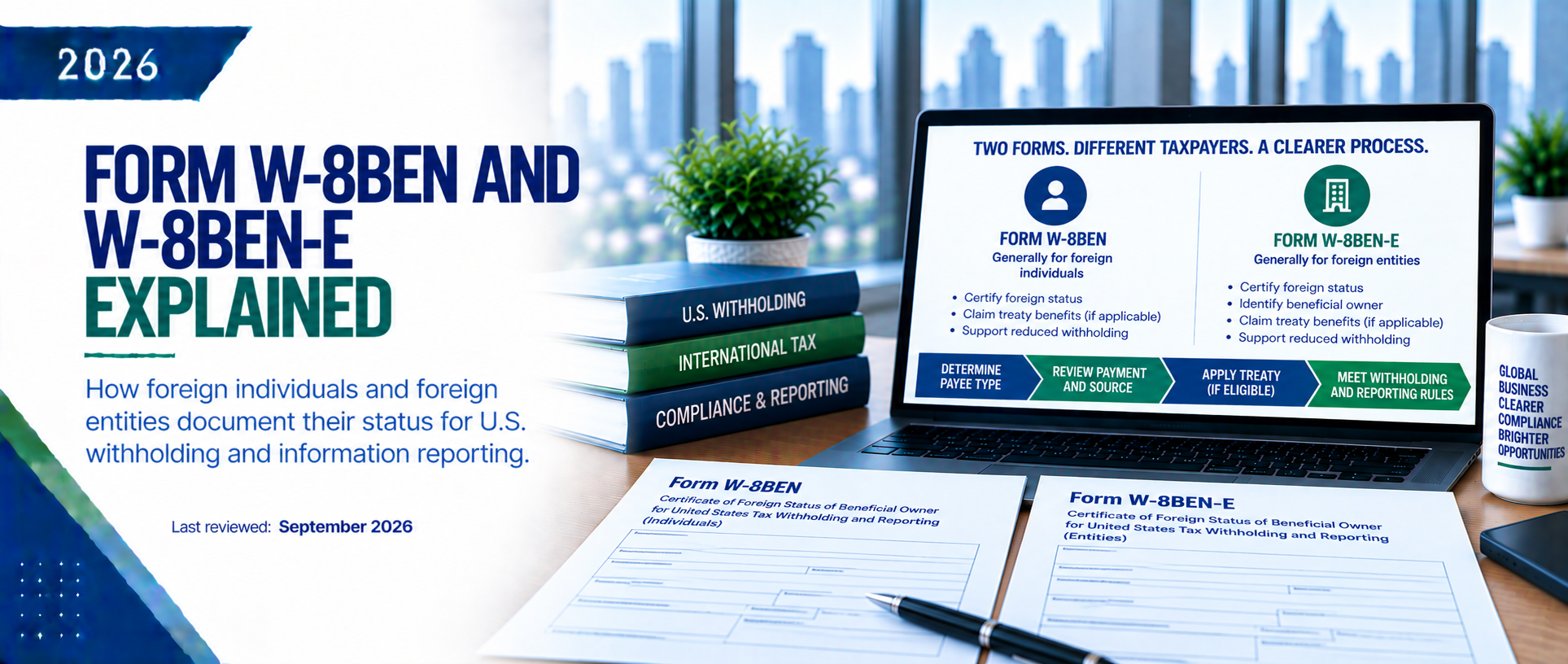
Form W-8BEN and W-8BEN-E Explained
How foreign individuals and foreign entities document their status for U.S. withholding and information reporting
Form W-8BEN is generally for a foreign individual, while Form W-8BEN-E is generally for a foreign entity. These forms document the payee’s status, but they do not automatically eliminate U.S. withholding. The payer must still analyze the payment type, source, treaty position, and reporting rules.
1. Definition
Forms W-8BEN and W-8BEN-E are withholding certificates used to document a foreign payee’s U.S. tax status. The payee gives the form to the payer or withholding agent that requests it; it is generally retained by the requester rather than filed directly with the IRS.
- W-8BEN: generally completed by the foreign individual beneficial owner.
- W-8BEN-E: generally completed by a foreign entity and may also document Chapter 3 status, FATCA classification, and treaty claims.
| Form | Usually Completed By | Primary Purpose |
|---|---|---|
| W-8BEN | Foreign individual | Establish foreign status and claim treaty benefits when applicable |
| W-8BEN-E | Foreign entity | Establish foreign and entity status, FATCA classification, and treaty benefits when applicable |
2. Why It Matters
- Documentation supports treatment: A valid W-8 can support foreign status, treaty benefits, reporting exemptions, or FATCA classification. Missing or unreliable documentation may require conservative IRS presumption rules.
- Withholding risk: Some U.S.-source income paid to foreign persons may be subject to 30% federal withholding unless an exception or treaty reduction applies. The payer may also have Forms 1042 and 1042-S reporting obligations.
3. How It Works
Identify the Payee Before Selecting the Form
First determine whether the payee is U.S. or foreign. A U.S. person generally provides Form W-9. A foreign individual generally provides W-8BEN, while a foreign entity generally provides W-8BEN-E.
Do not assume the cash recipient is the beneficial owner. Intermediaries or flow-through entities may need Form W-8IMY; effectively connected income may require Form W-8ECI; and certain U.S.-performed services may require Form 8233 or Form W-4.
Review the Required Information
W-8BEN commonly includes name, citizenship, permanent residence, mailing address, foreign TIN when required, and date of birth when applicable. Treaty claims also identify the treaty country and requested rate.
W-8BEN-E requires additional entity information, including legal name, country of organization, Chapter 3 status, FATCA status, addresses, tax IDs, and treaty position. Complete only the sections relevant to the entity’s classification, but ensure the certifications match the vendor and payment facts.
Analyze the Payment Separately
A W-8 form does not determine the tax result by itself. The payer must separately determine the source and character of the income. Interest, dividends, royalties, services, rents, partnership income, and property sales can follow different rules.
For services, where the services are physically performed is an important sourcing factor. Document work locations, travel, contract terms, and separate payment components when relevant.
Confirm Treaty and FATCA Claims
Treaty benefits require more than citizenship or incorporation in a treaty country. The beneficial owner generally must satisfy treaty residence, the applicable article, limitation-on-benefits rules, and required TIN documentation.
Foreign entities may also need a valid FATCA classification and, in some cases, a GIIN or additional documentation. This is a key reason W-8BEN-E is more detailed than W-8BEN.
Monitor Validity and Changes
A W-8BEN or W-8BEN-E is generally valid from the signing date through the last day of the third succeeding calendar year, unless a change in circumstances makes it incorrect sooner.
Update the form when facts change, including tax residence, address, entity/FATCA status, beneficial ownership, treaty eligibility, or U.S. tax status. Do not rely on a form known to be unreliable or incorrect.
4. Simple Example
Example: A U.S. company hires a Vietnamese consulting company and all services are performed in Vietnam. Before payment, the U.S. company requests Form W-8BEN-E.
- Vendor documentation: The foreign company completes and signs W-8BEN-E.
- Payment analysis: The payer confirms the payment is for services performed outside the United States, not a royalty or another payment type.
- Withholding/reporting: The payer applies the appropriate treatment and retains the W-8BEN-E with the vendor file.
If personnel later work in the United States or the contract adds a license or royalty, reassess sourcing, withholding, reporting, and documentation. The W-8BEN-E documents status; it does not replace payment analysis.
5. Common Mistakes and Quick Answers
Common Mistakes
- Wrong form: using W-8BEN for a foreign corporation or W-8BEN-E for an individual.
- One-form-for-all approach: different foreign payees may require different W-8 forms.
- Assuming no withholding: a signed W-8 does not automatically make the payment exempt.
- Incomplete documentation: do not accept unsigned forms or ignore conflicting U.S. information.
- Unsupported treaty claim: confirm residence, eligibility, and required tax IDs.
- Late or expired forms: collect documentation before payment and track expiration or changed facts.
Does the Foreign Payee Send the Form to the IRS?
Generally no. The payee gives the form to the requesting payer, financial institution, partnership, or withholding agent, which keeps it in its records and uses it to determine tax treatment.
Does a W-8 Form Mean No U.S. Tax Applies?
No. The W-8 documents the payee’s status and may support a treaty or other claim, but the payment source, character, payee role, treaty requirements, and other federal rules determine withholding and reporting.
6. Practical Checklist: What’s Next
Route each role’s action item as foreign-payee documentation comes in.
0 of 5 complete
Maintain a foreign-payee register with form type, signature date, expiration date, treaty claim, FATCA status, payment category, withholding conclusion, and reviewer. Reassess it before expiration and whenever vendor, contract, ownership, address, or service location changes.
PNJ Perspective
Foreign-payee compliance works best when the correct form is collected before payment and reviewed together with the payment analysis. PNJ helps businesses evaluate payee status, payment sourcing, treaty positions, FATCA classification, withholding, and Forms 1042/1042-S reporting.
Technical Reference Points
- IRS Form W-8BEN and Instructions
- IRS Form W-8BEN-E and Instructions
- IRS Instructions for Requesters of Forms W-8
- IRS Publication 515
Disclaimer
This article provides general educational information and is not tax or legal advice. International withholding and reporting depend on the payee, payment type, source, treaty, FATCA classification, and specific facts. Obtain qualified advice before applying a reduced rate or exemption.