Suggested: bookkeeper comparing a printed bank statement against a general-ledger cash balance.
 –>
Accounting Foundation
How to Reconcile Bank Statements Step by Step
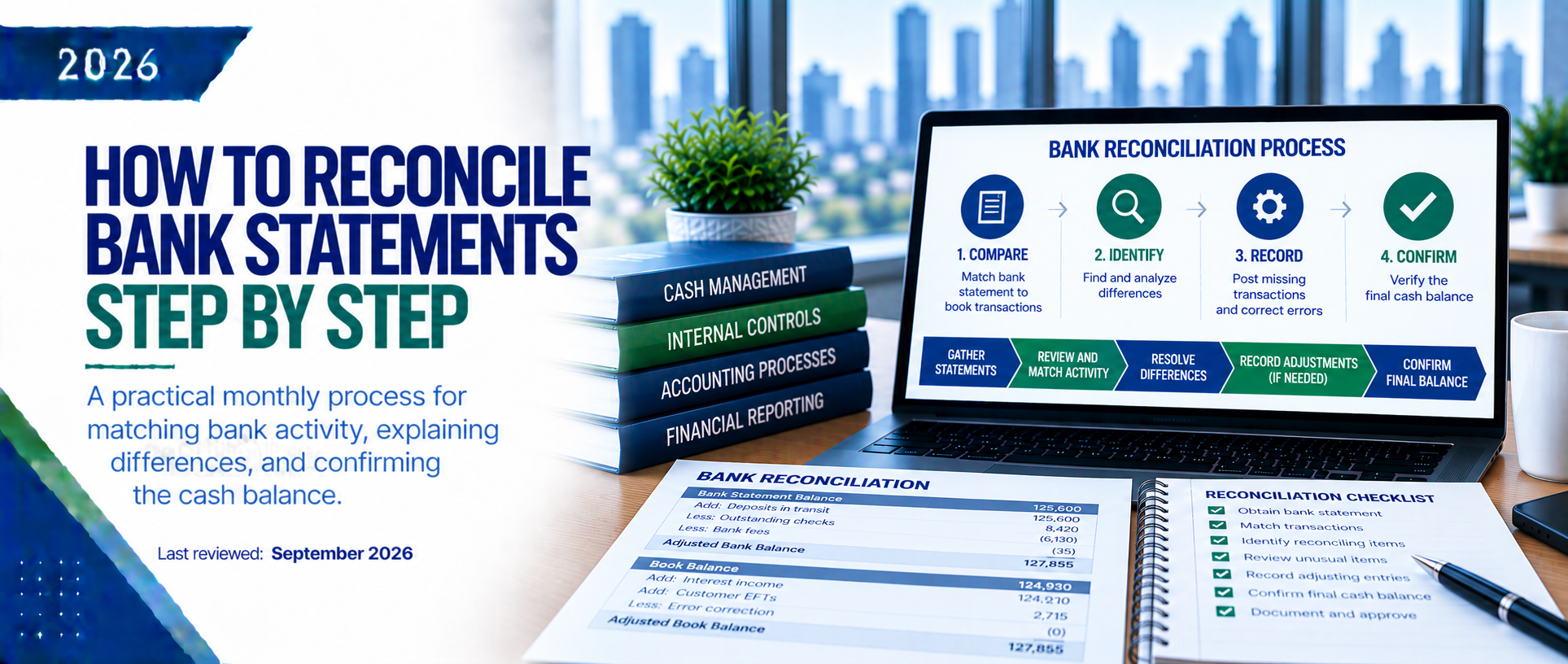
A practical monthly process for matching bank activity, explaining differences, and confirming the cash balance.
A bank reconciliation compares the bank statement to the accounting cash balance and explains every difference. The goal is not to force a match—it is to identify timing differences, record missing transactions, correct errors, and prove the final cash balance is reliable.
1. Definition
A bank reconciliation compares the bank statement ending balance with the general-ledger cash balance for the same account and period. Differences are common because the bank and the business do not always record transactions at the same time.
Common reconciling items:
- Outstanding checks: payments recorded in the books but not yet cleared by the bank.
- Deposits in transit: receipts recorded in the books but not yet posted by the bank.
- Bank-side items: fees, interest, returned payments, automatic withdrawals, or other activity not yet in the books.
- Errors: duplicate, omitted, transposed, or incorrectly classified transactions in the books or bank statement.
2. Why It Matters
- Risk of hidden errors: An unreconciled account can hide missing deposits, duplicate payments, bank fees, returned payments, unauthorized charges, or misposted transfers and can distort other balance-sheet and income-statement accounts.
- Internal control: Monthly reconciliation supports accurate financial statements, reliable cash reporting, and documented preparation/review. Reconcile every bank account, including operating, payroll, savings, and restricted-cash accounts.
3. How It Works
Step 1: Gather the Records. Collect the complete bank statement, GL/bank-register detail, prior reconciliation, and support for unusual activity. Confirm the current beginning balance agrees with the prior reconciled ending balance.
Step 2: Match Transactions That Cleared. Match deposits and withdrawals using amount, date, check number, payee, or bank reference. Software can automate routine matching, but still investigate duplicates, unexpected amounts, and wrong-account postings.
Step 3: Identify Timing Differences. List outstanding checks and deposits in transit at the statement date. Outstanding checks reduce the adjusted bank balance; deposits in transit increase it. These usually do not require new journal entries because they are already in the books.
Step 4: Record Items Missing From the Books. Record bank activity missing from accounting, including fees, interest, returned payments, ACH reversals, merchant fees, loan payments, and automatic withdrawals. Post each item to the proper account—not a generic miscellaneous or reconciliation account.
Correct duplicate entries, transposed numbers, wrong amounts, and wrong-account postings only after reviewing source documents. Preserve the audit trail. A true bank error stays on the bank side of the reconciliation and should be reported to the bank.
Step 6: Compare the Adjusted Balances. After timing differences and book adjustments, the adjusted bank balance and adjusted book balance should agree. If not, continue investigating—do not post a plug entry.
Step 7: Review and Close the Reconciliation. Post approved book-side entries, refresh the GL, and confirm the reconciliation still agrees. Then investigate aged items, attach support, document preparer/reviewer dates, and save the reconciliation with the month-end close.
4. Simple Example
Example: At March 31, the bank statement shows $100,000 and the GL shows $104,450. Reconciling items include a $12,000 deposit in transit, $8,000 outstanding checks, $150 bank fee, $500 returned payment, and $200 interest income.
| Reconciliation Item | Amount | Explanation |
|---|---|---|
| Bank statement ending balance | $100,000 | Starting bank balance |
| Add deposits in transit | + 12,000 | Recorded in books but not yet by bank |
| Less outstanding checks | – 8,000 | Recorded in books but not yet cleared |
| Adjusted bank balance | $104,000 | Bank side after timing differences |
| Book cash balance | $104,450 | Starting general-ledger balance |
| Less bank fee | – 150 | Book adjustment required |
| Less returned customer payment | – 500 | Book adjustment required |
| Add interest income | + 200 | Book adjustment required |
| Adjusted book balance | $104,000 | Must equal adjusted bank balance |
Both adjusted balances equal $104,000. Record journal entries for the bank fee, returned customer payment, and interest income. Do not record new entries for the outstanding checks or deposit in transit because they are already in the books.
5. Common Mistakes and FAQs
Common Mistakes
- Forcing the difference to zero: a plug entry hides the cause and may misstate another account.
- Ignoring old outstanding items: stale checks or deposits may indicate errors, lost payments, or wrong bank accounts.
- Using miscellaneous expense for unidentified items: research and classify every material item correctly.
- Reconciling only the main operating account: payroll, savings, restricted-cash, and other accounts also require reconciliation.
- Stopping before journal entries are posted: the final GL balance must include all approved book adjustments.
- Allowing one person to control the full process: when practical, separate payment preparation, transaction recording, and reconciliation approval.
Do Outstanding Checks Require a Journal Entry?
Usually no. It already reduced book cash. Keep it as a bank-side reconciling item until it clears, is properly voided, or needs another documented correction.
What If the Reconciliation Difference Is Small?
Yes. A small net difference may hide offsetting errors. Materiality can affect correction, but not the need to identify and explain the difference.
How Long Should Outstanding Items Remain?
Set an aging threshold. Investigate older items for stale checks, duplicates, posting errors, lost deposits, or unclaimed-property obligations before removal or reissue.
6. Practical Checklist and What Comes Next
For every monthly reconciliation:
- Reconciliation Preparer: match activity, list timing differences, identify book adjustments, and attach support.
- Bookkeeper / Accounting Staff: post approved fees, interest, returned payments, corrections, and other book-side entries.
- Controller / Reviewer: confirm adjusted balances agree, review aged/unusual items, verify entries, and document approval.
- Management / Cash Owner: resolve unauthorized activity, stale payments, bank errors, and operational follow-up.
How PNJ Can Help
PNJ Group can help with monthly bank reconciliations, historical differences, stale items, approval controls, and month-end integration.
Disclaimer
This article provides general educational information and is not accounting, tax, legal, or fraud-investigation advice. Appropriate procedures depend on the business, banking arrangements, systems, staffing, and risk level.