Suggested: adviser and client reviewing a relationship map and property documents at a desk.
 –>
–>
Tax Practice Guide
Self Directed IRAs Prohibited Transactions and Tax Consequences
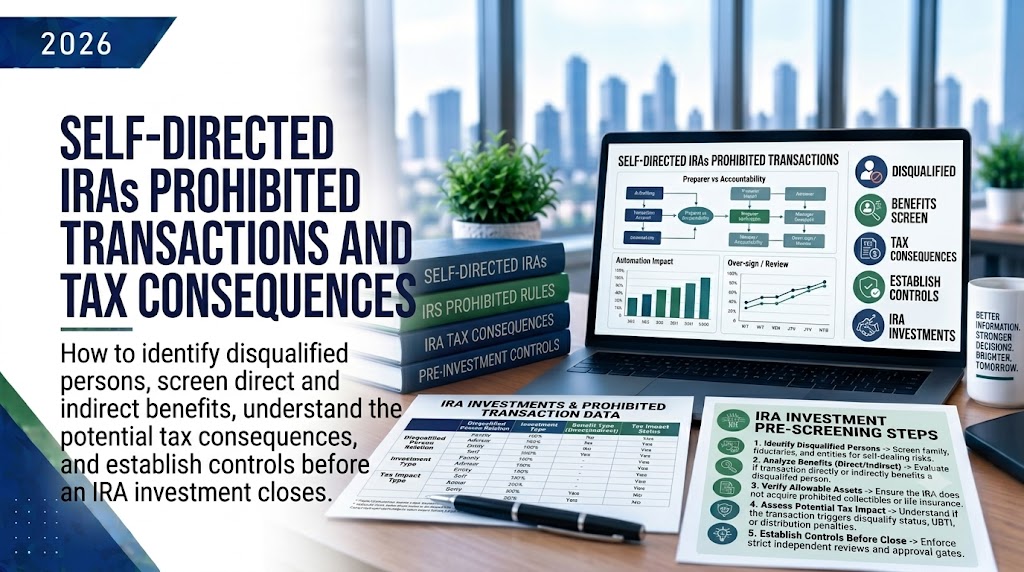
How to identify disqualified persons, screen direct and indirect benefits, understand the potential tax consequences, and establish controls before an IRA investment closes.
A self-directed IRA can hold many alternative assets, but the owner cannot use the account to transact with or benefit a disqualified person. If the owner or beneficiary engages in a prohibited transaction, the entire account may stop being an IRA as of January 1 of that year and be treated as distributed at fair market value. Review the parties, money flows, services, guarantees, and personal benefits before signing—not after the transaction closes.
1. Definition
A self-directed IRA is an IRA whose custodian permits the owner to direct investments beyond conventional publicly traded securities. Depending on the custodian and account documents, investments may include real estate, private-company interests, promissory notes, or other alternative assets. The term describes how the account is invested; it does not create an exception from the IRA rules.
A prohibited transaction is an improper direct or indirect transaction between the IRA and a disqualified person. The rules generally cover sales, exchanges, leases, loans, extensions of credit, furnishing goods or services, transfers or use of IRA assets, fiduciary self-dealing, and certain fiduciary payments.
Disqualified persons can include the IRA owner or beneficiary; fiduciaries or paid advisers; certain service providers; spouse, ancestors, lineal descendants, and spouses of lineal descendants; and certain entities owned 50% or more by disqualified persons. Officers, directors, highly compensated employees, and significant owners of related entities may also require analysis.
2. Why It Matters
The consequence can extend far beyond the transaction itself. If the owner or beneficiary engages in a prohibited transaction during the year, IRS guidance states that the account generally stops being an IRA on the first day of that year. The account is treated as distributing all assets at fair market value on that date. Taxable income may result, and the 10% additional tax on an early distribution may apply when the owner is under age 59½ and no exception is available.
If another disqualified person participates, the initial Section 4975 excise tax is generally 15% of the amount involved for each year or part of a year in the taxable period. If not timely corrected, an additional 100% tax may apply. Form 5330 is used to report the excise tax, and an ongoing use of money or property may create a new prohibited transaction in a succeeding year.
3. How It Works
Step 1: Map Every Party Before Reviewing the Asset
Begin with the IRA owner, beneficiaries, family members, fiduciaries, advisers, service providers, counterparties, lenders, tenants, and every related entity. Trace direct and indirect ownership rather than relying only on legal names. The relevant family definition does not automatically include every relative, but another ownership, fiduciary, or service relationship can still make a person disqualified.
Step 2: Identify What the IRA Gives and Receives
Review the full transaction, not only the investment agreement. Ask who contributes cash or property, receives fees or compensation, provides labor, occupies or uses the asset, guarantees debt, or receives another benefit because of the IRA investment. Fair market value does not make a transaction permissible when the counterparty or beneficiary is disqualified.
| Risk Area | Common Example | Why It Requires Review |
|---|---|---|
| Sale or lease | Owner sells property to the IRA or a family member rents IRA real estate | Transaction or use involves a disqualified person |
| Credit support | Owner guarantees a loan to an IRA-owned business | May be an indirect extension of credit |
| Services | Owner repairs or personally manages IRA property | May constitute furnishing services or self-dealing |
| Personal benefit | Owner or family uses IRA-owned property | IRA assets may be used for a disqualified person |
| Compensation | Owner receives salary or fees from an IRA-funded business | Funds may flow back to the fiduciary or owner |
Step 3: Separate Prohibited Transactions From Other IRA Restrictions
A prohibited transaction concerns the parties and benefits involved. A prohibited investment concerns the asset itself. IRAs generally may not invest in life insurance or collectibles, subject to limited exceptions for certain coins and bullion. UBTI, valuation, contribution, distribution, and custodian requirements are separate issues. Passing one test does not satisfy the others.
Step 4: Analyze Direct and Indirect Benefits
No cash needs to leave the IRA for a violation to occur. A personal guarantee, pledge, below-market arrangement, unpaid services, use of property, or payment of an IRA expense with personal funds can change the analysis. The owner should not treat the IRA as an extension of a personal business or use personal resources to improve an IRA asset without advice.
Step 5: Determine the Consequence and Reporting Path
First determine who participated: the owner or beneficiary, or another disqualified person. Then identify the transaction date, fair market value, basis, amount involved, duration, and whether the arrangement continued into another year. Loss of IRA status, early-distribution tax, Section 4975 excise taxes, Form 5329, Form 5330, amended returns, and information reporting may require separate analyses.
Step 6: Address a Suspected Violation Immediately
Do not assume reversing the transaction automatically restores the IRA. Correction for Section 4975 generally means undoing the transaction to the extent possible without leaving the plan worse off. The owner/beneficiary account-disqualification rule is different and can apply from January 1. Preserve documents, stop further activity, obtain a valuation when needed, and seek specialized tax and benefits counsel promptly.
4. Simple Example
An IRA purchases stock in a newly formed company. The company also issues a $150,000 note to the seller, and the IRA owner personally guarantees repayment. The guarantee may be treated as an indirect extension of credit involving the owner and the IRA investment—even though no IRA money is paid to the owner.
If the guarantee is a prohibited transaction involving the owner, the consequence is not limited to the $150,000 note. The IRA may be treated as having ceased to be an IRA as of January 1, with all IRA assets deemed distributed at January 1 fair market value. Income tax and a possible early-distribution tax must then be evaluated. The example reflects the same core risk illustrated by Thiessen: indirect credit support can be sufficient.
5. Common Mistakes and FAQs
Common Mistakes
- Assuming fair price or custodian processing makes the transaction safe.
- Reviewing only the named buyer and seller without tracing family relationships and entity ownership.
- Personally guaranteeing debt, pledging IRA assets, or paying IRA expenses personally.
- Providing repairs, management, professional services, or other sweat equity to an IRA investment.
- Allowing owner/family use or compensation such as salary, rent, fees, or another indirect benefit.
- Waiting until return preparation to identify the problem after the investment and related cash flows are complete.
Does Custodian Approval Make the Transaction Safe?
No. A self-directed IRA custodian generally administers the account and processes owner-directed transactions. Processing documents does not necessarily mean the custodian has determined compliance with Sections 408 and 4975. The owner remains responsible for obtaining appropriate tax and legal review.
Can the IRA Invest in a Business the Owner Controls?
The analysis is highly fact-specific and carries substantial risk. Review ownership percentages, parties involved, services, compensation, guarantees, existing relationships, and the flow of economic benefits. A structure should not be approved based only on the investment asset or ownership percentage.
6. Practical Checklist and What Comes Next
| Owner | Required Action | Evidence or Output |
|---|---|---|
| IRA owner or investment sponsor | List all parties, family relationships, ownership interests, services, guarantees, and expected benefits. | Relationship map and transaction summary |
| Legal or transaction lead | Provide agreements, financing terms, property-use rights, compensation terms, and closing documents. | Complete transaction file |
| Custodian or administrator | Confirm permitted account procedures and required custody documentation. | Account forms and processing requirements |
| Tax adviser | Apply Sections 408 and 4975, distinguish owner and third-party consequences, and identify reporting. | Written tax-risk analysis and filing plan |
| Accounting or property manager | Keep all investment income and expenses within the IRA and flag personal payments or use. | Cash-flow ledger and exception report |
| IRA owner and advisers | Reassess compensation, services, ownership, tenants, loans, and use at least annually. | Annual compliance review |
Complete the review before the IRA signs, funds, guarantees, leases, or uses the investment. The file should identify every party, value exchanged, services provided, financing support, personal benefits, approval conclusion, and responsible adviser. Revisit the analysis whenever ownership, compensation, financing, property use, or family participation changes.
How PNJ Can Help
PNJ Group can help map disqualified-person relationships, review money flows and benefits, coordinate transaction documents with legal advisers and custodians, assess existing holdings for reporting risk, and organize tax information if a potential violation is identified. Review should occur before closing because some consequences cannot be cured simply by reversing the transaction later.
Official References
- IRS Prohibited Transactions
- IRS Tax on Prohibited Transactions
- IRS Publication 590-B
- Form 5330 Instructions
- IRC Section 4975
Disclaimer
This article provides general educational information, not tax, accounting, legal, investment, or financial advice. Prohibited-transaction analysis is highly fact-specific and may involve federal tax, benefits, custody, valuation, and state-law issues. Consult qualified advisers before acting or filing.