Suggested: a tax adviser comparing a filed business return with corrected workpapers, red-pen marks and a calculator on the desk.
 –>
Tax Compliance Practice Guide | Intermediate
Amended Returns: When Should a Business File One?
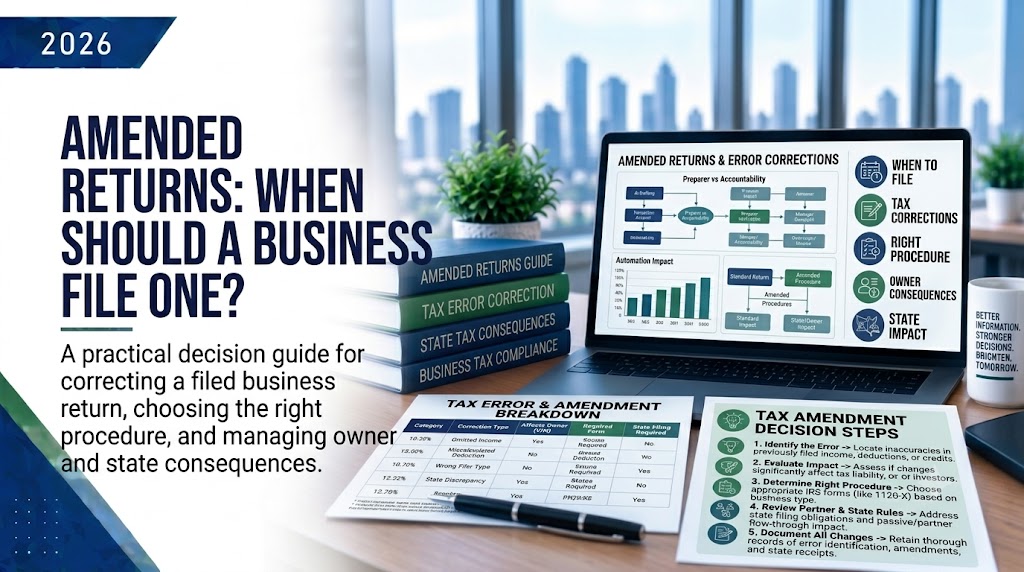
A practical decision guide for correcting a filed business return, choosing the right procedure, and managing owner and state consequences.
Do not amend automatically when the books change. First determine whether the filed return is actually wrong, whether the filing window is still open, which entity-specific procedure applies, and how the correction affects tax, owners, states, deadlines, and supporting records.
1. Definition
- Amended return. Corrects a return after the applicable filing period has closed.
- Superseding return. Filed after the original return but on or before the due date, including a valid extension, and generally replaces the earlier federal return. Elections and special rules may require separate review.
| Procedure | When Used | Practical Effect |
|---|---|---|
| Superseding return | The original or extended filing period is still open. | Replaces the earlier return for many federal purposes. |
| Amended return | The filing period has closed and a permitted correction is needed. | Changes a previously filed return through the form and procedure for that entity. |
| Notice response | The IRS asks for records or proposes a specific adjustment. | Addresses the notice directly; a separate amended return may be unnecessary or duplicative. |
Do not confuse a correction with an accounting-method change. A factual or mathematical error may be corrected through an amended or superseding return, while a method change may require Form 3115 and a Section 481(a) adjustment instead.
2. Why It Matters
A correction can affect more than one line, including taxable income, credits, carryforwards, depreciation, basis, owner allocations, state returns, interest, penalties, and refund claims. Using the wrong procedure can delay resolution or create inconsistent entity and owner records.
- Consider correction when. Income was omitted/overstated; a deduction or credit was missed or wrong; depreciation, basis, gain/loss, owner allocation, or required information was incorrect.
- An amendment may not be needed when. The IRS corrects a simple math error, requests a missing schedule, or the change is only a bookkeeping reclassification with no tax or information-reporting effect.
Dollar amount is not the only factor. A small error may still require correction if it affects a required disclosure, owner statement, election, or information return.
3. How It Works
Step 1 — Identify What Changed
Document the original treatment, corrected treatment, reason for the change, and affected tax year. Confirm the new information belongs to that filed year; do not move a future-period item backward simply because it was discovered later.
Step 2 — Decide Whether the Filed Return Is Incorrect
Reconcile the adjustment to the return and recompute every dependent item. A missed expense may change taxable income, credits, NOLs, estimated tax, state income, and owner basis. If the change affects only the GL, an amended return may not be appropriate.
Step 3 — Check the Filing Window and IRS Activity
If the original or extended due date is still open, evaluate a superseding return. If the period has closed, determine whether an amended-return procedure applies. If an IRS notice or examination is already open, coordinate the correction before filing separately.
Step 4 — Use the Entity-Specific Procedure
| Entity / Situation | Typical Federal Procedure | Related Action |
|---|---|---|
| C corporation | File Form 1120-X to correct a previously filed Form 1120. | Explain each change and attach supporting schedules. |
| S corporation | File an amended Form 1120-S and mark it as amended. | Issue amended K-1s and K-3s when shareholder information changes. |
| Non-BBA partnership | An amended Form 1065 or Form 1065-X may apply, depending on the facts and filing method. | Issue amended owner statements when required. |
| BBA partnership | Generally file an Administrative Adjustment Request rather than a traditional amended return. | Determine whether adjustments are pushed out or taken into account at partnership level. |
Never assume an “amended Form 1065” is correct. Confirm BBA status, centralized partnership audit rules, and whether the filing period is still open.
Step 5 — Recompute the Full Federal Effect
Start with the originally filed return and recompute the entire federal effect using corrected facts. Review income-linked deductions/credits, carryforwards, depreciation, estimated tax, elections, and statements affected by the change.
Step 6 — Evaluate Refund or Additional-Tax Timing
A federal refund claim is generally timely if filed within the later of 3 years from filing or 2 years from payment, subject to special rules. If the correction increases tax, file and pay promptly; interest generally runs from the original payment due date.
Step 7 — Coordinate Owners and States
For pass-through entities, identify affected owners and issue corrected statements when required. Review income, deductions, credits, basis, at-risk amounts, state-source information, and every affected state, because state procedures and deadlines may differ from federal rules.
4. Simple Example
A calendar-year C corporation files Form 1120 and later finds a $75,000 professional-fee invoice that was properly deductible in the filed year but omitted. Management should not simply reduce current-year expense. Review as follows:
- Confirm the tax year. Verify accounting method, service period, deductibility, and payment/accrual support.
- Check timing. If the extended filing period is open, consider a superseding Form 1120; if closed, Form 1120-X may be appropriate.
- Recompute the return. Update taxable income, related deductions/credits, carryforwards, and balance-sheet/book-to-tax schedules.
- Measure the result. Confirm the refund statute, prepare support, and review state filings separately.
The same facts may require a different procedure for an S corporation or partnership because owner statements and partnership audit rules may also apply.
5. Common Mistakes and FAQs
Common Mistakes
- Choosing the form first. Check filing window, entity type, and BBA status before selecting the procedure.
- Correcting only one line. Recompute related credits, limitations, carryforwards, and tax.
- Issuing an amended K-1 without context. Explain owner-level and state consequences.
- Using an amendment for a method change. Form 3115 or another procedure may be required.
- Missing deadlines. Check refund statutes and pay promptly when tax increases.
- Fixing the return but not the process. Address the accounting or review failure that caused the error.
Frequently Asked Questions
Does every post-filing journal entry require an amended return? No. Amend only if the entry changes a tax item, owner allocation, required disclosure, or information report for the filed year.
Will filing an amendment automatically trigger an audit? No automatic result should be assumed. The IRS may review the correction, so include a clear explanation and complete documentation.
What if the IRS has already sent a notice? Read and address the notice first. A direct response may be correct, and an uncoordinated amended return can create duplicate or conflicting processing.
6. Practical Checklist and What Comes Next
Owner Responsibilities
0 of 6 complete
Final Filing Review
0 of 5 complete
How PNJ Can Help
PNJ can help select the correction procedure, quantify federal and state effects, prepare supporting schedules, and coordinate corrected owner reporting.
Official References
- Amended and superseding corporate returns
- Form 1120-X instructions
- Form 1120-S instructions
- Amended partnership guidance
- Refund statute
- Form 3115
Disclaimer
General educational information only; not tax or legal advice. The correct procedure depends on the entity, year, filing date, elections, IRS activity, and specific facts. Consult a qualified adviser before filing or responding to a notice.