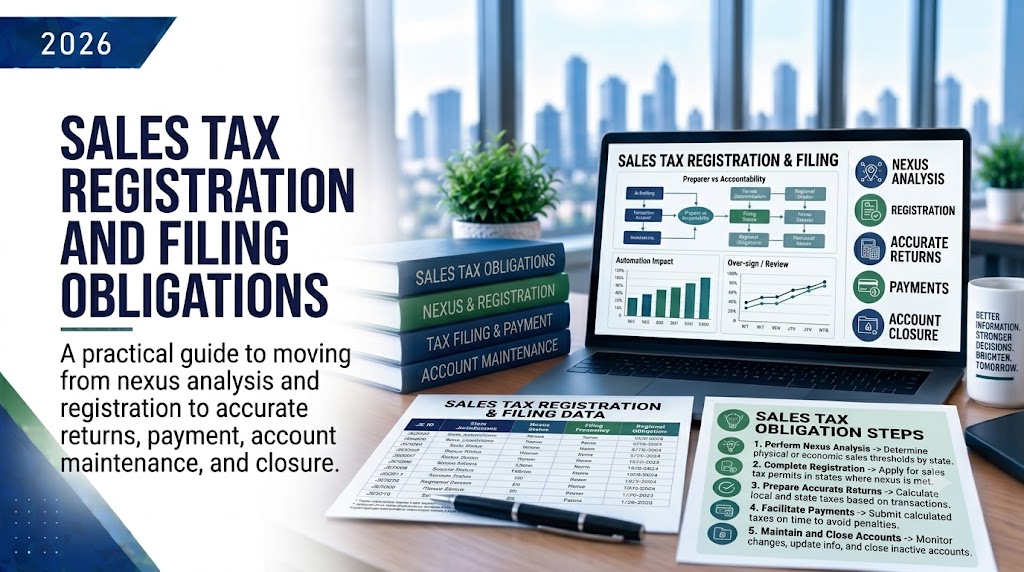
Suggested: an e-commerce finance manager reviewing a multistate filing calendar beside packed shipping boxes in a fulfillment office.
 –>
Tax Compliance Practice Guide | Intermediate
Sales Tax Registration and Filing Obligations
A practical guide to moving from nexus analysis and registration to accurate returns, payment, account maintenance, and closure.
Registration opens the sales-tax account; it does not complete compliance. Once active, the business must follow the assigned filing schedule, report required sales categories, remit tax when due, file zero/no-tax-due returns when required, and formally close the account when the obligation ends.
1. Definition
Sales-tax registration is obtaining a permit or account from a state or local tax authority. It generally gives the business authority—and creates the responsibility—to collect, report, and remit sales or use tax under that jurisdiction’s rules.
A filing obligation continues after registration. A return may report gross sales, taxable sales, exempt sales, marketplace sales, local detail, tax collected, credits, and tax due. A return may still be required even when no payment is due.
| Compliance Stage | Primary Question | Result |
|---|---|---|
| Registration | Where must the business open an account, and from what effective date? | Permit or account established. |
| Collection | Which direct sales are taxable, at what rate, and in which jurisdiction? | Tax calculated and charged to the customer. |
| Filing | What must be reported, how often, and through which state portal? | Return submitted for the assigned period. |
| Remittance | How much collected tax and other tax is payable? | Payment submitted by the deadline. |
| Closure | Has the state accepted the final return and account-cancellation request? | Future filing expectations ended. |
2. Why It Matters
- An active permit creates an ongoing compliance calendar. Monthly, quarterly, or annual returns may still be required even if sales decline, operations pause, or all sales move to a marketplace. Stopping filings can trigger notices, late-filing penalties, or estimated assessments.
- Registration does not answer every tax question. Nexus determines where an obligation may exist; taxability and sourcing determine what is taxable and where; marketplace rules determine who collects; and return instructions determine how transactions are reported.
No tax due does not mean no return due. Active permit holders may still be required to file zero or no-tax-due returns
3. How It Works
Step 1: Analyze Nexus and Taxability Before Registering
Review physical presence, remote-sales thresholds, employees, inventory, fulfillment, and other in-state activity. Then determine taxability, exemption/resale certificates, sourcing, thresholds, and lookback periods under each state’s rules.
Step 2: Confirm Marketplace and Direct-Sales Responsibilities
A marketplace facilitator may collect and remit tax, but that does not automatically eliminate seller obligations. Confirm whether the seller must still register, file, or report marketplace sales, and review direct website, invoice, or in-person sales separately.
Step 3: Register with the Correct Effective Date
Prepare the entity name, EIN, addresses, responsible-party information, business activity, products/services, estimated sales, sales channels, and nexus start date. Confirm state authorization before collecting tax. An incorrect effective date can create missing historical returns or unnecessary filing periods.
Step 4: Configure the Sales and Accounting Systems
Configure taxable products, exemptions, ship-to locations, marketplace channels, local jurisdictions, rates, and effective dates. Maintain separate tax collected and tax payable accounts, retain supporting certificates/reports, and test invoices before the first filing period closes.
Step 5: Track the Assigned Filing Calendar
Track the state-assigned filing frequency, due date, portal, account number, payment method, preparer, reviewer, and zero-return requirement. Monitor notices because the filing frequency may change.
Step 6: Reconcile Before Filing
Reconcile the return to the general ledger, e-commerce platform, payment processor, marketplaces, invoices, exemption records, and tax engine. Explain differences among gross sales, taxable sales, tax collected, tax payable, marketplace-remitted amounts, credits, and prior-period adjustments before filing.
Step 7: File, Pay, and Preserve Support
File every required return, including zero/no-tax-due returns when required, and remit tax through the approved method. Retain the filed return, confirmation, payment proof, reconciliation, exemption support, marketplace reports, and adjustment schedules.
Step 8: Close the Account Formally
When the obligation ends, file through the final period, pay the remaining balance, submit the final-return information, complete the state closure process, and retain written confirmation. Stopping sales or filings does not close the account.
Late Registration Requires a Separate Risk Review
If nexus began earlier, quantify uncollected tax, prior returns, interest, penalties, and customer-recovery options before registering retroactively. A Voluntary Disclosure Agreement (VDA) or similar program may be available. Evaluate eligibility before contacting the state or opening an account with an old effective date.
4. Simple Example
A remote seller files quarterly in State A and records $150,000 of marketplace sales and $25,000 of direct website sales. The marketplace remitted tax on marketplace sales; the seller collected tax on taxable direct sales.
- Registration. The active permit means the seller must follow the assigned quarterly filing requirement.
- Reporting. State instructions determine how marketplace sales are shown on the return.
- Payment. The seller generally remits tax collected on direct sales, not tax already remitted by the marketplace.
- Reconciliation. Gross sales, direct taxable sales, marketplace reports, tax collected, sales-tax payable, and the filed return should agree.
If the next quarter contains only marketplace sales, do not assume no return is required. Follow State A’s active-account and marketplace-reporting rules.
5. Common Mistakes and FAQs
Common Mistakes
- Registering too early. Confirm nexus, taxability, marketplace treatment, and effective date first.
- Assuming the permit satisfies filing. Registration and return filing are separate obligations.
- Missing zero returns or frequency changes. Monitor the state-assigned calendar and notices.
- Reporting net deposits. Reconcile gross sales and tax by channel.
- Assuming marketplace collection ends all obligations. Seller filing/reporting may still apply.
- Stopping returns without closure. File through the final period and formally close the account.
Frequently Asked Questions
Do we file if no tax is due? Often yes. If the account remains active, the state may still require a return.
Can a provider register and file for us? Yes, but responsibility must be clear. The business may remain responsible for interim returns and payments before the provider begins filing.
Does sales-tax registration create an income-tax filing obligation? Not automatically. Sales tax, income/franchise tax, payroll tax, and gross-receipts tax use different nexus and filing rules.
What if we registered too early? Follow the assigned filing schedule until the state changes or closes the account. Do not simply stop filing.
6. Practical Checklist and What Comes Next
Owner Responsibilities
0 of 6 complete
What Comes Next
0 of 5 complete
How PNJ Can Help
PNJ can evaluate registration requirements, build a multistate filing calendar, reconcile sales-tax accounts, address historical exposure, prepare returns, and close inactive accounts.
Official References
- Streamlined Sales Tax remote-seller guidance
- Marketplace-seller guidance
- Texas permit and filing FAQs
- New York filing requirements
- California marketplace guidance
Disclaimer
This article provides general educational information and is not tax or legal advice. Sales-tax rules vary by jurisdiction and can change. Review current rules and the business’s specific facts before registering, collecting, filing, paying, or closing an account.