Suggested: Small-business owner and bookkeeper comparing a tax return draft against receipts and bank statements at a desk.
 –>
Tax Compliance | Intermediate | U.S. Small Businesses
Common Tax-Return Red Flags for Small Businesses
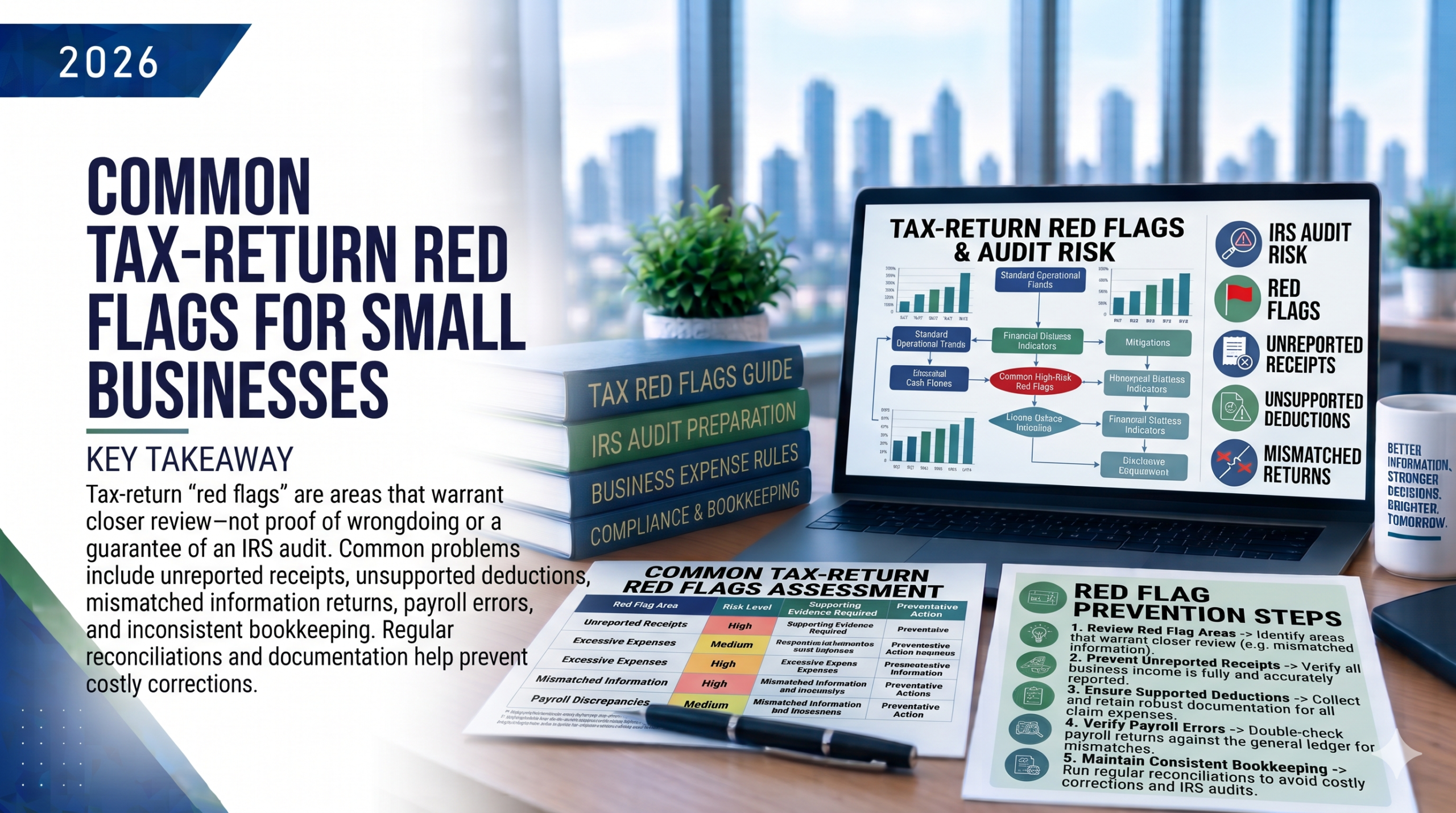
Tax-return “red flags” are areas that warrant closer review—not proof of wrongdoing or a guarantee of an IRS audit. Common problems include unreported receipts, unsupported deductions, mismatched information returns, payroll errors, and inconsistent bookkeeping. Regular reconciliations and documentation help prevent costly corrections.
1. Risk Statement: Who Is Exposed?
Small businesses can face federal tax reporting risks when their bookkeeping, payment-platform records, payroll reports, and filed returns do not agree. Sole proprietors, partnerships, S corporations, and C corporations can all be affected, although filing requirements differ. Cash-intensive businesses, online sellers, and companies using contractors or multiple payment processors may need particularly careful reconciliation.
2. Common Warning Signs and Red Flags
- Unreported or mismatched gross receipts. Sales in the return differ from bank deposits, POS reports, Forms 1099-K, or Forms 1099-NEC without a documented reconciliation.
- Unusually large or poorly supported expenses. Travel, meals, vehicle use, home-office, or other deductions lack receipts, business-purpose records, or required allocations.
- Personal and business spending mixed together. Owner purchases are recorded as business expenses or owner contributions and distributions are misclassified.
- Payroll and contractor inconsistencies. Forms W-2, 941, and 1099-NEC do not match the books, or worker classifications are not supported by the facts.
- Inventory or asset discrepancies. Cost of goods sold is unsupported by inventory records, or equipment purchases, depreciation, and disposals are reported inconsistently.
- Unexplained year-to-year changes. Margins, losses, officer compensation, or related-party balances change substantially without a business explanation.
An unusual amount does not, by itself, indicate an incorrect return. The concern is whether reporting is accurate and supported.
3. Root Causes and Underlying Tax Rules
- Incomplete income capture. Taxable business income generally must be reported even when no information return is issued. Form 1099-K shows gross payment transactions, which may include amounts that require reconciliation for refunds, fees, and nontaxable transfers.
- Insufficient substantiation. Business deductions generally must be ordinary and necessary, with additional limitations and documentation requirements for certain categories, such as meals, vehicles, and travel.
- Improper classification. Amounts paid for assets may require capitalization rather than immediate expense; employees and independent contractors have different employment-tax and reporting rules.
- Weak closing procedures. Missing reconciliations, duplicate transactions, incorrect cutoff, and unreconciled inventory or payroll balances can carry directly into tax returns.
4. Potential Tax, Financial, and Control Consequences
Depending on the underlying error, consequences may include additional tax, interest, applicable penalties, employment-tax exposure, delayed refunds, amended filings, and increased professional fees. Poor tax records can also obscure actual cash flow and profitability. An IRS inquiry is not automatic merely because a return contains an unusual figure.
5. Preventive Controls and Mitigation Measures
- Reconcile revenue monthly. Tie the general ledger to bank deposits, payment processors, sales platforms, and information returns; document timing and gross-to-net differences.
- Maintain supporting documentation. Retain invoices, receipts, contracts, mileage or usage logs, payroll records, and inventory reports according to applicable retention rules.
- Separate business and personal activity. Use dedicated accounts, define owner-transaction policies, and review related-party transactions.
- Review tax-sensitive balances before filing. Check fixed assets, depreciation, inventory/COGS, payroll, contractor payments, loans, and equity against tax schedules.
- Perform an independent return review. Compare the filed-return draft with financial statements, prior-year returns, source forms, and explanations of material variances.
6. What to Do If a Problem Is Discovered
- Identify and quantify the issue. Determine which tax years, entities, forms, and transactions are affected; preserve supporting records.
- Verify the correct treatment. Distinguish bookkeeping errors from tax-law differences and consider federal, state, and payroll implications.
- Correct the appropriate filing. Depending on the entity and issue, an amended return, corrected information return, payroll adjustment, or other procedure may be required. For example, individual taxpayers commonly use Form 1040-X; partnership corrections may involve special rules.
- Strengthen the process. Document the root cause, adjust reconciliations or approval controls, and assign an accountable reviewer for subsequent periods.
How PNJ Group Can Help
PNJ Group supports small businesses with bookkeeping cleanup, tax-ready reconciliations, payroll and 1099 reviews, financial reporting, and coordination of return corrections and compliance processes.
Official References
- IRS: “What to Do with Form 1099-K”
- IRS: “Recordkeeping”
- IRS: “Independent Contractor (Self-Employed) or Employee?”
- IRS: “Instructions for Schedule C”
- IRS: “Instructions for Form 1040-X”
Disclaimer
General educational information; requirements depend on the entity, tax year, jurisdiction, and facts. This article does not constitute individualized tax advice.