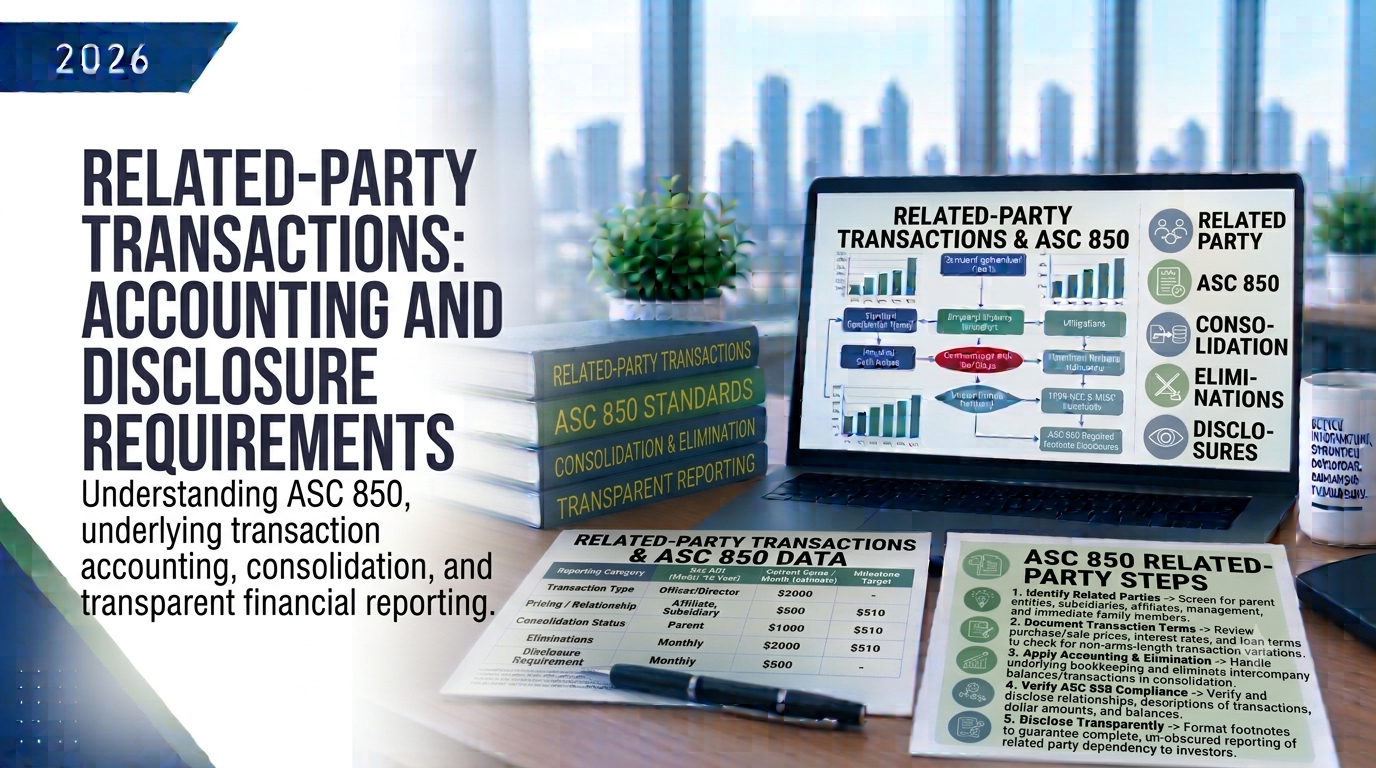
Suggested: Controller and CFO reviewing an intercompany reconciliation and a related-party register across a desk.
 –>
Accounting | Advanced | U.S. GAAP
Related-Party Transactions: Accounting and Disclosure Requirements
Understanding ASC 850, underlying transaction accounting, consolidation, and transparent financial reporting.
- Related-party transactions are not prohibited, but their terms may differ from transactions with independent third parties.
- ASC 850 principally governs disclosures; recognition and measurement follow the guidance relevant to the actual loan, lease, sale, guarantee, or transfer.
- Separate-company and consolidated statements differ: intercompany balances and unrealized profits are generally eliminated in consolidation, while transactions with unconsolidated related parties may remain.
- Documentation and transparency matter: identify the relationship, support the transaction, reconcile balances, and avoid unsupported claims of arm’s-length pricing.
1. Scope and Key Issues
Related-party arrangements arise when a company transacts with owners, executives, affiliates, or entities under common control. Common examples include shareholder loans, management fees, shared-service charges, leases, inventory sales, guarantees, and capital transfers. These arrangements may be commercially reasonable, yet their pricing and settlement terms may reflect influence rather than independent negotiation.
Under ASC 850, Related Party Disclosures, relationships can extend beyond direct ownership to principal owners and their immediate families, management and immediate families, affiliates, and parties able to exercise significant influence. An ownership chart is a useful starting point, but management must also understand control, family relationships, and informal financial support.
For financial statement users, two questions are essential: Was the transaction recognized and measured correctly? And does the relationship or transaction require disclosure?
2. Applicable Rules and Requirements
ASC 850 supplies the disclosure framework, not a universal pricing or measurement rule. The company applies the appropriate accounting Topic to each underlying arrangement and then assesses related-party disclosure requirements. The same transaction may also require tax review, but tax treatment and GAAP presentation are separate analyses.
| Transaction | Primary accounting guidance | Key consideration |
|---|---|---|
| Shareholder or affiliate loan | ASC 310 / ASC 470; credit-loss guidance as applicable | Substance, interest, repayment and collectibility |
| Related-party lease | ASC 842 | Lease terms and common-control considerations |
| Intercompany revenue or purchases | ASC 606; inventory and consolidation guidance | Recognition and consolidation eliminations |
| Guarantee | ASC 460 | Recognition and exposure disclosures |
| Common-control business transfer | ASC 805-50 | Generally carryover-basis treatment |
For certain private-company and eligible nonprofit common-control leases, ASU 2023-01 permits an arrangement-by-arrangement practical expedient based on written terms and conditions. Whether the expedient is available must be assessed rather than assumed.
3. Accounting Treatment by Transaction Type
Loans and owner funding
A loan recorded as Due from Shareholder or Due to Affiliate should be supported by its legal and economic substance: principal, interest, maturity, repayment expectations, and payment history. A transfer described as a loan may instead be a distribution, capital contribution, or compensation depending on the facts. Related-party receivables also require appropriate collectibility and credit-loss analysis.
Management fees and intercompany sales
Shared accounting, management, technology, or administrative services should have a clear allocation method tied to services performed and a supportable basis for charges. In each entity’s separate records, income and expense may be recognized. In consolidated statements, reciprocal revenue, expense, receivable and payable balances are generally eliminated. Unrealized profit in inventory or internally transferred fixed assets may also require elimination and subsequent adjustments.
Leases, guarantees, and common-control transfers
Related-party leases are evaluated under ASC 842. Guarantees are analyzed under ASC 460 for possible recognition and disclosure, even when no cash is paid immediately. Transfers of businesses or net assets under common control generally follow ASC 805-50, often using carryover amounts rather than acquisition-date fair values. The specific transaction and reporting entity determine the result.
4. Exceptions, Limitations, and Special Considerations
Separate versus consolidated reporting. A company’s separate financial statements may present related-party balances that disappear upon consolidation. ASC 850 generally does not require disclosure of transactions eliminated in consolidated or combined statements; transactions with unconsolidated related parties, however, can still require disclosure.
Arm’s-length assertions. A signed agreement does not establish that pricing matches independent-market terms. ASC 850 cautions that statements describing transactions as equivalent to arm’s-length arrangements should be made only when substantiated. Even zero-priced services or other transactions assigned no amount may be relevant to disclosure.
Book versus tax treatment. Cross-border management fees, royalties and financing may require separate IRC §482 transfer-pricing review; §267 can affect the timing or deductibility of certain related-party items. Tax workpapers do not replace GAAP recognition or ASC 850 disclosure analysis.
5. Practical Example and Financial Statement Disclosure
Assume Company A receives accounting and management services from an affiliated Company B. During the year, Company B invoices $120,000, of which $25,000 remains unpaid at year-end. Assume the services are valid operating costs, and the two companies issue separate financial statements.
| Separate-company accounting | Debit | Credit |
|---|---|---|
| Company A: management expense / payable | $120,000 management expense | $120,000 payable to affiliate |
| Company B: receivable / service revenue | $120,000 receivable from affiliate | $120,000 service revenue |
If the entities are consolidated, the $120,000 intercompany revenue and expense and the $25,000 reciprocal balance are generally eliminated. If not consolidated, the relevant balances and activity remain in their respective financial statements, subject to applicable presentation and disclosure requirements.
“The Company purchased management and administrative services from an affiliated entity under a shared-services arrangement. Charges totaled $120,000 during the year. At year-end, $25,000 was payable to the affiliate. Amounts are settled under the arrangement’s agreed payment terms.” Actual disclosures should reflect material terms and circumstances.
6. Reporting, Documentation, and Key Considerations
When material, ASC 850 disclosure generally describes the relationship, nature and amounts of transactions for each period presented, outstanding balances, and settlement terms when not otherwise apparent. Material changes in the method of setting terms should also be considered. Some common-control relationships may require disclosure even without transactions if they could significantly affect the entity’s financial position or results.
A strong close process combines a related-party register with agreements, dedicated due-to/due-from accounts, monthly reciprocal reconciliations, consolidation entries, and an annual disclosure review. Reviewers should challenge unsubstantiated balances, missing loan terms, unusual charges, unreconciled intercompany activity, and unsupported claims about market-equivalent pricing.
How PNJ Group Can Help
PNJ Group helps businesses identify and document related-party arrangements, reconcile intercompany accounts, prepare consolidation adjustments, evaluate accounting classifications, and develop clear financial statement disclosures. Effective related-party reporting connects contractual substance, accounting records, and disclosure—not just year-end journal entries.
Technical References
- FASB ASC 850 (Related Party Disclosures);
- ASC 842 (Leases);
- ASC 460 (Guarantees);
- ASC 805-50 (Common Control Transactions);
- ASC 310 / 470 (Receivables and Debt);
- FASB ASU 2023-01 (Common Control Arrangements).
Disclaimer
This article provides general U.S. GAAP information, not entity-specific accounting, tax, audit, or legal advice.