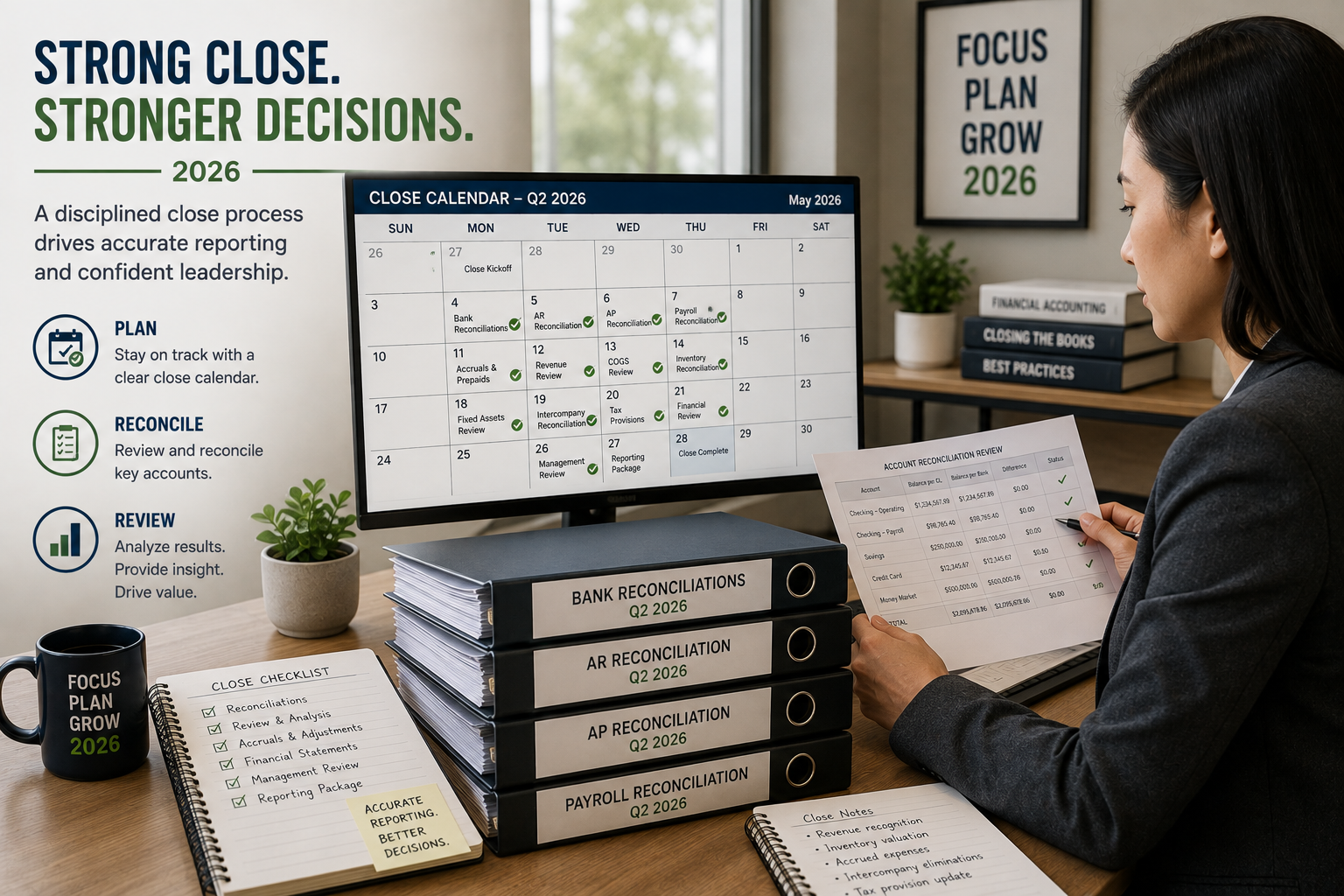
Suggested: controller reviewing a close calendar and reconciliation binders at a desk.
 –>
–>
Accounting Intermediate Practical Guide
A Practical Month-End Closing Checklist
A repeatable process for accurate, timely and decision-ready financial reporting
A strong month-end close turns daily transactions into reliable, decision-ready financial information.
It should confirm that key balances, accruals and estimates are complete, supported and recorded in the correct period—with clear review and approval.
A strong close balances timeliness, accuracy and review. Every material balance should be supported, significant judgments documented, and unresolved items assigned an owner and resolution date.
Designed for growing businesses using accrual-based reporting. Procedures, materiality and timing should reflect the company’s size, systems, industry and reporting needs.
What a Strong Close Should Accomplish
- Capture all material activity and record it in the correct accounting period.
- Reconcile significant balance-sheet accounts to reliable independent support.
- Document accruals, estimates and judgmental entries.
- Identify unusual balances and business trends before reports reach management.
- Create a review trail showing who prepared, reviewed and approved key work.
- Define materiality and escalation rules so the team knows what must be corrected before close and who approves judgmental items.
Start With a Close Calendar
Set the target close date, owners, reviewers and escalation points. Whether the close takes five, seven or ten business days, consistency and accountability matter most.
1. Complete the Period and Confirm Cutoff
Capture all activity that belongs in the month—even when the invoice, payment or system feed arrives later.
- Confirm sales, credits, refunds, deferred and unbilled revenue are recorded in the correct period.
- Accrue material goods or services received before cutoff when vendor invoices arrive after month-end.
- Record payroll-related accruals when the service period crosses month-end.
- Obtain missing support for expense reports, corporate cards and recurring invoices.
2. Reconcile Cash and Operating Subledgers
Tie the general ledger to independent support and resolve material differences. Old reconciling items should not simply roll forward.
- Reconcile all material bank and credit-card accounts and investigate outstanding or unidentified items.
- Reconcile AR and AP subledgers to the general ledger.
- Review post-close receipts and overdue receivables.
- Reconcile payroll expense and liabilities to payroll-provider reports—not only bank cash activity.
3. Support the Balance Sheet
Every material balance-sheet account should tie to reliable support. Review:
- Fixed assets: additions, disposals, depreciation and placed-in-service dates;
- Prepaids and deferred costs: balances and amortization schedules;
- Debt: loans, interest, notes payable and covenant-related balances;
- Inventory / WIP: where applicable; and
- Intercompany and related-party balances: confirm both entities agree.
Negative asset balances, old reconciling items, unsupported clearing accounts and unexplained related-party differences should be investigated before reports are released—not carried forward indefinitely.
4. Record and Review Close Entries
Separate routine entries from judgmental entries. Estimates and unusual entries require stronger support and review.
- Update key close entries: accruals, prepaids, depreciation, deferred revenue and allowances.
- Confirm accrual reversals and replacement invoices or entries.
- Attach support to material manual journal entries and document purpose, calculation and period.
- Require review for sensitive or above-threshold entries such as cash, revenue, retained earnings or reserves.
5. Perform Analytical Review
A balanced reconciliation is not enough. The Controller or reviewer should assess whether the financial statements make sense as a whole.
- Compare results with prior month, prior year and budget or forecast.
- Review key ratios including gross margin, payroll and operating expenses.
- Investigate large or unusual movements and unexpected balances.
- Review liquidity and working capital including overdue receivables and upcoming obligations.
Variance analysis can uncover errors that reconciliations miss, including duplicates, misclassifications and wrong-period postings.
6. Finalize Reporting and Protect the Period
- Prepare the final reporting package including income statement, balance sheet and cash flow or management reports.
- Explain significant variances and unresolved issues.
- Obtain Controller or management approval before distribution.
- Assign every open item an owner and target date and protect the closed period.
Management reporting should explain what changed, why it changed and whether action is required.
Common Close Mistakes
- Starting only after month-end. Prepare schedules and resolve missing support throughout the month.
- Waiting for every invoice. Use reasonable, documented accruals for material expenses.
- Treating reconciliation as mechanical. Investigate aging, unusual and recurring reconciling items.
- Distributing reports before review. Complete analytical review and approval before release.
- Depending on one employee. Document procedures, templates, owners and backup responsibilities.
How to Improve the Next Close
After close, review late inputs, recurring corrections and tasks that can move earlier or be automated. A faster close usually comes from standardization and earlier work—not less review.
How PNJ Can Help
PNJ can help design close calendars, standardize reconciliations and journal entries, strengthen Controller review, and build management reports that explain results and risks.
Disclaimer
This article is for general informational purposes only and does not constitute accounting, tax or legal advice. Close procedures, estimates, approvals and reporting requirements depend on the company’s facts, reporting framework and stakeholder obligations. Consult qualified advisers regarding your specific circumstances.