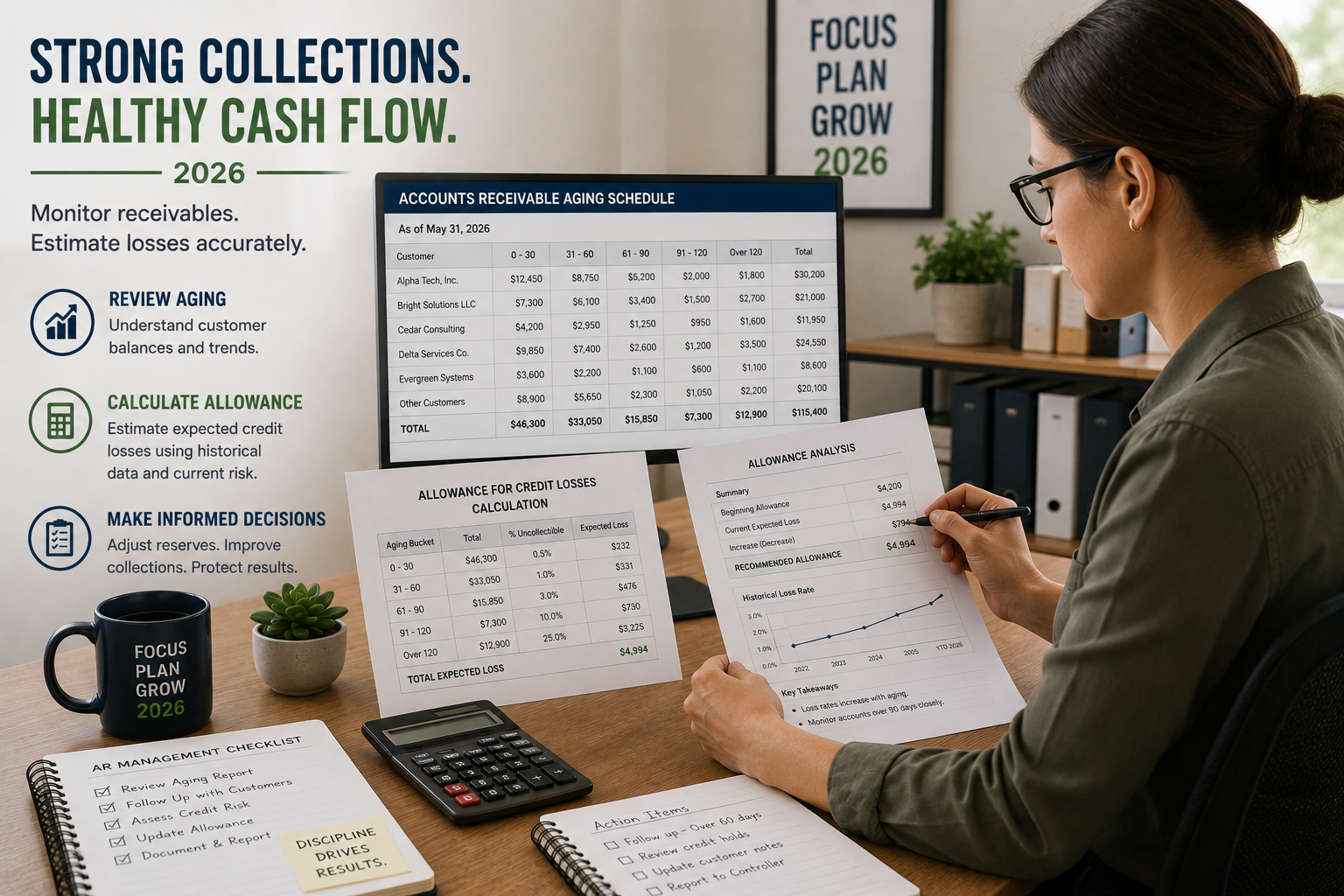
Suggested: accounting manager reviewing an AR aging schedule and allowance calculation.
 –>
–>
Accounting Intermediate Practical Guide
Accounts Receivable and the Allowance for Doubtful Accounts
How to estimate expected credit losses, record write-offs and improve collection reporting
Credit sales do not always become cash. Accounts receivable should reflect what the business expects to collect—not simply what customers were billed.
The allowance for credit losses uses aging, collection history and current customer risk to estimate expected losses and improve cash-flow and collection decisions.
Report receivables at net realizable value: gross receivables less the allowance for expected credit losses. An allowance estimates portfolio losses; a write-off removes a specific uncollectible balance.
This guide covers ordinary trade receivables under U.S. GAAP. ASC 326 uses the broader term “allowance for credit losses.”
What the Two Balances Represent
Accounts receivable is the gross amount customers owe. The allowance for credit losses is a contra-asset that reduces receivables to the amount expected to be collected.
Gross A/R − Allowance for Credit Losses = Net A/R
The allowance does not predict exactly who will default. It estimates expected losses by risk group and separately considers unusual or high-risk balances.
The U.S. GAAP Expected-Credit-Loss Model
ASC 326 requires expected credit losses to be estimated using information available at the reporting date. For short-term trade receivables, an aging schedule is often practical, but no single method is required.
Start with historical loss experience and adjust for:
- Receivable age and recent collection patterns.
- Customer-specific risk: disputes, financial stress or bankruptcy.
- Changes in credit terms, customer mix or concentrations.
- Current economic and industry conditions.
- Reasonable, supportable forecasts affecting collection risk.
ASU 2025-05 is effective for fiscal years beginning after December 15, 2025. Eligible entities may elect a practical expedient for certain current receivables and contract assets. Document the election, scope and disclosures.
Practical Aging Example
Assume $500,000 of trade receivables at month-end. Management applies loss rates by aging category based on experience and current facts:
| Aging Category | Receivable Balance | Expected Loss Rate | Expected Loss |
|---|---|---|---|
| Current | $300,000 | 0.5% | $1,500 |
| 1–30 days past due | $100,000 | 2.0% | $2,000 |
| 31–60 days past due | $50,000 | 5.0% | $2,500 |
| 61–90 days past due | $25,000 | 20.0% | $5,000 |
| More than 90 days past due | $25,000 | 60.0% | $15,000 |
| Total | $500,000 | — | $26,000 |
Required ending allowance: $26,000. Net A/R: $474,000. The adjusting entry depends on the existing allowance balance.
Record the Period-End Adjustment
If the allowance already has an $8,000 credit balance, record only the additional $18,000 needed to reach $26,000.
| Account | Debit | Credit |
|---|---|---|
| Credit-loss expense | $18,000 | — |
| Allowance for credit losses | — | $18,000 |
Common error: expensing the full required allowance each period. Instead, adjust the existing allowance for write-offs, recoveries and prior entries.
Allowance, Write-Off and Recovery
| Event | Typical Entry | Financial-Statement Effect |
|---|---|---|
| Estimate or update allowance | Debit credit-loss expense; credit allowance | Changes expense and net receivables. |
| Write off a specific $6,000 account | Debit allowance; credit accounts receivable | Reduces gross receivables and the allowance equally; ordinarily no new expense if fully reserved. |
| Recover a previously written-off account | Reinstate receivable and allowance; then record cash collection | Restores the account before recording cash; exact presentation follows the entity’s policy. |
Support write-offs with collection history, customer correspondence, legal status and approval. A write-off does not necessarily end collection efforts or waive a legal claim.
How Management Should Use the Analysis
At each close, connect the allowance analysis to collections and operating decisions. Review:
- A/R roll-forward: billings, collections, credits, write-offs and ending balance.
- DSO and past-due trends.
- Large customer concentrations and unusual payment patterns.
- Disputes, unapplied cash and billing errors.
- Credit holds and payment plans.
- Actual write-offs vs. prior estimates.
A rising allowance may signal credit deterioration—or internal issues such as late billing, weak follow-up or unclear terms. Separate true credit risk from process problems.
Book Accounting and Federal Tax Are Different
Book and tax treatment differ. A GAAP allowance estimates expected losses, but a general reserve is generally not deductible for federal tax. A tax bad-debt deduction generally requires a bona fide debt that becomes partly or wholly worthless.
Accrual-method business: an uncollectible receivable may be deductible if the amount was previously included in taxable income. Cash-method business: an unpaid amount never included in income generally produces no bad-debt deduction.
Keep the invoice, contract, aging history, collection notes, correspondence and write-off approval. Book write-off and tax deduction may occur in different periods.
Common Mistakes to Avoid
- Unsupported flat percentage. Tie rates to loss history and current facts.
- Ignoring specific customer risk. Bankruptcy, disputes or severe stress may require separate review.
- Aging does not reconcile to the ledger. The estimate is only as reliable as the underlying data.
- Treating age as proof of uncollectibility. Consider collections, payment plans and disputes.
- Confusing book allowance with a tax deduction. GAAP recognition does not automatically establish tax worthlessness.
Month-End Review Checklist
Work through these items when closing accounts receivable each month.
0 of 5 complete
How PNJ Can Help
PNJ can help businesses reconcile receivables, build aging and collection reports, document allowance methodology, prepare period-end entries and coordinate book-to-tax analysis.
Authoritative References
- FASB ASU 2016-13
- FASB ASU 2025-05
- IRS Topic 453
- IRS Publication 334
Disclaimer
This article is for general informational purposes only and does not constitute accounting, tax or legal advice. The appropriate allowance method, journal entries, disclosures and tax treatment depend on the entity’s facts, reporting framework, elections and applicable law. Consult qualified advisers before applying this guidance.