Suggested: accountant reviewing an accounts-receivable aging report with an overdue invoice flagged on a desk.
 –>
–>
Tax Practice Guide
Bad Debt Deductions for Businesses
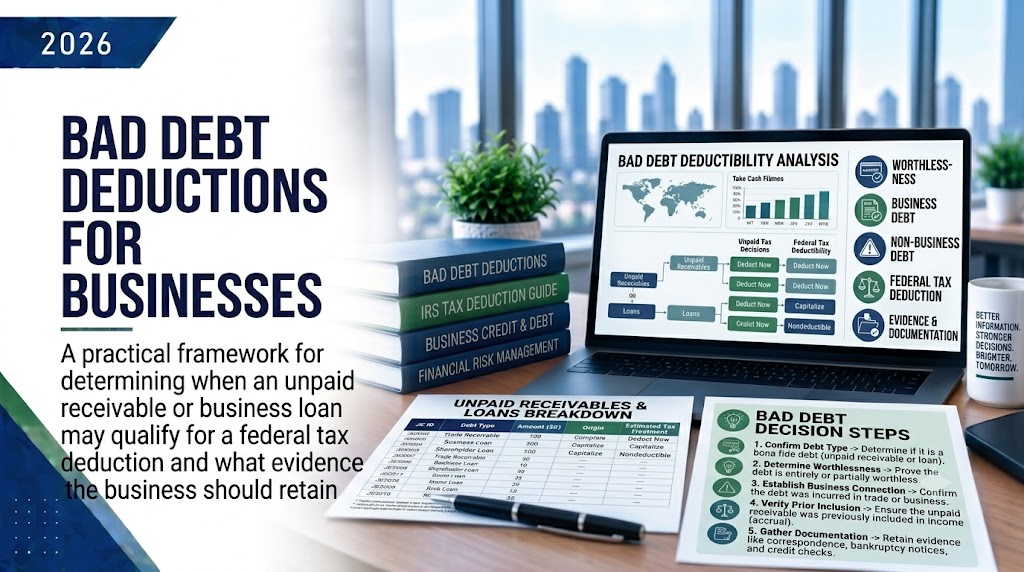
A practical framework for determining when an unpaid receivable or business loan may qualify for a federal tax deduction and what evidence the business should retain.
An overdue balance is not automatically deductible. A business must establish a bona fide debt, show tax basis, connect it to the trade or business, support when it became partly or totally worthless, and apply the correct charge-off rule. The strongest file links the agreement or invoice, prior income inclusion or funding, collection history, accounting entry, and tax treatment.
1. Definition
A business bad debt is a bona fide debt created or acquired in—or closely related to—the taxpayer’s trade or business when it becomes worthless. Common examples include customer credit sales, business loans, notes receivable, and qualifying guarantee payments.
A bona fide debt requires an enforceable obligation to repay a fixed or determinable amount. Gifts, capital contributions, informal owner withdrawals, or advances without a realistic repayment expectation may not qualify. Facts—not the GL label—control.
2. Why It Matters
- Book vs. tax timing: Financial statements may record an allowance before a specific debt is written off. For tax, most businesses use the specific-charge-off method; a general allowance increase is not automatically deductible.
- Accounting method matters: An accrual-method business may have basis because revenue was already taxed; a cash-method service business generally has no deduction for an unpaid fee never included in income. A funded loan may have basis even though it did not arise from revenue.
| Situation | Likely Federal Tax Direction | Key Support |
|---|---|---|
| Accrual-method credit sale | Potential deduction when the receivable becomes partly or totally worthless | Prior income inclusion and evidence of worthlessness |
| Cash-method service invoice | Usually no separate deduction if the fee was never included in income | Accounting method and income history |
| Funded business loan | Potential deduction if bona fide, business-related, and worthless | Note, funding, payments, and collection file |
3. How It Works
Step 1: Confirm the Debt and Tax Basis
Start with the transaction—not the age of the balance. Retain the invoice or note, funding record, repayment terms, and proof of prior income inclusion or cash advanced. For related parties, also document interest, maturity, enforcement rights, actual payments, and a realistic repayment expectation.
Step 2: Determine Whether It Is a Business Debt
The debt must arise from or be closely related to the taxpayer’s trade or business. Customer receivables usually qualify; loans to suppliers, distributors, or employees need a genuine business purpose. Debt held by an individual owner may instead be a nonbusiness debt subject to different rules.
Step 3: Support Worthlessness in the Correct Year
Worthlessness depends on facts and circumstances. Evidence may include bankruptcy, business closure, failed collection efforts, inadequate collateral, or a documented settlement. A lawsuit is generally unnecessary if a judgment would be uncollectible, but age alone is not enough.
Claim the deduction in the year worthlessness is established. Document the event—or combination of events—that changed the collection conclusion during that year.
Step 4: Distinguish Partial From Total Worthlessness
| Issue | Partly Worthless | Totally Worthless |
|---|---|---|
| Expected recovery | Some amount remains reasonably collectible | No meaningful recovery is expected |
| Tax charge-off | Deduction is generally limited to the amount charged off on the books during the year | An actual book charge-off is not strictly required, but is a strong control and avoids uncertainty |
| Timing | Deduct the supported charged-off portion; the remainder stays open | Deduct in the year total worthlessness is established |
For partial worthlessness, remove the specific uncollectible amount from the receivable or a specific valuation account—not merely a general reserve. The workpaper should identify the debtor, amount, approval date, and supporting evidence.
Step 5: Reconcile Book and Tax Treatment
Reconcile book and tax treatment. With an allowance, a specific write-off commonly debits the allowance and credits AR; without one, it may debit bad-debt expense. Because book expense may have been recognized earlier, reconcile allowance activity, write-offs, recoveries, and the tax-deductible amount.
Step 6: Track Guarantees, Settlements, and Recoveries
A business guarantee requires a legal payment obligation and business purpose. If payment creates a reimbursement claim, that right generally must become worthless. A sale or settlement of a receivable may require a separate gain-or-loss analysis.
Keep written-off accounts in a recovery log. A later collection is generally income to the extent the earlier deduction produced a tax benefit. Preserve the customer history and reconcile the recovery separately.
4. Simple Example
An accrual-method consulting company previously included a $40,000 customer invoice in taxable income. In 2026, after documented collection efforts and settlement analysis, management expects to recover only $10,000 and charges off $30,000 before year-end.
| Calculation | Amount | Tax Treatment |
|---|---|---|
| Customer receivable | $40,000 | Previously included in taxable income |
| Expected recovery | $10,000 | Remains as a receivable |
| Supported charge-off | $30,000 | Potential 2026 business bad-debt deduction |
The company may debit the allowance and credit AR for $30,000. The tax file should connect the aging, invoice, prior income, collection record, approval, entry, and book-to-tax reconciliation. The remaining $10,000 stays open for later evaluation; future collections of a deducted amount are subject to the recovery rule.
5. Common Mistakes and FAQs
Common Mistakes
- Cash-method unpaid fee: No deduction if the fee was never included in taxable income.
- General allowance or aging bucket: Does not by itself prove tax worthlessness.
- Partial deduction without charge-off: The specific amount generally must be charged off during the tax year.
- Related-party “loan” without commercial terms: Weak terms or repayment conduct may undermine debt treatment.
- Using only the write-off date: Document when and why the debt became worthless.
- Ignoring recoveries: Keep the receivable history and track later collections separately.
Can a Business Deduct Only Part of a Debt?
Potentially, yes. Support the partly worthless amount and charge off that specific amount during the tax year. A partial charge-off may be deferred, but not beyond the year the debt becomes totally worthless.
Is a Shareholder Loan Automatically Deductible When Unpaid?
No. First establish that a bona fide debt existed. Weak documentation, no repayment activity, subordinated terms, or advances resembling capital may cause the transaction to be treated as equity, compensation, a distribution, or another transfer instead of deductible debt.
6. Practical Checklist and What Comes Next
| Owner | Required Action | Evidence or Output |
|---|---|---|
| Accounting | Export the aging; separate customer receivables, loans, guarantees, and related-party balances. | Detailed balance list and account classification |
| Collections or account owner | Document contacts, promises, disputes, settlements, collateral, and collection status. | Collection log and supporting correspondence |
| Controller | Confirm accounting method, prior income inclusion or tax basis, and the book entry for each proposed write-off. | Basis support, journal entry, and allowance rollforward |
| Management | Approve the business conclusion and the amount considered partly or totally worthless. | Dated write-off approval or memorandum |
| Tax preparer | Test business connection, worthlessness, timing, and charge-off requirements; reconcile book to tax. | Tax bad-debt schedule and return support |
| Accounting and tax preparer | Maintain a recovery log for amounts collected after deduction. | Recovery register and income reconciliation |
Before finalizing the books and return
Confirm for each material balance:
0 of 4 complete
How PNJ Can Help
PNJ Group can coordinate receivables review, prepare the book-to-tax reconciliation, evaluate related-party and guarantee issues, and organize support for worthlessness. The goal is a deduction supported by both the accounting records and underlying facts.
Official References
Disclaimer
This article provides general educational information, not tax, accounting, legal, or financial advice. Bad-debt treatment depends on the taxpayer and specific facts. Consult qualified advisers before claiming a deduction.