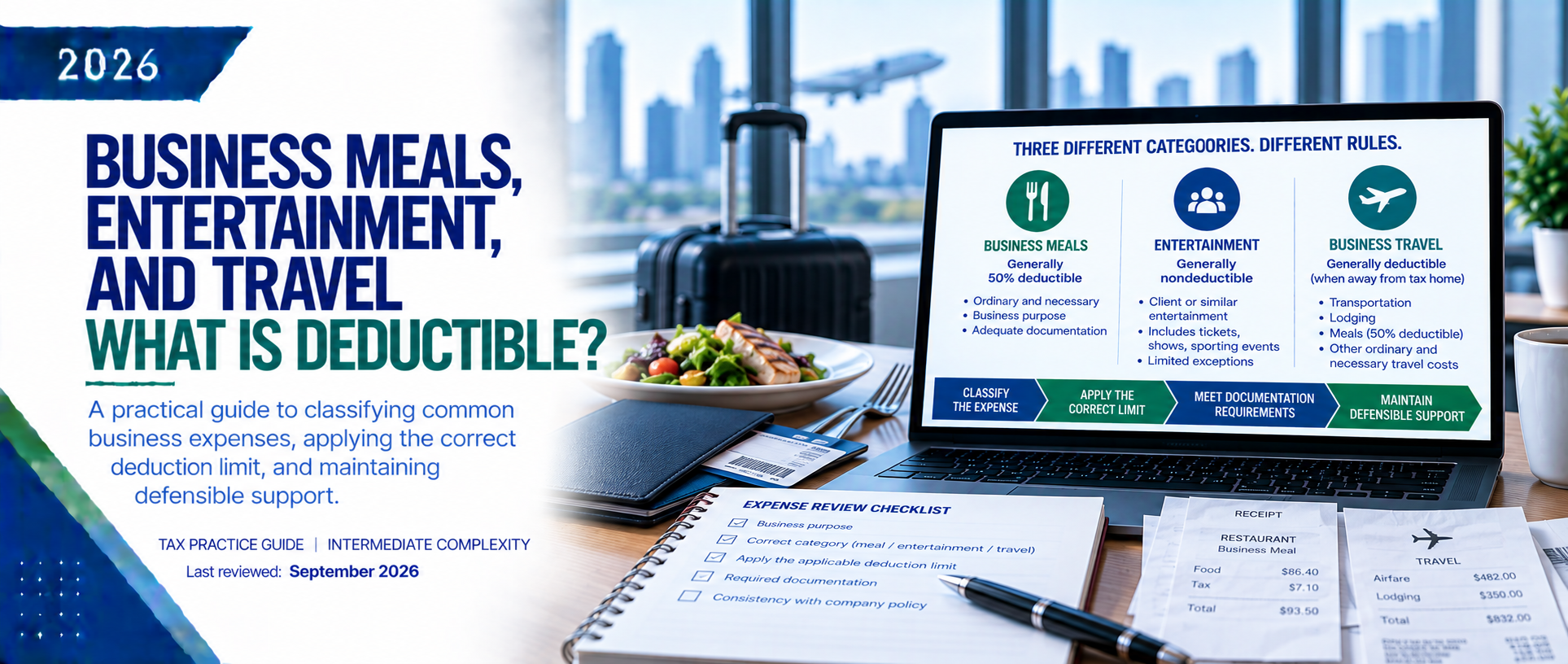
Suggested: colleagues at a business dinner meeting, with a travel bag and boarding pass nearby.
 –>
–>
Tax Practice Guide
Business Meals, Entertainment, and Travel: What Is Deductible
A practical guide to classifying common business expenses, applying the correct deduction limit, and maintaining defensible support.
Business meals, entertainment, and travel are separate tax categories. A qualifying business meal is generally 50% deductible, client entertainment is generally nondeductible, and ordinary business travel may be deductible when the taxpayer is away from the tax home for a bona fide business purpose. The result depends on classification, facts, and documentation—not simply who paid the charge.
1. Definition
Business meals are food and beverage costs connected with the business; entertainment generally includes amusement or recreation such as sports, golf, theater, or concerts; and business travel includes ordinary and necessary costs while traveling away from the tax home for work.
- Ordinary and necessary: The expense must be common and accepted in the business and helpful or appropriate.
- Tax home: Generally the taxpayer’s main place of business—not automatically the personal residence. Travel is usually “away from home” when work requires an overnight stay or rest.
2. Why It Matters
- One event can have multiple tax treatments: tickets may be nondeductible, separately purchased food may be 50% deductible, and qualifying transportation or lodging may follow separate travel rules.
- Documentation matters: A receipt proves the amount paid, but usually not the business purpose, attendees, dates, or necessity. Proper account coding and timely support reduce year-end cleanup and audit risk.
3. How It Works
Step 1: Classify the Expense Before Applying a Percentage. Classify the charge first as meal, entertainment, travel, commuting, employee event, or personal expense. Do not assume every client-related charge is deductible.
| Expense | General Federal Treatment | Primary Test |
|---|---|---|
| Client or prospect meal | Generally 50% deductible | Business purpose, taxpayer or employee present, not lavish |
| Travel meal | Generally 50% deductible | Qualifying business travel away from the tax home |
| Employee holiday party | Potentially 100% deductible | Primarily recreational or social and for employees |
| Client entertainment | Generally nondeductible | Entertainment, amusement, or recreation expense |
| Separately stated food at an event | Potentially 50% deductible | Purchased separately or separately stated at usual selling price |
| Business airfare and lodging | Generally deductible | Ordinary, necessary, and connected to qualifying business travel |
| Commuting or personal travel | Nondeductible | Personal travel rather than transportation between business locations |
Step 2: Apply the Meal Rules and Exceptions. A qualifying non-entertainment business meal is generally 50% deductible. The taxpayer or an employee must be present, the meal cannot be lavish or extravagant, and attendees should have a valid business relationship.
Some meals may be 100% deductible, including qualifying employee recreational/social events, meals treated as taxable compensation, food sold to customers, and food made available to the general public. Beginning in 2026, certain de minimis eating-facility and employer-convenience meal deductions are generally disallowed. Do not automatically code every employee meal as 100% deductible.
Step 3: Separate Meals From Entertainment. Client entertainment is generally nondeductible even when business is discussed. Food and beverages may still qualify for the meal deduction if they are purchased separately or separately stated at the usual selling price. A bundled ticket-and-food package may be treated entirely as entertainment.
Step 4: Test Business Travel and Mixed Use. Qualifying travel may include airfare, lodging, rental cars, rideshares, baggage fees, business communications, parking, tolls, and similar ordinary costs. Travel meals are generally 50% deductible. Daily commuting between home and a regular workplace is generally personal and nondeductible.
For mixed business and personal travel, separate personal hotel nights, sightseeing, recreation, and other personal costs. A spouse’s or family member’s travel is generally nondeductible unless that person is an employee, has a bona fide business purpose, and independently qualifies. International travel and certain conventions may have additional limits.
Under an accountable plan, an employee expense must have a business connection, be substantiated within a reasonable period, and any excess reimbursement must be returned. Keep support for date, amount, vendor, location, business purpose, attendees, destination, itinerary, agenda, and personal portion.
4. Simple Example
Example: A company sends an executive on a three-day domestic customer trip and pays $600 airfare, $900 hotel, $200 travel meals, $500 event tickets, and $150 separately stated food.
- Airfare + hotel: $1,500 generally deductible.
- Travel meals: $100 generally deductible after the 50% limit.
- Event tickets: $500 generally nondeductible entertainment.
- Separately stated food: $75 may be deductible after the 50% meal limit, assuming the other requirements are met.
Potential federal deduction: $1,675—not the full $2,350 paid. Personal extensions, companion travel, or state-law differences may change the result.
5. Common Mistakes and FAQs
Common Mistakes
- Deducting routine client meals at 100%: the general rule is 50% unless a specific exception applies.
- Treating entertainment as deductible because business was discussed: business discussion does not make tickets, golf, or recreation deductible.
- Failing to separate food from entertainment: food should be purchased or stated separately when possible.
- Treating commuting as business travel: home-to-regular-workplace transportation is generally personal.
- Relying only on a credit-card statement: it does not establish business purpose, attendees, or travel facts.
- Combining every charge in one GL account: separate 50%, 100%, nondeductible, travel, and personal categories.
Are Employee Meals Still Deductible in 2026?
It depends. Qualifying employee holiday parties and recreational events may remain fully deductible. Beginning in 2026, certain meals historically treated as de minimis or provided for the employer’s convenience are generally nondeductible to the employer. Employee income exclusion and employer deductibility are separate issues.
Can a Conference Trip Be Deducted?
Generally yes, when the conference benefits the trade or business and the trip is primarily business. Keep the agenda and business-purpose support, separate personal extensions, and review additional limits for certain foreign or cruise-ship conventions.
Does Reimbursement Make an Expense Deductible?
No. Reimbursement does not convert a personal or nondeductible expense into a business deduction. Accountable-plan rules govern employee reporting, while the company must still classify the underlying expense correctly.
6. Practical Checklist and What Comes Next
Before period-end and tax preparation:
- Employees / Owners: submit receipts promptly and record business purpose, attendees, destination, dates, and any personal portion.
- Accounting Team: use separate accounts for 50% meals, qualifying employee events, nondeductible entertainment, business travel, travel meals, and personal charges.
- Payroll / HR / Controller: administer the accountable plan, follow up on excess advances, identify possible wage treatment, and review unusual or mixed-purpose charges before close.
- Tax Preparer: apply the correct federal limitation, review 2026 employee-meal changes and state differences, and reconcile tax adjustments to the general ledger.
How PNJ Can Help
PNJ Group can help review reimbursement policies, expense-account design, meal/travel documentation, nondeductible or personal charges, and year-end tax adjustments.
Official References
- IRS Publication 463 — Travel, Gift, and Car Expenses
- IRS Topic 511 — Business Travel Expenses
- IRS Publication 15-B — Employer’s Tax Guide to Fringe Benefits
- IRS Business Meal and Entertainment Guidance
Disclaimer
This article provides general educational information and is not tax or legal advice. The result depends on the taxpayer, business purpose, participants, reimbursement arrangement, location, documentation, and current federal/state law.