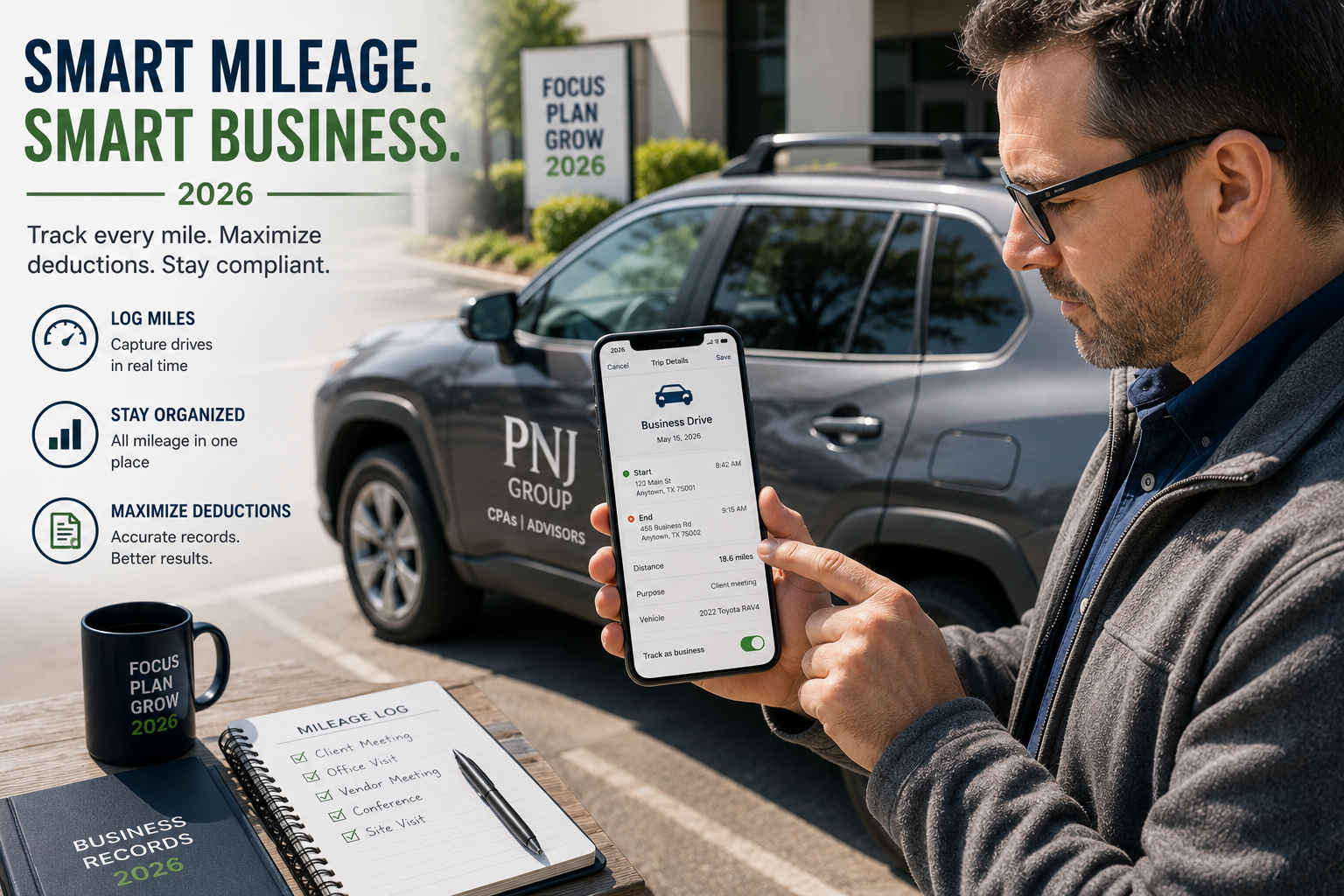
Suggested: business owner logging mileage on a phone app next to a company vehicle.
 –>
–>
Tax Intermediate Practical Guide
Business Vehicle Deduction: Actual Expense vs. Standard Mileage
How to compare the methods, document business use and avoid costly election mistakes
A business vehicle may qualify for a federal tax deduction—but only for the business-use portion. Paying through the company does not make every vehicle cost deductible.
The key choice is between the standard mileage and actual-expense methods. Your first-year election can affect both the deduction and future flexibility, so accurate records matter.
First identify deductible business miles, then compare both methods. A larger first-year deduction is not automatically the better long-term choice if it creates difficult recordkeeping, depreciation recapture or loss of future method flexibility.
1. Definition
A business vehicle deduction applies only to qualifying business use. If a vehicle is used for both business and personal purposes, the personal portion is not deductible.
Standard Mileage Method
Multiplied business miles by the applicable IRS rate. The rate generally includes operating costs and depreciation; business parking and tolls may be deducted separately.
| 2026 Period | Business Standard Mileage Rate |
|---|---|
| January 1–June 30 | 72.5 cents per business mile |
| July 1–December 31 | 76 cents per business mile |
Under IRS Announcement 2026-11, the rate increased to 76¢ per mile effective July 1, 2026. Businesses should track first- and second-half mileage separately.
Actual-Expense Method
Deduct the business-use percentage of eligible costs such as fuel, insurance, repairs, lease payments, and depreciation. Section 179, bonus depreciation, and depreciation limits may significantly affect the deduction.
2. Why It Matters
Not every trip is deductible. Commuting between home and a regular workplace is generally personal, while travel between business locations may qualify. Travel from a qualifying home office to another work location may also qualify.
The method choice affects:
- Current deduction: Standard mileage may favor high-mileage, lower-cost vehicles; actual expenses may favor higher-cost vehicles.
- Future flexibility: Choosing standard mileage in the first year can preserve the option to switch methods later.
- Depreciation: Accelerated deductions may create recapture or future limitations.
- Documentation: Both methods require a mileage log; actual expenses also require supporting receipts.
3. How It Works
Step 1: Establish Business Use
Keep a timely mileage log showing the date, destination, business purpose, and business miles. Also retain beginning- and ending-year odometer readings. Fuel receipts alone do not prove business use.
Step 2: Confirm Which Methods Are Available
For an owned vehicle, standard mileage generally must be chosen in the first year to preserve future flexibility. For a leased vehicle, the method generally continues for the entire lease period.
Standard mileage may be unavailable if five or more vehicles are used at the same time or if the vehicle previously used Section 179, special depreciation, MACRS, or other accelerated depreciation.
Step 3: Calculate Both Methods
| Factor | Standard Mileage | Actual Expense |
|---|---|---|
| Calculation | Business miles x applicable IRS rate | Business-use percentage x qualifying costs |
| Main records | Mileage log and business purpose | Mileage log, receipts, basis and depreciation records |
| Fuel, repairs and insurance | Included in the rate | Included as actual costs |
| Depreciation | Built into the rate | Calculated separately under applicable limits |
| Typical fit | Higher mileage or lower vehicle cost | Higher vehicle cost or operating expenses |
Step 4: Consider Ownership and Entity Structure
- Sole proprietor: deduct qualifying business use with the business activity.
- S corporation owner-employee: personal vehicle costs may be reimbursed under an accountable plan.
- Company-owned vehicle: personal use may be a taxable fringe benefit and must be tracked.
A reimbursement should have a business connection, be substantiated within a reasonable period and require the return of any excess amount. Properly handled reimbursements generally are not treated as wages.
4. Common Mistakes
- Treating commuting as business mileage. Answering calls or handling minor business activity while driving does not generally convert ordinary commuting into deductible transportation.
- Double-deducting vehicle costs. Gas and repairs are already included in the standard mileage rate; parking and tolls may be separate.
- Reconstructing mileage records at year-end. A timely mileage log is much stronger than estimates prepared later.
5. Practical Checklist / What’s Next
Work through these items before choosing or confirming a method.
0 of 7 complete
The best method is the one that fits the actual use, supports the return and produces a sensible result over the vehicle’s expected life – not simply the largest deduction in the purchase year.
How PNJ Can Help
PNJ can help business owners compare the two methods, review mileage documentation, evaluate depreciation and business-use limitations, establish accountable-plan procedures and coordinate vehicle reporting with the company’s books and tax return.
Current Federal References
- IRS Announcement 2026-11
- IRS Topic No. 510
- IRS Publication 463
Disclaimer
This article is for general informational purposes only and does not constitute tax, legal or accounting advice. Vehicle deductions depend on ownership, entity structure, business use, elections, depreciation history and supporting records. Taxpayers should confirm current law and consult qualified advisers regarding their specific facts.