Suggested: business owner opening and reviewing an IRS notice letter at a desk.
 –>
–>
Tax Compliance Foundation
Common IRS CP Notices and How to Respond
A practical guide to understanding the notice, protecting deadlines and choosing the next step
Receiving an IRS notice can feel urgent, but a notice does not automatically mean an audit—or that the IRS is correct. Many CP notices are generated for unpaid balances, missing payments, reporting mismatches, or incorrect taxpayer information.
The key is to identify what the IRS is asking for, the deadline, and whether the notice matches the business records before paying, amending a return, or sending a response.
Do not ignore the notice—but do not pay or amend a return before understanding it. Verify the notice, reconcile it to the records, respond by the stated date, and keep proof of every action taken.
1. What a CP Notice Means
“CP” is an IRS notice identifier. The notice number helps identify the issue, but the actual letter controls the required action and deadline.
Before responding, confirm:
- Taxpayer name and EIN/SSN are correct.
- Tax form and tax period match the account you expected.
- Notice date and response/payment deadline are calendared immediately.
- Proposed adjustment, balance, or mismatch is understood before action is taken.
Not every notice requires a written reply. Follow the instructions in the actual notice. If the notice appears suspicious, verify it through IRS.gov or an independently obtained IRS telephone number rather than using an unexpected email, text or payment link.
2. Common Notices at a Glance
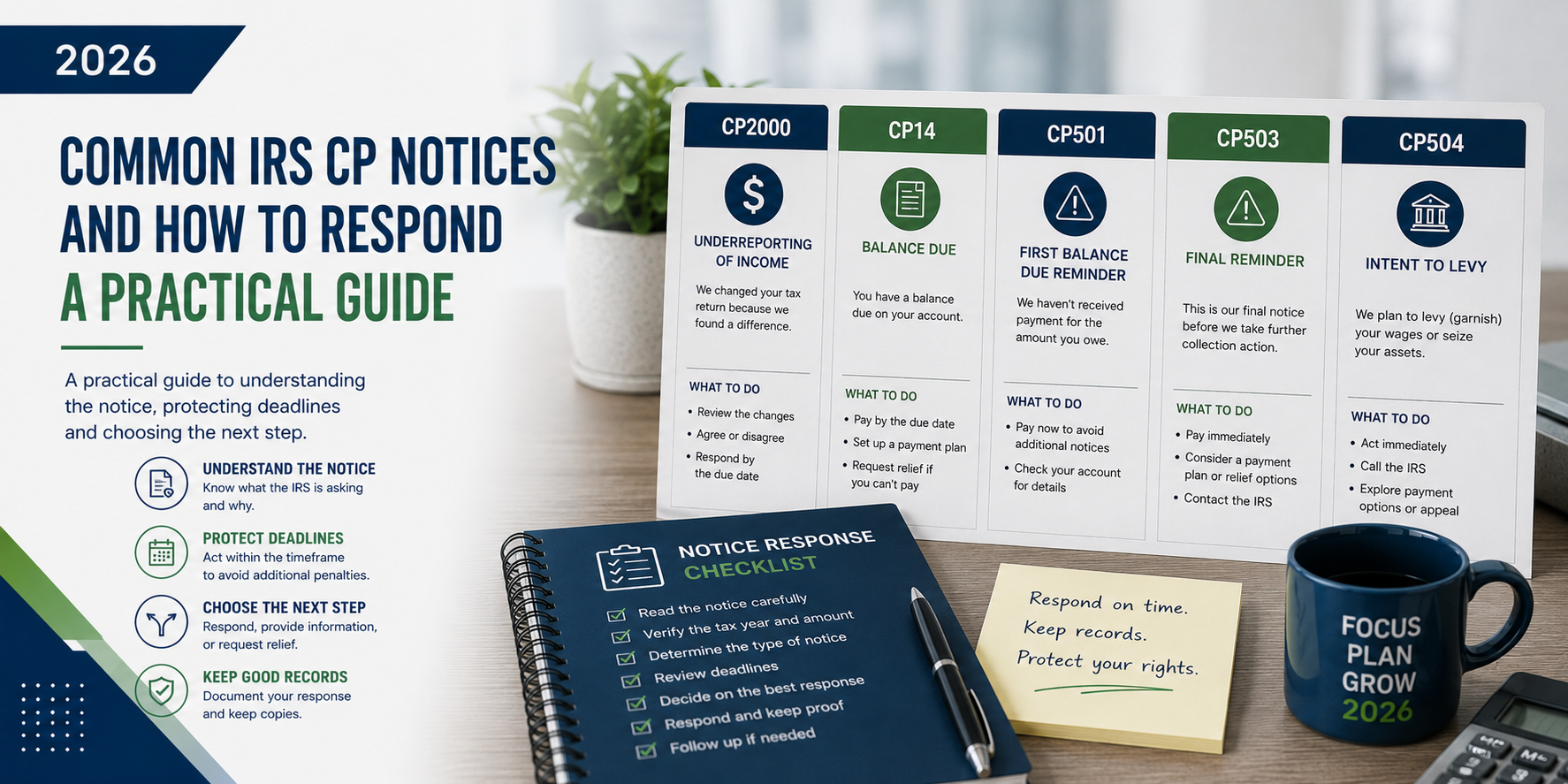
| Notice | Plain-English Meaning | First Action | Priority |
|---|---|---|---|
| CP14 | Initial notice that a tax balance is due. | Reconcile the return, payments, penalties and interest; then pay, arrange payment or dispute. | Prompt |
| CP161 | A business tax account shows an unpaid balance or payment-posting issue. | Match the EIN, form and period to filed returns and payment confirmations. | Prompt |
| CP2000 | Third-party information does not match the filed return; the IRS proposes a change. | Compare the notice detail with Forms W-2, 1099, K-1, brokerage and return records. | Prompt |
| CP501 / CP503 | Repeated reminders that a balance remains unpaid. | Address the balance, payment option or disagreement before collection advances. | Elevated |
| CP504 | Final reminder and notice of intent to levy for an unpaid balance. | Obtain immediate review and follow the notice’s payment or appeal instructions. | Urgent |
| CP2100 / CP2100A | A payer filed information returns with missing or incorrect name/TIN combinations. | Follow Publication 1281; review B-notice and backup-withholding duties. | Prompt |
Important: these are starting points only. Similar notices can carry different deadlines or appeal rights. CP504 is materially more serious than an initial balance notice because it signals potential collection action.
3. A Five-Step Response Method
- Verify: Confirm authenticity and match the taxpayer, notice number, form, and period.
- Calendar: Record the deadline immediately and assign responsibility for the response.
- Reconcile: Compare the notice with filed returns, general ledger, payroll reports, EFTPS confirmations, checks, information returns, and prior correspondence.
- Decide: Determine whether the business agrees, disagrees, or partly agrees—and calculate the correct tax, penalty, and interest position.
- Respond and track: Use the method and address in the notice, keep proof of delivery, and monitor the account until the issue is resolved.
4. Choose the Correct Type of Response
- If the business agrees: Follow the notice instructions to pay or establish an available payment arrangement. Correct the underlying process so the issue does not repeat.
- If the business disagrees: Respond to the specific adjustment and attach organized support. For a missing payment, provide the date, amount, tax form, period, and confirmation. For a CP2000 mismatch, show why the information is duplicated, incorrect, or already reported.
- If the business partly agrees: Address each item separately and show how the corrected amount was calculated.
Do not automatically file an amended return because a notice arrived. A CP2000, for example, is a proposed adjustment rather than a bill. The correct procedure depends on the notice and the underlying facts.
5. When to Escalate Immediately
Professional review is especially important when the notice involves:
- Intent to levy, seizure, federal tax lien, or a stated appeal/hearing deadline.
- Payroll or employment taxes, repeated missed deposits, or possible responsible-person exposure.
- A large unexplained adjustment, identity theft, suspected fraud, or an unknown return.
- Multiple unresolved notices, an uncredited prior response, or a deadline that is close.
- CP2100 / CP2100A payee-notice and backup-withholding duties.
Calling the IRS does not automatically suspend a deadline. Document any call with the date, representative name or ID, and agreed next step.
6. Practical Checklist / What to Do Next
Work through these items as soon as a notice arrives.
0 of 7 complete
How PNJ Can Help
PNJ can help businesses identify what an IRS notice means, reconcile the stated issue to tax and accounting records, prepare a clear response package, evaluate payment or penalty-relief options, coordinate authorized representation, and strengthen the process that caused the notice.
Current Reference Points
- IRS: CP14 Notice
- IRS: CP2000 Series
- IRS: CP504 Notice
- IRS: Backup Withholding B Program
Disclaimer
This article is for general informational purposes only and does not constitute tax, legal or accounting advice. IRS procedures, deadlines and taxpayer rights depend on the notice and the taxpayer’s facts and may change. Review the complete notice and consult a qualified adviser regarding your circumstances.