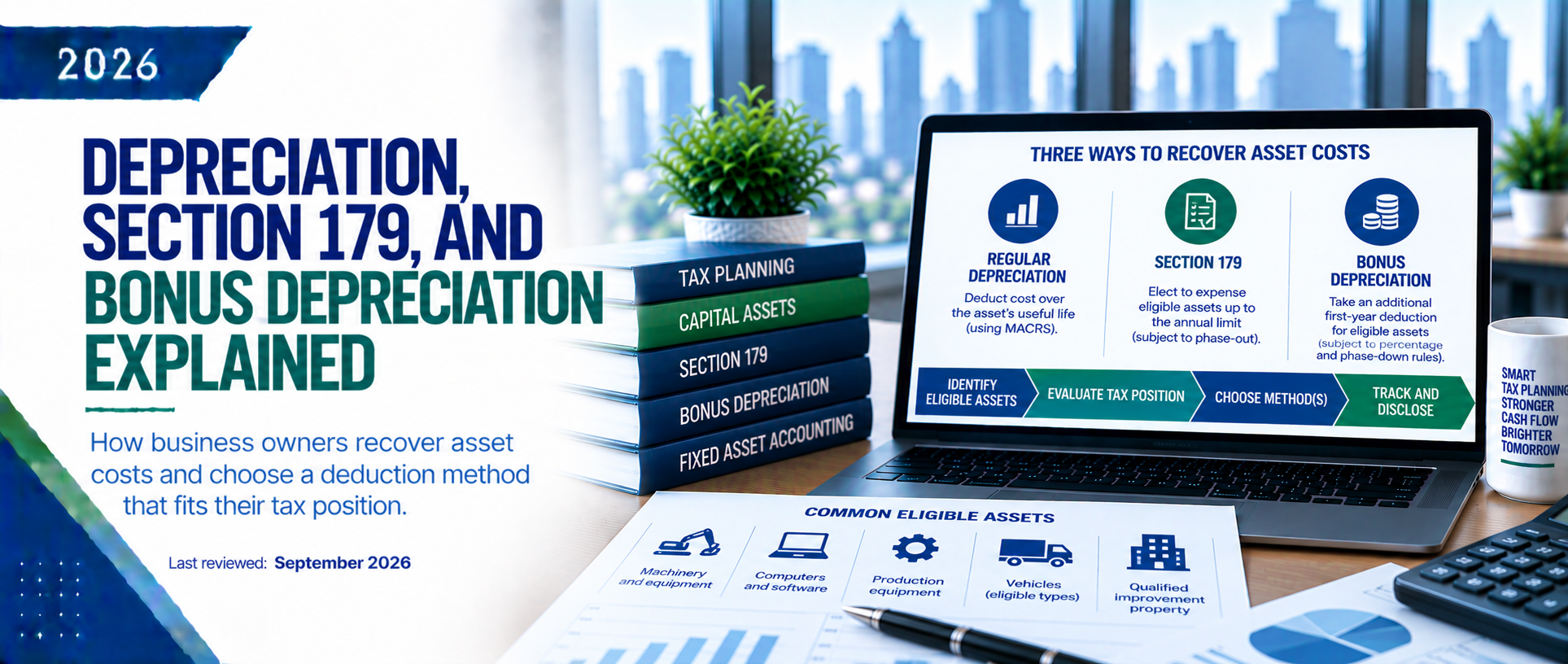
Suggested: business owner reviewing equipment purchase records and a depreciation schedule.
 –>
–>
Tax Foundation
Depreciation, Section 179, and Bonus Depreciation Explained
How business owners recover asset costs and choose a deduction method that fits their tax position.
A business asset is not automatically deductible when purchased. The deduction depends on what the asset is, when it is placed in service, and which tax method is elected. Regular MACRS, Section 179, and bonus depreciation can produce very different timing results, so the goal is the best overall tax benefit—not simply the largest deduction today.
1. Definition
Depreciation recovers the cost of business property that is used to earn income, expected to last more than one year, and subject to wear or obsolescence. Common examples include equipment, computers, furniture, vehicles, and buildings. Land is not depreciable.
Most business property uses MACRS. Depreciation begins when the asset is placed in service—ready and available for business use. The purchase, payment, or delivery date does not always control.
Businesses generally recover qualifying asset costs in three ways:
- Regular MACRS: spreads the deduction over the asset’s recovery period.
- Section 179: allows an elected immediate deduction for selected qualifying property, subject to limits.
- Bonus depreciation: provides a large first-year deduction for qualifying property unless the business elects out.
2. Why It Matters
- Timing matters: A large current deduction may help a profitable business, but may provide less immediate value if the business already has losses. Preserving deductions can be useful when higher future income or tax rates are expected.
- Future tax impact: Accelerated deductions reduce tax basis, which may increase gain on a later sale and can create depreciation recapture. Federal, state, and book basis may differ.
| Method | Current Deduction | Main Limitation |
|---|---|---|
| Regular MACRS | Spreads cost over the assigned recovery period | Deduction is received over several years |
| Section 179 | Allows an elected amount for selected qualifying assets | Annual phaseout and business-income limits apply |
| Bonus depreciation | Generally allows 100% for eligible 2026 property | Election out generally applies by property class |
3. How It Works
Step 1: Confirm the Asset and Placed in Service Date. Confirm whether the cost should be capitalized and when the asset became ready and available for use. Equipment delivered in December but installed in January may not begin depreciation until January.
Step 2: Determine Which Methods Are Available. Section 179 commonly applies to machinery, equipment, furniture, computers, certain software, qualifying vehicles, and qualified improvement property. It may also apply to certain roofs, HVAC, fire-protection, alarm, and security systems added to qualifying nonresidential real property. Where applicable, business use generally must exceed 50%.
Bonus depreciation generally applies to eligible MACRS property with a recovery period of 20 years or less, qualified improvement property, and certain software. Both new and certain used property may qualify. Land, inventory, personal-use property, and most building structures do not qualify for these immediate deductions, although buildings may still qualify for regular depreciation.
Step 3: Apply the 2026 Limits and Elections. For tax years beginning in 2026, the maximum federal Section 179 deduction is $2,560,000, with phaseout beginning when qualifying property placed in service exceeds $4,090,000. Certain heavy SUVs have a separate $32,000 limit. Section 179 is also limited by taxable income from the active conduct of a trade or business; unused amounts may generally carry forward.
Qualified property acquired and placed in service after January 19, 2025 generally qualifies for 100% bonus depreciation under current federal law. Bonus depreciation is not subject to the Section 179 business-income limit and can create or increase a tax loss. An election out generally applies by property class.
Step 4: Choose and Report the Method. When more than one method applies, the usual order is Section 179 → bonus depreciation → regular MACRS. Section 179 offers more control over selected assets and deduction amounts; bonus depreciation may produce the largest immediate deduction; regular MACRS preserves more deductions for future years. Report the elections and depreciation on Form 4562.
4. Simple Example
Example: A business purchases and places in service $180,000 of qualifying equipment in 2026. Depending on income, plans, and elections, it may compare the approaches below.
| Approach | 2026 Treatment | When It May Fit |
|---|---|---|
| Regular depreciation | Deduct the $180,000 over the applicable MACRS period | The business expects higher taxable income in later years |
| Section 179 | Elect some or all of the $180,000, subject to the limits | Management wants to choose the deduction amount for this asset |
| Bonus depreciation | Potentially deduct the full qualifying basis | The business wants a large deduction and can use a current loss |
No method is always best. Also model state adjustments, existing losses, expected future income, and the tax effect of a later sale.
5. Common Mistakes and FAQs
Common Mistakes
- Using the purchase date: depreciation starts when the asset is placed in service.
- Assuming every fixed asset qualifies: an asset may be depreciable without qualifying for Section 179 or bonus depreciation.
- Choosing the largest current deduction automatically: the deduction may be more valuable in a higher-income future year.
- Ignoring state treatment: states may limit Section 179 or require bonus-depreciation addbacks.
- Ignoring business-use or sale consequences: reduced qualified use or a later sale may trigger recapture or additional taxable gain.
Can a Business Use More Than One Method?
Yes. A business may combine methods: Section 179 for selected assets, bonus depreciation for eligible remaining basis, and regular MACRS for the rest, subject to applicable limits and elections.
What Happens If Section 179 Is Limited?
A Section 179 deduction limited by the business-income rule may generally be carried forward. Maintain a schedule showing the amount elected, used, and carried forward.
What Happens When the Asset Is Sold?
Prior depreciation reduces adjusted tax basis. A later sale can therefore produce a larger gain, and some or all may be taxed as ordinary income under depreciation-recapture rules.
6. Practical Checklist and What Comes Next
Before the return is finalized:
- Business Owner / Management: confirm business purpose, actual use, placed-in-service date, expected holding period, and plans for major assets.
- Accounting Team: reconcile additions/disposals, retain invoices and installation records, and update the book fixed-asset schedule.
- Tax Preparer: classify each asset, test Section 179 and bonus eligibility, apply vehicle and income limits, and prepare Form 4562.
- Tax Adviser: compare regular depreciation, Section 179, bonus depreciation, and combined strategies using federal, state, entity, and owner-level projections.
- Controller / Reviewer: document elections and maintain separate book, federal-tax, and state-tax basis schedules, including carryforwards and later disposals.
How PNJ Can Help
PNJ Group can help review fixed-asset additions, placed-in-service dates, depreciation-method choices, federal/state effects, tax-depreciation schedules, and Form 4562 reporting.
Official References
- IRS Publication 946 — How To Depreciate Property
- IRS Topic 704 — Depreciation
- IRS Bonus Depreciation FAQs
Disclaimer
This article provides general educational information and is not tax or legal advice. Depreciation results depend on the asset, acquisition and placed-in-service dates, business use, entity structure, elections, and federal/state law. Review the facts with a qualified tax adviser before filing.