Suggested: business owner reviewing a worker classification checklist against a contractor agreement.
 –>
–>
Tax Compliance Foundation
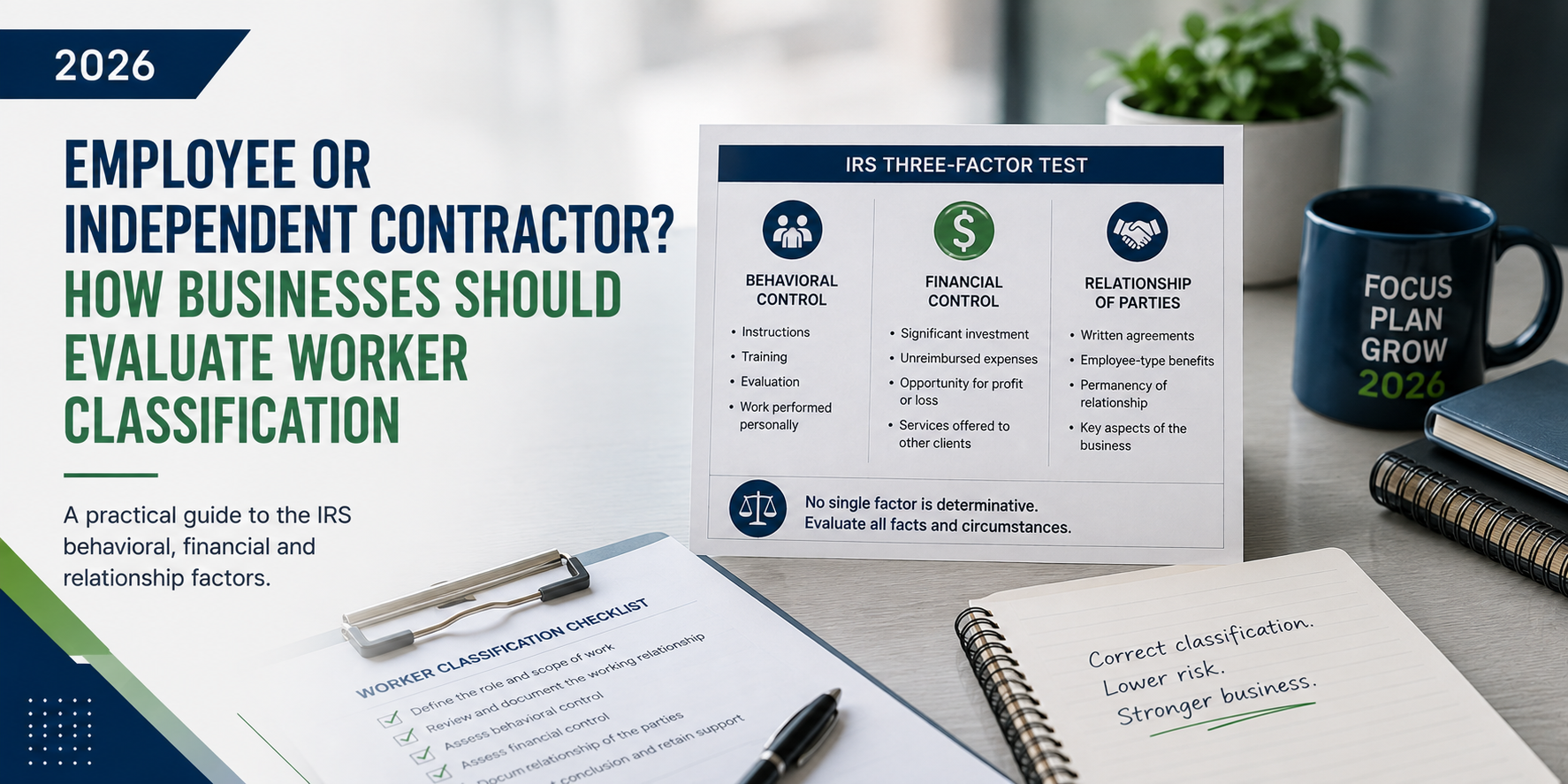
Employee or Independent Contractor? How Businesses Should Evaluate Worker Classification
A practical guide to the IRS behavioral, financial and relationship factors
Worker classification affects payroll taxes, reporting and compliance. Employees are generally subject to payroll withholding; independent contractors are generally responsible for their own taxes.
The business cannot simply choose the label. The actual working relationship controls—not the contract title, payment method, remote-work arrangement or Form 1099.
Classify the worker based on control and independence, not labels. Review the relationship before onboarding and whenever the facts change.
This guide covers the IRS common-law test for federal employment tax. Labor, state, unemployment and workers’ compensation rules may use different tests.
Why Worker Classification Matters
- Employee: the employer generally withholds federal income, Social Security and Medicare taxes, pays applicable employer payroll taxes, files employment tax returns and issues Form W-2.
- Independent contractor: the payer generally does not withhold federal payroll taxes. The contractor handles income and self-employment taxes, while the payer may have Form W-9 and Form 1099 obligations.
Misclassification can trigger employment taxes, penalties and compliance costs and may also affect wage, benefits, unemployment, workers’ compensation and state-law obligations.
The Three IRS Classification Factors
There is no single test or fixed score. The IRS weighs all facts showing control and independence across three categories.
1. Behavioral Control
Does the business control how the work is performed? Consider:
- Schedule and direction. Who controls when, where and in what sequence the work is done?
- Instructions and training. Does the business prescribe detailed procedures or methods?
- Tools and systems. Who chooses the tools, systems and work methods?
- Evaluation. Is the worker judged on the process or mainly on the final result?
2. Financial Control
Does the worker have meaningful economic independence? Consider:
- Investment. Does the worker provide equipment, software, insurance or personnel?
- Profit or loss. Does the worker bear unreimbursed costs and business risk?
- Market presence. Does the worker actively serve or seek other customers?
- Pricing and payment. Who negotiates fees and controls the economics of the work?
Payment method alone is not decisive. Contractors may be paid hourly, and employees may sometimes receive project-based compensation.
3. Type of Relationship
How do the parties structure and operate the relationship? Consider:
- Agreement. Does the written contract match the actual arrangement?
- Benefits. Are employee-type benefits provided?
- Duration. Is the relationship ongoing or tied to a defined project?
- Business importance. Are the services a key activity of the company?
A written agreement matters, but facts override labels. Likewise, no employee benefits does not automatically mean contractor status.
A Simple Comparison
Example: ABC Technology engages two software professionals. Their facts point in different classification directions.
| Factor | Michael | Sarah |
|---|---|---|
| Schedule and direction | Works a required 9:00 a.m.–5:00 p.m. schedule, receives detailed assignments and reports to an ABC manager. | Controls her schedule and methods and is responsible for delivering agreed project results. |
| Tools and expenses | Uses ABC’s laptop, software and systems. | Uses her own equipment, software and business insurance and bears unreimbursed expenses. |
| Customers and market | Has worked exclusively for ABC for two years. | Advertises publicly and serves several unrelated customers. |
| Payment | Is paid every two weeks based on hours worked. | Negotiates fixed project fees and manages the costs of completing the work. |
| Relationship | Performs continuing core development work and requires approval for time off. | Is engaged for defined projects and can hire assistance at her own expense. |
| Likely direction | The facts suggest an employee relationship despite any contractor label or Form 1099. | The facts suggest an independent business, subject to the complete facts and applicable laws. |
Five Common Misconceptions
- Contractor agreement = contractor. No. The actual relationship controls.
- The worker requested contractor status. Preference does not override federal tax rules.
- Paid through accounts payable. Accounting treatment does not determine worker status.
- Remote work + personal computer. Relevant facts, but not decisive by themselves.
- Form 1099 proves contractor status. No. The form reports payments; it does not establish classification.
Practical Classification Checklist
Before onboarding, document the facts that show control, independence and relationship structure.
0 of 8 complete
Review the Classification When Facts Change
Classification is not a one-time decision. If a project worker later works full-time, reports to a manager, uses company equipment or becomes economically dependent on one business, reassess and document the classification.
When the Answer Is Unclear
When status remains unclear, the business or worker may file Form SS-8 for an IRS determination. Because the process can take time and covers only federal tax classification, do not wait until a filing deadline or assume it resolves separate state or labor-law tests.
How PNJ Can Help
PNJ can help evaluate employee-vs.-contractor status, document the supporting factors, review onboarding and payroll procedures, and coordinate W-2, W-9 and 1099 reporting.
Disclaimer
This article is intended for general informational purposes only and does not constitute tax, employment, accounting or legal advice. Worker classification depends on the specific facts and circumstances, and different federal, state and local laws may apply different tests. Businesses should consult qualified tax and legal professionals regarding their workforce arrangements.
Official References
- IRS Topic No. 762
- IRS common-law employee guidance
- IRS Form SS-8 guidance
- IRS SS-8 determination database
- U.S. Department of Labor worker-classification guidance