

Accounting Standards
FASB New Environmental-Credit Accounting Guidance — ASU 2026-02
What companies using or trading environmental credits must update under Topic 818
ASU 2026-02 creates a dedicated GAAP model for environmental credits and environmental credit obligations. Accounting now depends on management’s intended use for each credit — compliance, sale or trade, or voluntary retirement — which drives recognition, classification, measurement, impairment, and balance-sheet presentation. Effective dates run 2027–2029, but the data, policy, and control work should start now.
In May 2026, the Financial Accounting Standards Board (FASB) issued ASU 2026-02, Environmental Credits and Environmental Credit Obligations (Topic 818), creating a dedicated U.S. GAAP model for environmental credits and for certain regulatory obligations that can be settled using those credits.
The guidance reaches well beyond companies that actively trade carbon credits. It can affect any business that purchases, receives, generates, sells, trades, or uses instruments such as carbon offsets, emissions allowances, renewable energy certificates (RECs), and renewable identification numbers (RINs), as well as companies subject to environmental compliance programs.
The central implementation issue is intended use. Under Topic 818, the accounting for the same type of credit can differ depending on whether management expects to use it for regulatory compliance, sell or trade it, transfer it to another party, or retire it voluntarily — which means adoption requires better data, documented intent, and controls connecting accounting with sustainability, operations, legal, procurement, and trading functions.
1. Who Is Affected?
Topic 818 applies when an item meets the definition of an environmental credit. In general, the credit must:
- Represent an enforceable right.
- Lack physical substance and not be a financial asset.
- Be, or previously have been, separately transferable in an exchange transaction.
- Be represented as preventing, controlling, reducing, or removing emissions or other pollution.
- Not be an income tax credit.
Examples that may fall within scope include carbon offsets, emissions allowances, RECs, and RINs. The standard also covers environmental credit obligations (ECOs) — obligations arising from laws, statutes, or ordinances designed to prevent, control, reduce, or remove emissions or other pollution when the obligation may be settled with environmental credits.
A company’s voluntary climate target, by itself, generally does not create an ECO. A self-imposed net-zero or carbon-neutral commitment is different from a regulatory obligation owed to an external party.
2. The Biggest Change: Accounting Follows Intended Use
Topic 818 introduces an intent-based recognition and measurement model. A company recognizes an environmental credit as an asset only when it is probable that the credit will be used to:
- Settle an environmental credit obligation.
- Be transferred in an exchange transaction, such as a sale or trade.
- Be used in a nonreciprocal transfer.
If none of those qualifying uses is probable, the cost is generally expensed rather than capitalized. This produces an important result for companies purchasing credits solely to meet voluntary ESG goals: if management intends to retire a purchased credit voluntarily, rather than use it for compliance or transfer it, the credit generally does not qualify for asset recognition.
Compliance vs. noncompliance credits
Once a credit qualifies for asset recognition, management must classify it based on intended use, and this classification drives the subsequent accounting:
- Compliance environmental credit. It is probable that the credit will be used to settle an ECO.
- Noncompliance environmental credit. It qualifies for asset recognition but is not expected to be used to settle an ECO — for example, a credit held for sale or trading.
3. How Environmental-Credit Assets Are Measured
Initial measurement
Environmental credits acquired in a transaction are generally initially measured at cost, subject to other applicable U.S. GAAP. For credits that are internally generated or granted by a regulator or its designee, Topic 818 generally uses the transaction costs incurred, if any — in practice, some regulator-granted credits may carry a value of zero when no qualifying transaction costs were incurred.
Compliance credits
Compliance credits generally remain at their applicable cost basis and are not subject to ongoing impairment testing while classified as compliance credits — reflecting the linkage between the carrying amount of credits expected to be surrendered and the measurement of the related compliance obligation.
Noncompliance credits
Noncompliance credits generally must be evaluated for impairment at each reporting date. An impairment is recognized when carrying amount exceeds fair value, and an impairment loss generally cannot be reversed.
For certain eligible classes of noncompliance credits, companies may elect an irrevocable fair-value accounting policy, with changes in fair value recognized in earnings. The election is made by class rather than credit by credit.
Cost-flow assumptions
For similar environmental credits recognized as assets, Topic 818 permits costing approaches such as:
- First-in, first-out (FIFO).
- Average cost.
- Specific identification.
Companies will need a defined costing policy and sufficiently detailed subledger information to apply it consistently across compliance and noncompliance populations.
4. Environmental Credit Obligations: A Linked Measurement Model
An ECO is recognized when the underlying activities or events have created an obligation as of the reporting date, determined as though the reporting date were the end of the applicable compliance period. For example, if a regulation requires credits to be surrendered based on emissions or electricity usage, the liability may build as those activities occur even though the actual compliance period ends later. The liability is divided conceptually into funded and unfunded portions.
Funded portion
The funded portion represents the obligation for which the company already holds compliance credits it expects to surrender. That portion is generally measured using the carrying amount of those compliance credits — which is why the liability measurement is described as “linked” to the related assets.
Unfunded portion
The remaining obligation depends on how management expects to settle it:
- If the company intends and is able to settle in cash, the liability is based on the required cash settlement amount.
- If the company has an unconditional commitment to purchase a fixed quantity of credits at a fixed price, or an unconditional right to receive credits under a compliance program, the measurement reflects the estimated cost basis of those credits.
- Other unfunded amounts are generally measured using the fair value of the credits required to settle the obligation at the reporting date.
The ECO must be remeasured at each reporting date as the obligation, credit inventory, commitments, settlement strategy, and market values change.
5. Balance-Sheet Presentation: Gross, Not Net
One of the clearest presentation changes under Topic 818 is that environmental-credit assets and ECO liabilities must be presented gross. A company cannot simply offset the credits it holds against its regulatory obligation and show only a net asset or net liability.
Topic 818’s linked measurement does not mean net presentation. The carrying amount of certain credits may determine the measurement of the funded portion of the ECO, but the asset and liability remain separate line items on the balance sheet.
Current vs. noncurrent classification
For companies presenting a classified balance sheet, classification depends primarily on expected timing. Generally:
- Compliance credits expected to be remitted to settle an ECO within one year are current assets.
- ECOs expected to be settled within one year are current liabilities.
- Credits expected to be sold or traded within one year — or within the operating cycle if longer — are current assets.
- Amounts falling outside those periods are classified as noncurrent.
Companies that previously grouped credits into inventory, intangible assets, other assets, or net regulatory balances may need to revisit both account mapping and financial-statement presentation.
6. New Accounting Policies Companies Should Establish
Adoption requires more than adding a Topic 818 reference to an accounting manual. Companies should document policies for at least the following areas:
- Scope assessment. How the company determines whether an instrument is an environmental credit within Topic 818, and how out-of-scope items — such as income tax credits — are routed to other U.S. GAAP.
- Intended-use determination. Who determines intended use, what evidence supports that conclusion, and how frequently it is reassessed — particularly when the same pool of credits could be used for compliance or sold depending on results.
- Compliance vs. noncompliance classification. Criteria for classification and reclassification, including the accounting when management’s intent changes.
- Initial measurement. The cost basis for purchased, internally generated, regulator-granted, and otherwise received credits, including which transaction costs qualify for capitalization.
- Subsequent measurement and impairment. The impairment methodology for noncompliance credits, fair-value sources, review frequency, and any fair-value policy election.
- Costing methodology. FIFO, average cost, or specific identification for similar credits, and how the method applies to compliance and noncompliance populations.
- ECO recognition and measurement. How regulated activity is translated into credits required, how funded and unfunded portions are determined, and how commitments, allocations, cash-settlement alternatives, and market values affect measurement.
- Current/noncurrent classification and presentation. How expected sale, remittance, or settlement dates are established, and confirmation that assets and ECOs are presented gross.
7. Data Companies Will Need to Capture
For many businesses, the hardest part of Topic 818 will be obtaining the data needed to support accounting judgments every reporting period. At a minimum, companies should expect to maintain data covering:
| Data area | Why it matters under Topic 818 |
|---|---|
| Credit type and program | Supports scope assessment and disclosures |
| Source of credit | Distinguishes purchased, granted, internally generated, and other credits |
| Quantity on hand | Supports asset records and funded ECO measurement |
| Cost basis and transaction costs | Supports initial measurement and liability linkage |
| Intended use | Drives recognition and compliance/noncompliance classification |
| Expected sale, transfer, retirement, or remittance date | Drives current/noncurrent classification |
| Applicable regulatory program | Supports ECO recognition |
| Regulated activity to date | Determines credits required as if the reporting date were the compliance-period end |
| Credits expected to settle the ECO | Determines funded portion |
| Purchase commitments and regulator allocations | Affects measurement of unfunded obligations |
| Cash settlement alternatives | May determine liability measurement |
| Current market/fair-value data | Needed for impairment, fair-value elections, and certain unfunded ECOs |
| Changes in intended use | May trigger reclassification, impairment, derecognition, and disclosure |
| Expenses and impairments | Supports required income-statement disclosures |
In practice, many companies will also want identifiers for credit vintage, jurisdiction, registry, certification, and expiration — fields that are not merely operational when they affect whether a credit can actually settle the related ECO.
8. Internal Controls Will Need to Extend Beyond Accounting
Because Topic 818 relies heavily on management intent and operating data, accounting teams may not control all of the information needed to apply the standard. Companies should consider controls over:
- Approval and documentation of intended use.
- Completeness and accuracy of environmental-credit holdings.
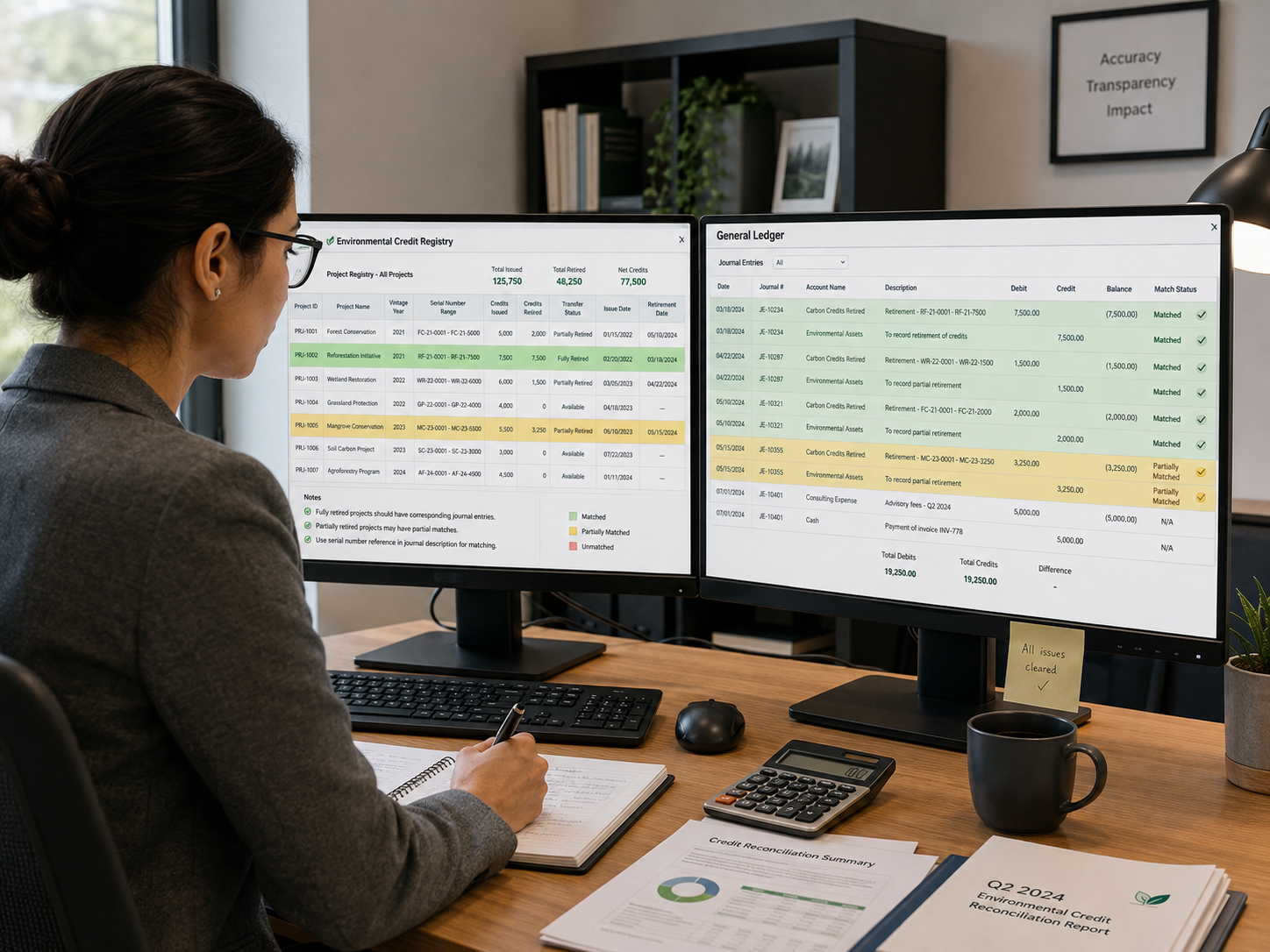
- Reconciliation of registry or trading-platform records to the general ledger.
- Regulatory activity data used to calculate ECOs.
- Valuation inputs for noncompliance credits and unfunded ECOs.
- Identification of fixed-price purchase commitments and regulator allocations.
- Reassessment of expected settlement dates.
- Changes in intent and resulting reclassification.
- Credit retirements, transfers, or sales.
- Disclosure data supplied by sustainability, operations, legal, procurement, or trading teams.
A quarter-end spreadsheet maintained only by accounting may be insufficient if the underlying information comes from multiple systems and functions.
9. Disclosure Requirements Will Increase
Topic 818 requires both qualitative and quantitative disclosures about environmental-credit assets and obligations. Depending on the company’s activities, disclosures can include:
- How credits were obtained and how management intends to use them.
- Carrying amounts of compliance and noncompliance credits, including current and noncurrent portions.
- Costing and subsequent-measurement policies, including any fair-value elections.
- The activities or events creating ECOs and the nature and timing of settlement provisions.
- Funded and unfunded portions of ECO liabilities and how unfunded ECOs are measured.
- Significant estimates and judgments.
- Expense recognized for ECOs, expenses for credits not qualifying for asset recognition, and impairment expense.
- The financial-statement effect of changes in intended use.
This makes disclosure readiness another reason to build a dedicated environmental-credit subledger or structured data repository rather than relying on year-end manual schedules.
10. Effective Dates and Transition
- Public business entities: Annual reporting periods beginning after December 15, 2027, including interim periods within those annual periods.
- All other entities: Annual reporting periods beginning after December 15, 2028, including interim periods within those annual periods.
Early adoption is permitted. The transition approach is a modified-retrospective method with a cumulative-effect adjustment to opening retained earnings, or another appropriate component of equity or net assets, at the beginning of the annual period of adoption. Prior comparative periods generally are not recast.
11. Implementation Checklist
Use the two phases below to plan and track ASU 2026-02 adoption work.
Phase 1 — Assess (Start Now)
0 of 4 complete
Phase 2 — Build (Before Adoption)
0 of 5 complete
Bottom Line
ASU 2026-02 replaces diverse environmental-credit accounting practices with a dedicated framework, but it also creates new operational demands. The most important implementation point is that accounting depends on what the company intends to do with each credit — a determination that affects whether a credit is capitalized at all, whether it is classified as compliance or noncompliance, whether impairment or fair-value measurement applies, how related regulatory obligations are measured, and how amounts appear on the balance sheet.
For companies with significant environmental-credit activity, the accounting team will need more than a new policy memo — Topic 818 requires a controlled flow of information from regulatory, sustainability, procurement, operations, treasury, and trading functions into the financial-reporting process. Starting that data and control work early will be more important than waiting for the mandatory adoption date.
How PNJ Can Help
PNJ works with controllers, CFOs, and accounting teams to translate new standards like ASU 2026-02 into practical accounting policies, subledger design, account mapping, and disclosure-ready reporting — from initial scope assessment through the first year of adoption.
Sources and Professional Notes
- Financial Accounting Standards Board, Accounting Standards Update 2026-02 — Environmental Credits and Environmental Credit Obligations (Topic 818), issued May 19, 2026.
- Deloitte, Heads Up — FASB Issues Guidance on the Accounting for Environmental Credit Programs, May 19, 2026.
- KPMG, FASB issues ASU on environmental credits and obligations, May 2026.
- BDO, Environmental Credits and Environmental Credit Obligations Under ASC 818, May 2026.
- Crowe, ASU 2026-02 Addresses Accounting for Environmental Credits, May 29, 2026.
- RSM, FASB Issues Guidance on Environmental Credits and Related Obligations, May 26, 2026.
Disclaimer
This material is for general informational purposes only and does not constitute accounting, tax, or legal advice. Appropriate accounting treatment under ASU 2026-02 depends on an entity’s specific facts, contracts, and regulatory programs. This article is a general summary and is not a substitute for reviewing ASU 2026-02 directly or obtaining advice based on an entity’s specific circumstances. Consult qualified advisers before implementing or changing accounting policies.