Suggested: finance manager reviewing balance-sheet reconciliation workpapers at a desk.
 –>
–>
Accounting Insight
Five Balance-Sheet Accounts That Deserve Monthly Reconciliation
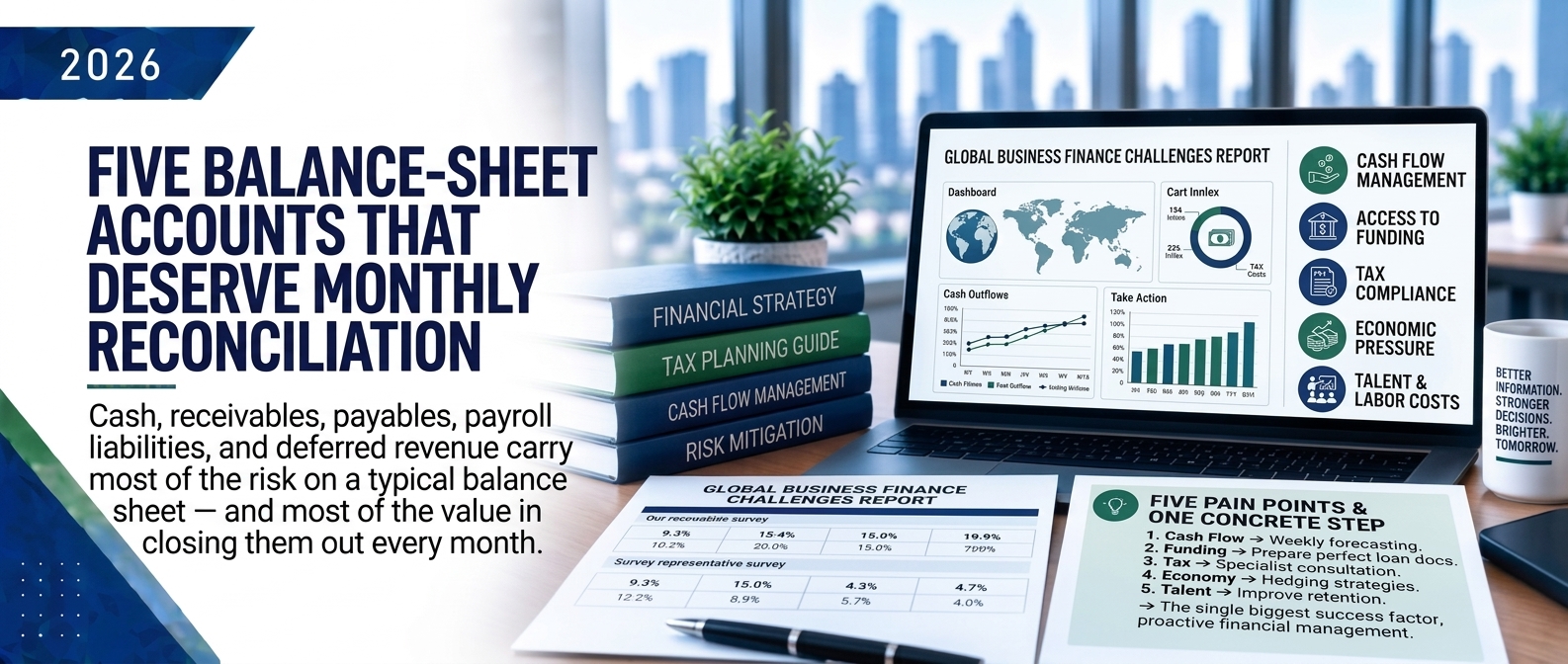
Cash, receivables, payables, payroll liabilities, and deferred revenue carry most of the risk on a typical balance sheet — and most of the value in closing them out every month.
Five accounts deserve monthly reconciliation: cash, accounts receivable, accounts payable, payroll liabilities, and deferred revenue. Reconciling them before the close is finalized keeps small timing and posting differences from becoming year-end surprises.
Balance-sheet risk is rarely spread evenly. The highest-risk accounts usually have the most transaction volume, manual activity, and judgment—which is why missed reconciliations compound quickly.
These five accounts are fed by different subledgers, teams, and rules, so they can drift from the general ledger if no one reconciles them monthly.
Below is why each account deserves a standing monthly reconciliation, what commonly goes wrong, and how a reconciled balance differs from an unreconciled one.
1. Cash
A monthly bank reconciliation matches the book balance to the bank statement and explains every difference, including outstanding checks, deposits in transit, bank fees, and errors.
- Stale outstanding items: A check outstanding for months may be lost, voided without a journal entry, or invalid.
- Multiple accounts/currencies: Each bank account needs its own reconciliation, not one blended balance.
Cash is the balance-sheet account most exposed to fraud and misappropriation. A reconciliation performed by someone who cannot create or approve payments is a strong, low-cost internal control.
2. Accounts Receivable
AR reconciliation ties the customer subledger to the GL control account. Common differences include direct GL postings, unmatched credit memos, and duplicate invoices.
- Aging matters: A balance may tie to the GL but still be wrong in substance if old invoices remain with no collection plan.
- Allowance review: A growing past-due balance with an unchanged allowance for doubtful accounts may indicate a stale reserve.
3. Accounts Payable
AP reconciliation asks whether all obligations are recorded. The AP subledger should tie to the GL, and open invoices should be supported by the appropriate purchase and receipt documentation.
- Completeness risk: Duplicate invoices overstate liabilities, while unrecorded liabilities understate them and may not surface until a later period.
Match the purchase order, receiving record, and vendor invoice before posting. This catches many AP errors before they reach the ledger.
- Unbilled costs: Accrue costs already incurred—such as freight, utilities, and professional fees—even if no invoice has arrived.
4. Payroll Liabilities
Payroll liabilities include employee withholdings, employer payroll taxes, benefits, retirement deferrals, and garnishments. Keep each obligation in a separate account because each is owed to a different agency or provider.
- Reconcile to source records: Tie balances to the payroll register and actual filings, not just the prior-month balance.
Mixing employee withholdings and employer tax expense in one account makes reconciliation difficult and can hide underpayments.
- Old balances: A large unexplained beginning balance usually means a prior-period error was carried forward instead of resolved.
5. Deferred Revenue
Deferred revenue is a liability for cash collected but not yet earned. The monthly rollforward should be: opening balance + new deferrals – revenue recognized = closing balance, tied to contract-level detail.
Revenue recognition should follow contract performance obligations. Without a contract-level reconciliation, revenue may be recognized too early or too late.
Higher-risk businesses: Subscription, retainer, and multi-year service companies often carry larger deferred-revenue balances and more exposure to mis-scheduled recognition.
6. Reconciled vs. Unreconciled: What the Difference Looks Like
The table below compares what these five accounts look like when they are properly reconciled versus allowed to drift.
| Account | Reconciled Looks Like | Unreconciled Looks Like |
|---|---|---|
| Cash | Bank balance ties to the GL to the penny; every outstanding check and in-transit deposit is listed and aging. | GL balance is a plug; stale outstanding items sit for months with no explanation. |
| Accounts Receivable | Subledger total equals the GL control account; the aging report supports the allowance for doubtful accounts. | Subledger and GL drift apart; old balances are carried with no collection plan or write-off decision. |
| Accounts Payable | Subledger matches the GL; open invoices are supported by a three-way match; accruals capture unbilled costs. | Duplicate or missing invoices go unnoticed; unbilled liabilities are omitted until the vendor calls. |
| Payroll Liabilities | Each withholding and employer-tax account ties to the payroll register and the related agency filing. | Employee and employer taxes are commingled; the balance grows with no link to an actual filing. |
| Deferred Revenue | Opening balance plus cash received minus revenue recognized equals the closing balance, tied to contracts. | Revenue is recognized on a schedule no one revisits; the balance no longer reflects real remaining obligations. |
Bottom Line
These reconciliations are standard close procedures: bank reconciliation, AR aging review, AP subledger tie-out, payroll liability comparison, and deferred-revenue rollforward. The difference between clean books and year-end cleanup is doing them every month, on a fixed schedule, with documented review. Catching a posting error during the monthly close is far easier than finding it during an audit.
How PNJ Can Help
PNJ Group can build a standing monthly reconciliation calendar for these five accounts—and others specific to your business—with documented workpapers and reviewer controls that catch discrepancies before they reach the financial statements.
Sources and Professional Notes
- Financial Accounting Standards Board, Accounting Standards Codification Topic 606, Revenue from Contracts with Customers, accessed 2026.
- Numeric, “A Complete Guide to the Balance Sheet Reconciliation Process,” 2026.
- HighRadius, “Balance Sheet Reconciliation: Process, Example and Checklist,” 2026.
- HighRadius, “General Ledger Reconciliation: Definition, Types, and Example,” 2026.
- NetSuite, “What Is Payroll Reconciliation? A How-To Guide,” 2026.
- Papaya Global, “5 Challenges in Payroll Reconciliation and How to Solve Them,” 2026.
- AccountingTools, “How to Reconcile Accounts Receivable,” 2026.
Disclaimer
This article is provided for general informational purposes only and does not constitute accounting, tax, or legal advice. Reconciliation procedures should be tailored to the organization’s systems, controls, and risk profile. Consult qualified advisers and applicable primary guidance, including ASC 606 and related FASB literature, before changing the close process.