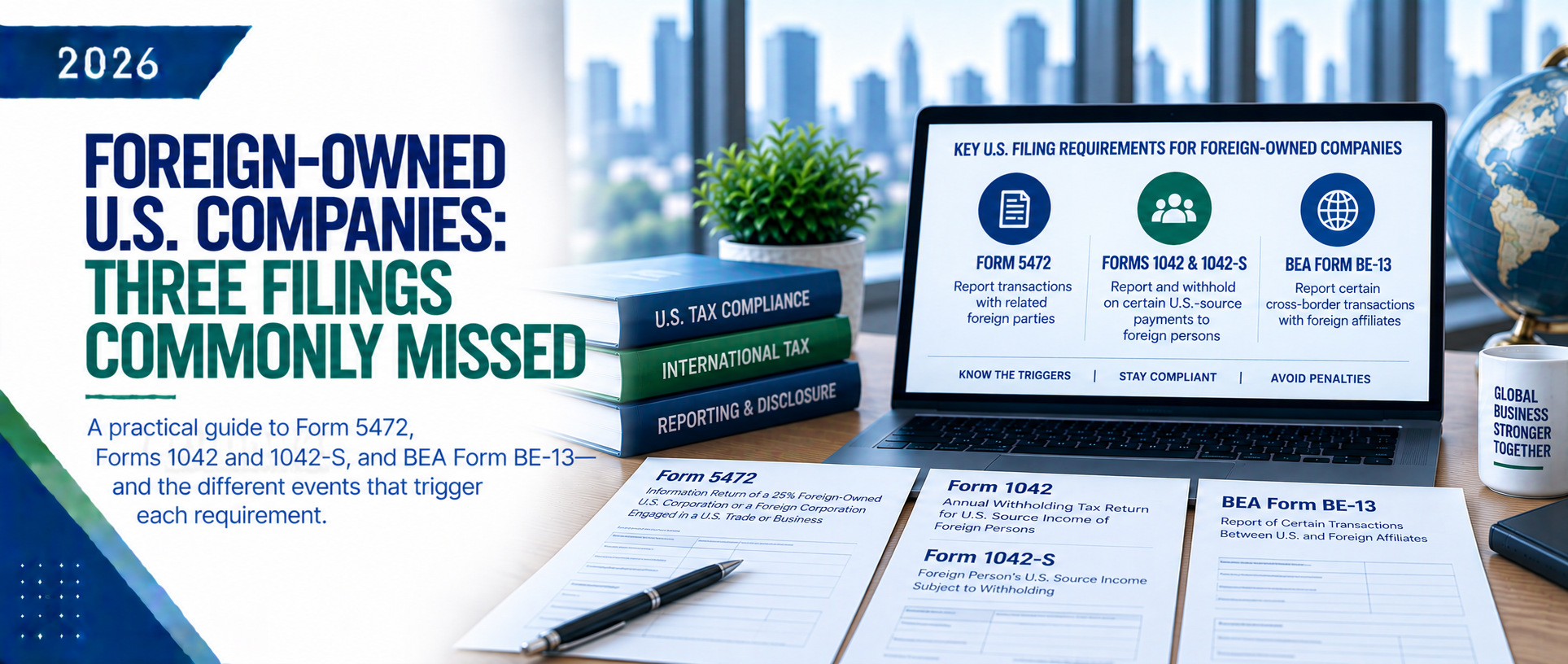
Suggested: tax adviser reviewing Form 5472, Form 1042-S, and BEA Form BE-13 filings.
 –>
–>
International Tax Compliance | Practical Guide
Foreign-Owned U.S. Companies: Three Filings Commonly Missed
A practical guide to Form 5472, Forms 1042 and 1042-S, and BEA Form BE-13—and the different events that trigger each requirement.
Foreign ownership does not create one universal filing. The trigger depends on what happened:
• Form 5472: a reportable transaction with a foreign related party.
• Forms 1042/1042-S: a reportable U.S.-source payment or other covered amount paid to a foreign person.
• BEA Form BE-13: new foreign direct investment generally reaching at least 10% voting interest.
These filings may apply even when the U.S. company has little revenue or no income tax due.
1. Definition: What “Foreign-Owned” Means for These Filings
A foreign-owned U.S. company is a U.S.-created business with a direct or indirect foreign owner. Each filing has its own trigger, so one ownership percentage does not determine the entire compliance picture.
For Form 5472, a domestic corporation is generally within scope when a foreign person owns at least 25% by vote or value and there is a reportable related-party transaction. A wholly foreign-owned U.S. disregarded entity is treated as a corporation for this information-reporting purpose.
Forms 1042/1042-S use a payment-based test, while BEA Form BE-13 generally uses a 10% voting-interest threshold for new foreign direct investment. A company may need one, several, or none of these filings.
2. Why It Matters
- Separate from income tax: A company can report no taxable profit and still miss an international information or withholding filing.
- Penalties can be significant: The source article notes a $25,000 Form 5472 failure-to-file penalty, possible continuation penalties, withholding-agent liability, and BEA civil enforcement exposure.
- Accounting records must show the trigger: Ownership, related-party activity, and cross-border payments should be identified clearly. Generic “owner transfer” entries or missing payee documentation can hide a filing requirement.
3. How the Three Filings Work
| Filing | Main Trigger | General Timing |
|---|---|---|
| Form 5472 | Specified transactions involving a reporting corporation and a related party | With the applicable income-tax return; special pro forma Form 1120 procedure for a foreign-owned U.S. disregarded entity |
| Forms 1042 / 1042-S | Reportable U.S.-source income or other covered amounts paid to a foreign person | Generally March 15 after the calendar year; withholding deposits may be due earlier |
| BEA Form BE-13 | New foreign direct or indirect voting ownership of at least 10%, or a covered establishment or expansion | Generally within 45 days of the transaction, establishment, or expansion |
Filing 1: Form 5472 and the Disregarded-Entity Trap
Form 5472 reports specified transactions between the reporting company and each related party. Examples include contributions, distributions, loans, interest, rents, royalties, services, sales, purchases, reimbursements, and certain noncash transfers. A separate form is generally prepared for each related party.
A U.S. corporation generally attaches Form 5472 to its income-tax return. A wholly foreign-owned disregarded entity generally files Form 5472 with a pro forma Form 1120. Under the source article’s cited IRS instructions, this filing uses a special fax or mailing procedure rather than e-file, and a timely Form 7004 may extend the deadline.
Track related-party transactions by counterparty and transaction type. “Owner transfer” is not enough to determine whether an amount is equity, debt, reimbursement, compensation, royalty, or distribution.
Filing 2: Forms 1042 and 1042-S
A U.S. company can become a withholding agent when it controls or pays an amount to a foreign person that is subject to withholding. Covered categories may include U.S.-source dividends, interest, rents, royalties, and certain compensation. The default Chapter 3 rate is often 30%, but the Code or a treaty may change the result when properly documented.
Not every foreign payment is subject to 30% withholding. Character, source, recipient status, and documentation control. Services are generally sourced where performed, and a U.S. bank wire is not automatically U.S.-source income. Obtain the appropriate Form W-8 before payment.
Form 1042 is the annual withholding return; Form 1042-S reports each recipient’s covered payment and withholding. Reporting may still apply even when withholding is reduced to zero, and tax deposits may be due during the year.
Filing 3: BEA Form BE-13
BEA Form BE-13 is a mandatory, confidential economic survey—not an IRS tax return. It generally applies when a foreign entity acquires at least 10% voting interest in a U.S. business, establishes a new U.S. entity, or undertakes a covered expansion through a U.S. affiliate.
The filing is generally due within 45 days after the acquisition, establishment, or expansion begins. The transaction determines the applicable form; some situations use a Claim for Exemption.
4. Simple Example
Assume a foreign individual forms a wholly owned U.S. single-member LLC on October 1, contributes $50,000, and the LLC later pays the owner a $20,000 royalty for IP used in the United States.
- Form 5472: Review the contribution and royalty as related-party transactions; the LLC generally files Form 5472 with a pro forma Form 1120.
- Forms 1042/1042-S: Analyze the U.S.-source royalty under the withholding rules. Without valid support for a reduced rate, 30% withholding may apply.
- BEA Form BE-13: Because the new U.S. entity is at least 10% foreign-owned, review the applicable BE-13 filing within 45 days—not at year-end.
One set of facts can trigger multiple filings for different reasons: related-party reporting, payment withholding, and the foreign-investment event.
5. Common Mistakes and Quick Answers
Common Mistakes
- Assuming a disregarded LLC has no federal filing obligation: A foreign-owned disregarded entity can still have Form 5472 reporting.
- Using generic owner-transfer entries: Identify the related party, purpose, and transaction type.
- Collecting W-8 documentation after payment: Review documentation, source, and withholding before payment.
- Using one withholding assumption for every foreign payment: Character, source, recipient status, and treaty documentation may differ.
Does no revenue mean no Form 5472?
No. A wholly foreign-owned disregarded entity may have reportable formation costs, capital contributions, loans, or distributions even with no customers or taxable income.
Does a U.S.-created company still file a BOI report?
The source article states that under FinCEN’s rule effective August 14, 2026, U.S.-created companies are exempt from federal BOI reporting, while certain foreign entities registered to do business in the United States remain subject unless exempt. BOI is separate from the three filings discussed here.
6. Practical Checklist: What’s Next
Work through these items to identify and manage international filing obligations.
0 of 6 complete
PNJ Perspective
Foreign-owned U.S. company compliance should be driven by ownership events, related-party transactions, and cross-border payments—not by whether the company owes income tax. PNJ helps businesses connect Form 5472, Forms 1042/1042-S, BEA reporting, W-8 documentation, and related filing calendars so international obligations are identified before deadlines are missed.
Technical Reference Points
- IRS Form 5472 Instructions
- IRS Form 1042-S Instructions
- IRS Publication 515
- BEA Foreign Direct Investment Surveys
- IRS FBAR Guidance
- FinCEN BOI Guidance
Disclaimer
This article provides general educational information and is not tax, legal, withholding, or regulatory advice. Filing requirements depend on the company’s ownership, transactions, payment types, documentation, and current rules. Confirm applicable requirements before filing or taking a compliance position.