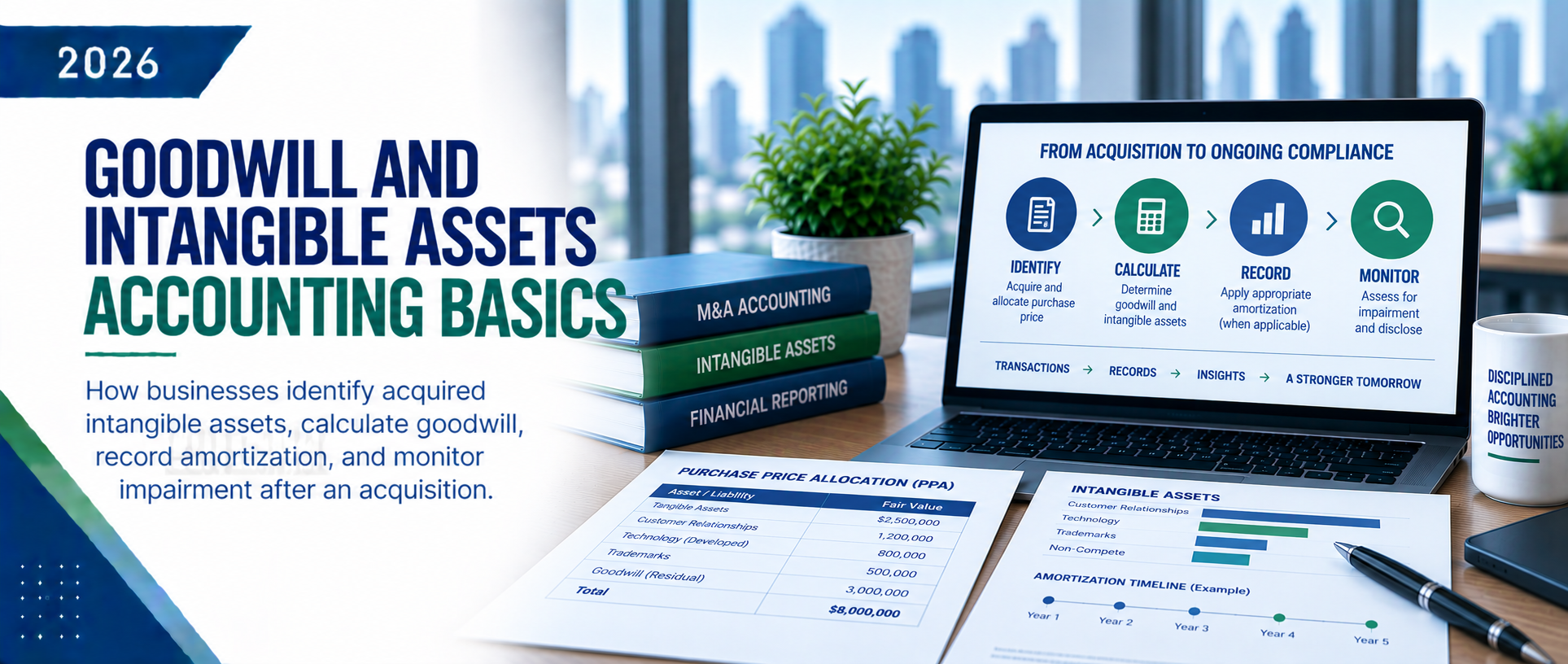
Suggested: accountant reviewing a purchase price allocation and intangible asset schedule.
 –>
–>
Accounting Practice Guide | Intermediate
Goodwill and Intangible Assets Accounting Basics
How businesses identify acquired intangible assets, calculate goodwill, record amortization, and monitor impairment after an acquisition.
Goodwill is the residual value in a business combination after identifiable assets and liabilities are measured. Qualifying identifiable intangible assets are recorded separately, then each balance follows its own useful-life, amortization, and impairment model.
1. Definition
An intangible asset is a nonphysical asset that provides future economic benefits, such as patents, trademarks, customer relationships, technology, licenses, contracts, and certain noncompete agreements. Recognition depends on the asset and how it was obtained.
An acquired intangible is identifiable when it is separable or arises from contractual/legal rights. In a business combination, qualifying intangibles are measured at acquisition-date fair value and recorded separately from goodwill.
Goodwill is the residual after comparing consideration with the fair value of identifiable net assets acquired. It may reflect synergies and other benefits that are not separately recognizable. Internally generated goodwill is not recorded.
2. Why It Matters
- Future earnings: More value assigned to finite-lived intangibles generally means more amortization; more value assigned to goodwill generally means no amortization under the general U.S. GAAP model but ongoing impairment exposure.
- Financial reporting: The allocation affects asset values, operating income, EBITDA explanations, taxes, and acquisition reporting. Amortization and impairment are noncash but still affect GAAP income.
- Supportability: The purchase agreement, valuation analysis, legal rights, customer data, forecasts, and useful-life assumptions should tell one consistent story—not use goodwill as a plug.
3. How It Works
Determine What Was Acquired
First determine whether the transaction is a business combination under ASC 805 or an asset acquisition. A business combination can create goodwill; an asset acquisition generally allocates cost to acquired assets and does not recognize goodwill. Transaction-cost treatment also differs, so document the conclusion early.
Recognize Identifiable Assets Before Goodwill
In a business combination, measure identifiable assets and liabilities at fair value before calculating goodwill. Customer relationships, technology, trade names, licenses, and contract-based rights may require separate valuation.
| Asset Type | Useful Life | Subsequent Accounting |
|---|---|---|
| Patent or developed technology | Usually finite | Amortize over the useful life and review for impairment when indicators exist. |
| Customer relationship | Usually finite | Amortize using the expected benefit pattern; straight line if another pattern cannot be reliably determined. |
| Trade name or trademark | Finite or indefinite | Amortize if finite; if indefinite, do not amortize and test for impairment at least annually. |
| Goodwill | Indefinite under the general model | Do not amortize under the general model; test at the reporting-unit level at least annually and when triggering events occur. |
Assign and Reassess Useful Lives
For each finite-lived intangible, determine the period it is expected to contribute to cash flows. Consider legal terms, renewals, customer attrition, technology cycles, competition, and expected use. Amortization begins when the asset is available for use, and the life/method should be reassessed when facts change.
Monitor Impairment Under the Correct Model
Use the correct impairment model:
- Finite-lived intangibles: test with other long-lived assets when impairment indicators exist.
- Indefinite-lived intangibles: test at least annually and when triggering events occur.
- Goodwill: test under the separate reporting-unit model under general U.S. GAAP.
Common triggers include customer loss, obsolescence, declining forecasts, restructuring, or falling enterprise value.
Keep Book and Tax Records Separate
Keep book and tax schedules separate. Book useful lives may differ from federal tax recovery periods. Many acquired Section 197 intangibles, including goodwill, are generally amortized over 15 years for federal tax purposes. Transaction structure can change the result and create book-tax differences.
4. Simple Example
Assume a company pays $5 million for a business. Tangible assets are $2.4 million, liabilities assumed are $800,000, and identifiable intangibles are separately valued as shown below.
| Purchase Price Allocation | Amount | Accounting Result |
|---|---|---|
| Tangible net assets | $1,600,000 | $2.4 million of assets less $800,000 of liabilities. |
| Customer relationships | $1,200,000 | Finite lived; assume six-year useful life. |
| Developed technology | $800,000 | Finite lived; useful life based on expected technology cycle. |
| Trade name | $300,000 | Assume indefinite lived based on the facts. |
| Goodwill | $1,100,000 | Residual: $5 million less $3.9 million of identifiable net assets. |
The purchase accounting records the tangible assets, identifiable intangibles, $1.1 million of goodwill, $800,000 of assumed liabilities, and $5 million of consideration. If customer relationships are amortized straight-line over six years, annual book amortization is $200,000. The trade name and goodwill are not amortized under the general model but remain subject to impairment.
5. Common Mistakes and Quick Answers
Common Mistakes
- Recording internally generated value as goodwill: Internally developed brand, customer loyalty, or workforce value generally is not recognized as goodwill.
- Using goodwill as a plug: Identify and value separate intangible assets first.
- Assuming an asset acquisition creates goodwill: Goodwill generally arises only in a business combination.
- Combining all intangibles in one account: Maintain asset-level useful-life and amortization support.
- Using the tax schedule as the book schedule: Book and tax lives may differ.
- Starting amortization too late: Begin when the finite-lived asset is available for use.
- Ignoring impairment because it is noncash: Noncash does not mean immaterial; impairment can affect GAAP income and acquisition analysis.
Can a Business Record Its Own Brand or Workforce Value?
Generally no. A business may have valuable internally developed brands, customer loyalty, or workforce capabilities without recognizing them as balance-sheet assets. Related costs follow the applicable expense or capitalization guidance.
Is Goodwill Always Amortized?
No. Under general U.S. GAAP, goodwill is not amortized. An eligible private company may elect straight-line amortization generally over 10 years or a shorter supportable life, with simplified trigger-based impairment testing. Federal tax treatment is separate and may include 15-year Section 197 amortization.
Does a Goodwill Impairment Mean the Business Has No Value?
No. A goodwill impairment means the carrying amount is not fully supported under the applicable accounting model. It does not necessarily equal the total decline in enterprise value or indicate an immediate cash loss.
6. Practical Checklist: What’s Next
Work through these items when accounting for an acquisition or reviewing goodwill.
0 of 9 complete
PNJ Perspective
Goodwill and intangible-asset accounting should tell one consistent story from the purchase agreement and valuation through useful lives, amortization, impairment, and book-tax schedules. PNJ helps businesses organize purchase accounting, valuation support, recurring schedules, and review controls so management can trace the original acquisition to the current carrying amount.
Technical Reference Points
- FASB ASU 2014-02, Private Company Goodwill Alternative
- FASB ASU 2017-04, Goodwill Impairment
- IRS Instructions for Form 8594
Disclaimer
This article provides general educational information and is not accounting, tax, legal, valuation, or transaction advice. Recognition, fair value, useful lives, impairment, tax basis, and available accounting alternatives depend on the transaction and applicable reporting framework. Consult qualified advisers regarding specific facts.