Suggested: partners reviewing a Schedule K-1 and partnership agreement together.
 –>
–>
Tax Practice Guide | Intermediate
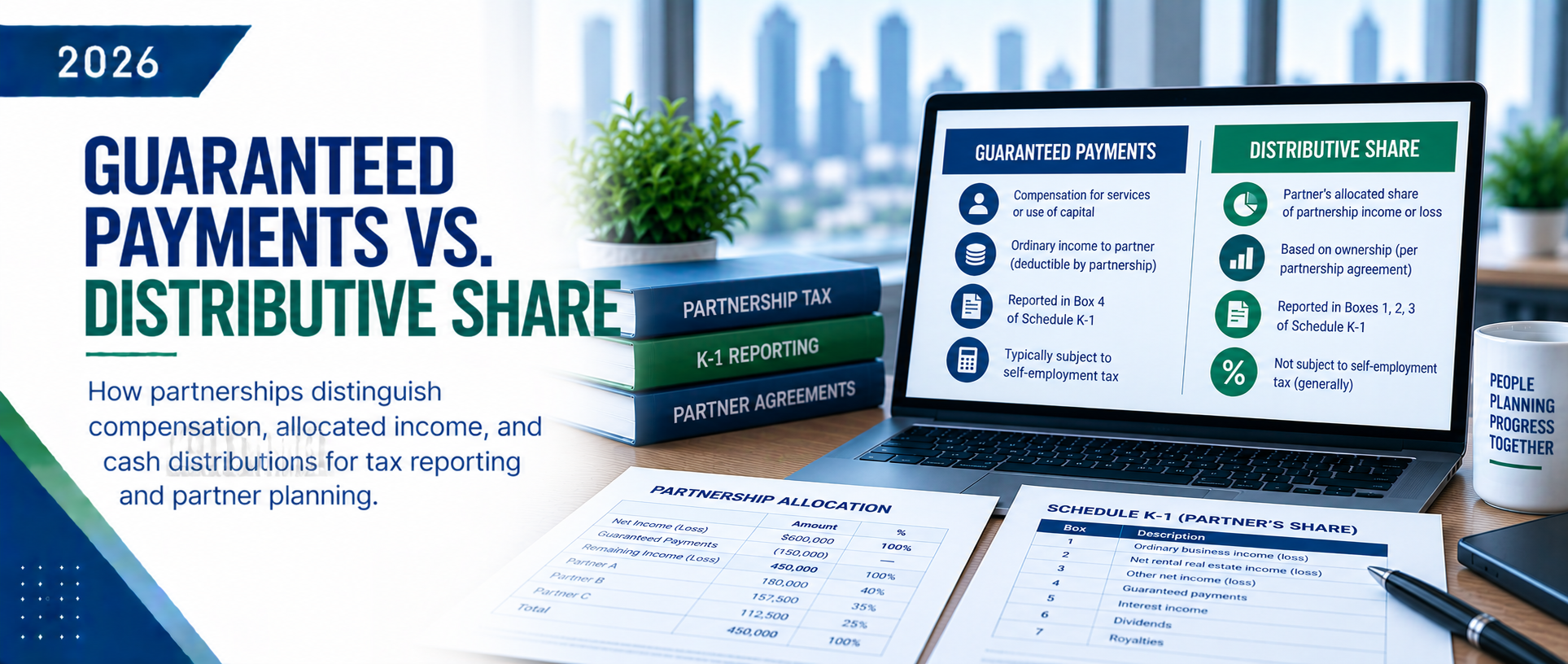
Guaranteed Payments vs. Distributive Share
How partnerships distinguish compensation, allocated income, and cash distributions for tax reporting and partner planning.
A guaranteed payment compensates a partner for services or use of capital without regard to partnership income. A distributive share allocates partnership tax items among partners. A cash distribution is separate from both. A partner may receive all three in the same year.
1. Definition
A guaranteed payment is determined without regard to partnership income. Example: a managing partner receives $8,000 per month even if the partnership has a loss.
A distributive share is the partner’s allocated share of partnership tax items under the agreement and federal tax rules, including ordinary income/loss and separately stated items.
A cash distribution transfers cash or property but does not determine taxable allocation. Keeping these concepts separate supports accurate books, Form 1065, Schedule K-1, and basis records.
2. Why It Matters
- Partnership return: A deductible guaranteed payment generally reduces income remaining for allocation; a distributive share is not a partnership deduction.
- Partner-level tax: Guaranteed payments generally produce ordinary income and often no federal income-tax withholding. Partners are generally self-employed, so self-employment and estimated-tax effects may apply.
- Taxable income vs. cash: A partner can owe tax on distributive share even when the partnership retains cash for growth or debt service.
3. How It Works
| Question | Guaranteed Payment | Distributive Share |
|---|---|---|
| What determines it? | Services or use of capital; determined without regard to partnership income. | Allocation of partnership tax items under the agreement and tax rules. |
| Partnership treatment | Generally deductible if otherwise allowable or capitalized when required. | Not deductible; remaining items are allocated among partners. |
| Schedule K-1 | Boxes 4a, 4b, and 4c for services, capital, and total payments. | Ordinary business income often appears in Box 1; other items use separate boxes. |
| Cash required? | Usually paid or accrued under the agreement. | Taxable allocation can exist even when no cash is distributed. |
| Self-employment tax | Service payments from the trade or business are generally included; capital-payment treatment requires analysis. | Treatment depends on partner status and activity; limited-partner and LLC-member rules can be fact-sensitive. |
Start With the Partnership Agreement
The agreement should identify service/capital payments, allocations, draws, tax distributions, and other distributions. The books should follow those terms, and changes in partner economics should be documented before year-end reporting.
Determine Partnership Income Before Allocation
A deductible guaranteed payment is generally recorded before remaining ordinary income or loss is allocated. Some payments must be capitalized. A deductible payment can create a partnership loss; any allocated loss remains subject to basis and other deduction limitations.
Report the Partner Items Separately
Schedule K-1 reports guaranteed payments separately from distributive share. Boxes 4a–4c report guaranteed payments for services/capital, while ordinary business income or loss generally appears in Box 1.
Evaluate Self-Employment Tax and Basis
Self-employment-tax treatment depends on partner status and activity. Service guaranteed payments are generally included for partners outside the limited-partner exception; LLC-member treatment can be fact-sensitive.
Maintain a separate outside-basis schedule. Distributive share generally increases outside basis, while cash distributions generally reduce it. A Schedule K-1 capital account is not a substitute for outside tax basis.
4. Simple Example
Assume a two-partner consulting firm earns $180,000 before a guaranteed payment. Partner A receives a $60,000 guaranteed payment for managing operations; the remaining income is allocated 50/50.
| Step | Amount | Tax Result |
|---|---|---|
| Income before guaranteed payment | $180,000 | Starting partnership income. |
| Guaranteed payment to Partner A | ($60,000) | Deductible service payment in this illustration. |
| Remaining ordinary income | $120,000 | Allocated 50% to each partner. |
| Partner A reporting | $120,000 | $60,000 guaranteed payment plus $60,000 distributive share. |
| Partner B reporting | $60,000 | $60,000 distributive share. |
If the partnership also distributes $25,000 to each partner, the income allocations do not change. The distribution is recorded separately and generally reduces outside basis.
5. Common Mistakes and Quick Answers
Common Mistakes
- Calling every payment a draw/distribution: Identify its actual economic purpose.
- Putting a bona fide partner on W-2 payroll: Partners are generally self-employed for services performed as partners.
- Treating a cash distribution as an expense or distributive share: Cash distribution is a separate concept.
- Allocating income before a deductible guaranteed payment: Record the payment first, then allocate remaining income.
- Assuming tax follows cash received: Distributive share may be taxable without a matching distribution.
- Ignoring SE tax, estimated tax, or outside basis: Analyze each partner separately and maintain basis records.
Is a Guaranteed Payment the Same as Salary?
No. It may be salary-like economically, but a partner is generally self-employed. The amount is normally reported through Form 1065 and Schedule K-1—not Form W-2—and generally has no federal income-tax withholding.
Can a Guaranteed Payment Create a Loss?
Yes. A deductible guaranteed payment can create or increase a partnership loss. The recipient still reports the payment as ordinary income; any allocated loss is separately subject to deduction limitations.
6. Practical Checklist: What’s Next
Work through these items when classifying and reporting partner payments.
0 of 10 complete
PNJ Perspective
Partner payments should tell one consistent story across the partnership agreement, general ledger, Form 1065, Schedule K-1, and outside-basis records. PNJ helps distinguish guaranteed payments, distributive share, and cash distributions and evaluate the related self-employment, estimated-tax, and basis effects.
Technical Reference Points
- IRS Publication 541, Partnerships
- IRS Instructions for Form 1065
- IRS Partner’s Instructions for Schedule K-1
Disclaimer
This article provides general educational information and is not tax, accounting, legal, or payroll advice. Partnership allocations, guaranteed payments, self-employment tax, basis, and state treatment depend on the agreement and specific facts. Consult qualified advisers before acting.