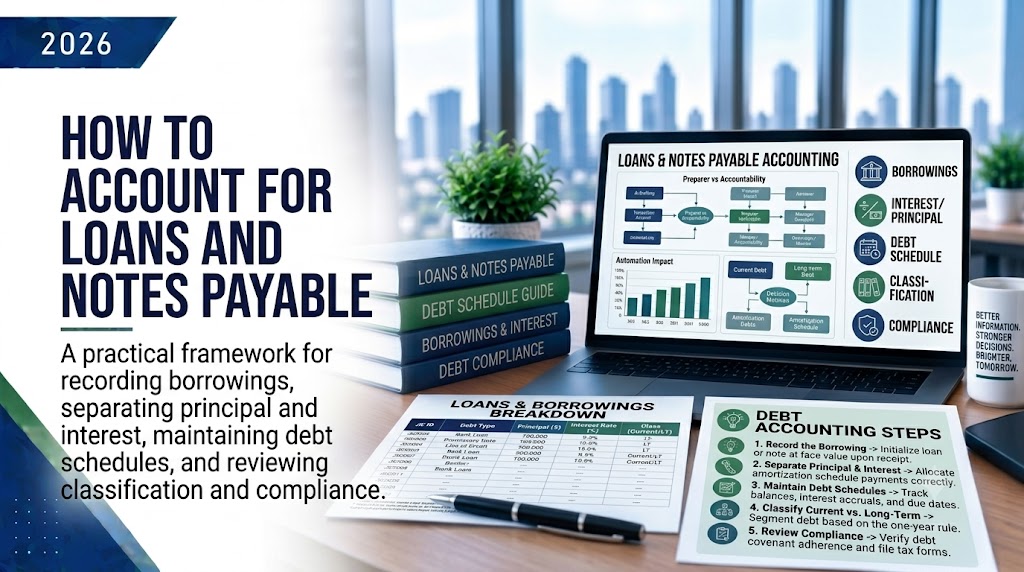
Suggested: finance team reviewing a loan amortization schedule and signed loan agreement at a desk.
 –>
–>
Accounting Practice Guide
How to Account for Loans and Notes Payable
A practical framework for recording borrowings, separating principal and interest, maintaining debt schedules, and reviewing classification and compliance.
Receiving loan proceeds does not create revenue, and a loan payment is not automatically an expense. Accurate debt accounting separates principal, interest, fees, and accrued amounts; reconciles each instrument to its agreement and lender support; and updates current maturities and covenant status at each reporting date.
1. Definition
Loans payable and notes payable are contractual obligations to repay borrowed funds. Common forms include bank loans, equipment financing, lines of credit, and private loans. A note payable is typically evidenced by a written agreement stating principal, interest, payment terms, and maturity. Regardless of label, both are debt liabilities.
Start with the executed agreement. Identify the borrower, lender, proceeds, interest terms, payment schedule, maturity, collateral, covenants, guarantees, prepayment terms, and fees. A lender statement is supporting evidence, but it does not replace the legal terms.
2. Why It Matters
- Financial-statement impact: Principal affects the balance sheet; interest and fee amortization affect earnings; borrowing proceeds and principal repayments are generally financing cash flows under U.S. GAAP; and interest paid is generally an operating cash flow.
- Liquidity and classification: Debt due within the next 12 months generally belongs in the current portion. Covenant violations, waivers, refinancing, and callable provisions may also affect classification and disclosure.
3. How It Works
Record the Borrowing and Related Costs
When cash is received, record Dr Cash / Cr Notes Payable. Example: a $500,000 borrowing creates a $500,000 debt liability—not revenue. Discounts, premiums, and qualifying issuance costs may cause the carrying amount to differ from contractual principal.
Debt issuance costs associated with a recognized debt liability are generally presented as a direct deduction from the debt and amortized to interest expense. Line-of-credit costs may be deferred as an asset when no balance is outstanding. Distinguish financing costs from ordinary legal, advisory, or bank-service costs.
Separate Principal From Interest
Only principal repayment reduces the liability. Interest is the cost of borrowing and is recognized over time. Use the lender amortization schedule or an independently maintained debt schedule rather than coding the full cash payment to expense.
| Payment Component | Accounting Effect | Typical Entry |
|---|---|---|
| Principal | Reduces the debt liability | Debit Notes Payable |
| Interest | Recognizes the borrowing cost | Debit Interest Expense |
| Total cash paid | Reduces cash | Credit Cash |
Accrue Interest at Period End
Accrue interest in the period incurred even if payment occurs later. If $3,000 has accrued, record Dr Interest Expense / Cr Accrued Interest Payable $3,000. When paid, clear the payable instead of recording the expense again.
Maintain the Debt Schedule and Classification
Maintain a schedule for each material debt instrument showing beginning principal, draws, principal repaid, interest, fee amortization, ending principal, accrued interest, and next-12-month maturities. Present the principal due within 12 months as current debt and the remainder as noncurrent.
Special items to track: variable-rate debt—current rate and reset date; lines of credit—draw-by-draw activity and actual outstanding balance; related-party/shareholder debt—written terms and consistent payments, clearly separated from capital contributions and distributions. Below-market related-party loans may also require tax analysis.
Review Covenants and Changes Before Issuance
Calculate covenants before issuing financial statements using the agreement definitions. If a violation allows the lender to demand repayment, evaluate current vs. noncurrent classification and disclosure. Retain waivers or amendments and involve the Controller, CFO, and external CPA early.
Refinancing, significant amendments, early payoff, forgiveness, or troubled debt require separate analysis. Under ASC 470, the change may be a modification or extinguishment, affecting unamortized fees, lender fees, prepayment penalties, and possible gain or loss. Do not simply replace the old balance with the new lender balance.
4. Simple Example
Example: A company borrows $500,000 and later pays $12,000 consisting of $9,500 principal and $2,500 interest. The entry is:
| Account | Debit | Credit |
|---|---|---|
| Notes Payable | $9,500 | |
| Interest Expense | $2,500 | |
| Cash | $12,000 |
After six identical payments, principal is $443,000. If $114,000 is due within the next 12 months, classify that amount as current debt and the remaining $329,000 as long-term debt. Actual amortizing loans usually have changing interest components.
| Debt Rollforward | Amount | Review Point |
|---|---|---|
| Beginning principal | $500,000 | Agree to the agreement and prior period |
| Principal repaid | ($57,000) | Agree to six payments and lender activity |
| Ending principal | $443,000 | Agree to the lender and general ledger |
| Current portion | $114,000 | Principal contractually due within 12 months |
| Long-term portion | $329,000 | Remaining principal due after 12 months |
5. Common Mistakes and FAQs
Common Mistakes
- Loan proceeds / payments: Do not record proceeds as revenue or the entire payment as interest expense.
- Interest and fees: Accrue unpaid interest and amortize qualifying debt issuance costs.
- Current maturities: Do not leave the full balance in long-term debt when principal is due within 12 months.
- Debt schedule: Do not rely only on the general ledger; maintain support by instrument.
- Variable-rate / LOC items: Update rates and consider unused commitment fees where applicable.
- Shareholder debt: Keep loans separate from equity contributions, distributions, and personal activity.
- Covenants and maturity: Review covenant calculations, waivers, maturity dates, and refinancing terms.
- Refinancing / forgiveness: Evaluate modification or extinguishment accounting before clearing balances.
Is a Loan Payment an Expense?
Only interest and applicable fee amortization generally affect expense. Principal repayment reduces the liability. Use the debt schedule to support the split.
Should Every Loan Have Its Own General Ledger Account?
Not necessarily. Similar instruments may be grouped in the general ledger when reporting remains clear, but the supporting debt schedule should track each loan separately and reconcile exactly to the summarized GL balance.
What If the Lender Statement Does Not Match the Books?
Reconcile the difference—do not force the books to the lender statement. Common causes include payments in transit, late fees, accrued interest, rate resets, lender-applied fees, or an incorrect principal-interest split. Confirm the lender’s principal balance and retain the resolution.
6. Practical Checklist and What Comes Next
| Owner | Required Action | Evidence |
|---|---|---|
| Accounting | Roll forward each loan; record draws, principal, interest, and fees. | Debt schedule, lender activity, and journal entries |
| Accounting | Accrue unpaid interest and reconcile ending principal to the general ledger. | Interest calculation and reconciliation |
| Controller | Review current maturities, rate changes, fee amortization, and unusual entries. | Reviewed maturity schedule and close sign-off |
| Controller or CFO | Calculate covenants and escalate actual or expected violations. | Covenant worksheet, waiver, or amendment |
| Controller and CPA | Evaluate new, modified, refinanced, forgiven, or extinguished debt. | Executed agreement and accounting conclusion |
| Management | Use scheduled principal and interest in liquidity and cash-flow forecasts. | Approved forecast and financing plan |
Year-end support should include: executed agreements and amendments, lender statements or confirmations, amortization schedules, fee support, covenant analysis, and waiver documentation. A reviewer should be able to trace the financial-statement balance to the legal obligation and third-party evidence without rebuilding the history from bank transactions.
How PNJ Can Help
PNJ Group can build and reconcile debt schedules, separate principal and interest, account for issuance costs, review current maturities and covenants, and document refinancing or modification conclusions. The goal is a debt balance that agrees across the agreement, lender records, general ledger, and financial statements.
Official References
- FASB ASU 2015-03 — Debt Issuance Costs
- FASB ASU 2015-15 — Line of Credit Costs
- FASB ASU 2016-15 — Cash Flow Classification
Disclaimer
This article provides general educational information and is not accounting, audit, tax, legal, or financial advice. Debt accounting depends on the executed agreement, payment terms, materiality, reporting framework, and specific facts. Consult qualified advisers regarding particular arrangements.