Suggested: an HR/payroll professional reviewing a U.S. map with multiple state locations highlighted, alongside payroll documents.
 –>
–>
Tax Compliance Practice Guide
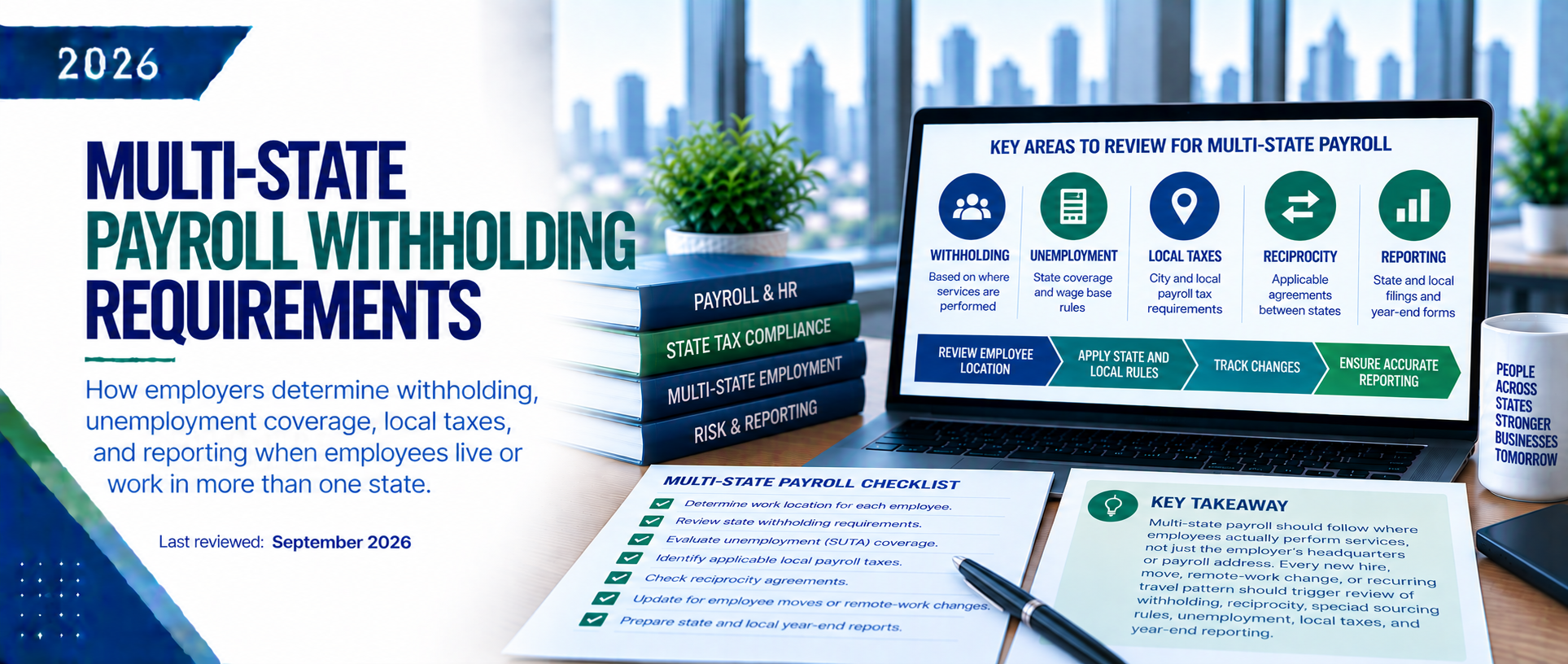
Multi-State Payroll Withholding Requirements
How employers determine withholding, unemployment coverage, local taxes, and reporting when employees live or work in more than one state
Multi-state payroll should follow where employees actually perform services, not just the employer’s headquarters or payroll address. Every new hire, move, remote-work change, or recurring travel pattern should trigger review of withholding, reciprocity, special sourcing rules, unemployment, local taxes, and year-end reporting.
1. Definition
Multi-state payroll withholding determines which state or local income taxes apply when an employee lives, works, travels, or relocates across jurisdictions. The analysis may involve the residence state, one or more work states, and special sourcing rules.
Withholding is only one part of the review: also evaluate state unemployment, local payroll taxes, registrations, wage reporting, and broader business-tax obligations.
2. Why It Matters
- Payroll systems follow configuration: A wrong work state can lead to incorrect withholding, missed filings, or wages reported to the wrong jurisdiction.
- Corrections can be costly: They may require retroactive registrations, amended payroll returns, tax payments, penalties, interest, and corrected Forms W-2. A remote employee may also create non-payroll nexus or registration issues.
3. How It Works
| Work Pattern | Primary Withholding Question | Additional Review |
|---|---|---|
| Lives and works in one state | Does that state require resident wage withholding? | Local tax and unemployment setup |
| Lives in one state and works in another | Does the work state tax the wages? | Reciprocity and resident-state credit |
| Works remotely from another state | Does the home work location create withholding? | Registration, nexus, and unemployment |
| Works or travels in several states | How should wages and days be allocated? | Thresholds, exceptions, and records |
Start with Residence and Actual Work Location
Start with where the employee physically performs services. A home office in another state, permanent move, temporary assignment, or repeated travel can change the withholding result.
Check Reciprocity and Resident State Rules
When an employee lives in one state and works in another, both states may matter. The work state may tax wages earned there while the residence state may tax all income and allow a credit. Some neighboring states instead have reciprocity agreements.
Reciprocity is not automatic. It applies only to specified state pairs and usually requires a state-specific exemption certificate. It generally affects wage withholding—not unemployment, local tax, or broader business-tax obligations.
Identify Special Remote Work Rules
Some states use convenience-of-the-employer rules for certain nonresident employees. For example, New York may treat out-of-state remote days as New York workdays in certain situations tied to the assigned office and employer necessity.
Document the assigned office, reason for remote work, bona fide employer-office facts, and days worked by jurisdiction. A home address alone does not answer the sourcing question.
Review Temporary Travel and Wage Allocation
There is no universal tax-free travel period. States may use day-count or wage thresholds, administrative exceptions, or first-day withholding. Executives, salespeople, consultants, installers, and project teams are common risk groups.
Maintain contemporaneous records such as calendars, time records, expense reports, travel approvals, and work-location certifications. Waiting until year-end makes accurate withholding and W-2 reporting much harder.
Determine Unemployment and Local Tax Separately
State unemployment insurance does not necessarily follow income-tax withholding. The localization analysis generally considers where services are localized, base of operations, direction and control, and then residence.
Local taxes are a separate layer. Cities, counties, school districts, and other jurisdictions may impose employee wage taxes, employer payroll taxes, occupational taxes, or local reporting. A state registration does not automatically complete the local setup.
Register, Configure, and Reconcile
After identifying the jurisdictions, register before withholding begins, obtain employee certificates, configure payroll, and add returns and deposits to the compliance calendar. Reconcile quarterly wage reports and payroll liabilities to the general ledger.
Before issuing Forms W-2, confirm state wages and withholding agree with quarterly filings and the company’s sourcing method. Multi-state employees may have more than one state entry, and state wages do not always equal federal Box 1 wages.
4. Simple Example
Example: A Pennsylvania company hires an employee who works permanently from a New York home office and occasionally visits Pennsylvania.
- Location & withholding: Document New York as the regular work location, track Pennsylvania workdays, and evaluate each state’s registration and withholding rules.
- Unemployment & other obligations: Apply separate unemployment-localization rules and review local payroll taxes, business-tax nexus, registrations, and workers’ compensation.
- Reporting: Maintain wage allocations during the year and reconcile both states before quarterly filings and Form W-2 issuance.
Changing only the employee’s mailing address in payroll is not a complete compliance process.
5. Common Mistakes and Quick Answers
Common Mistakes
- Using headquarters state for every employee: withholding generally starts with actual work location.
- Allowing a move before review: HR and Payroll should assess the new state before the change begins.
- Applying reciprocity without documentation: the required exemption certificate may be necessary.
- Treating withholding and unemployment as one analysis: they can follow different rules.
- Ignoring travel, convenience rules, or local taxes: short-term activity may still create obligations.
- Assuming the payroll provider identifies all nexus: business-tax and registration analysis may require separate review.
- Waiting until W-2 season: reconcile work locations and state wages throughout the year.
Does Every Business Trip Require Withholding?
Not necessarily. State rules vary, so identify where employees travel, applicable thresholds or exceptions, and supporting records. Repeated travel generally deserves more attention than an isolated visit.
Can an Employee Choose the Withholding State?
Generally no. Withholding follows state and local law, residence, and where services are performed. An employee certificate may claim an available exemption or provide allocation information, but it cannot create a rule that does not otherwise apply.
6. Practical Checklist: What’s Next
Route each role’s action item whenever a work-location change comes up.
0 of 6 complete
Maintain an employee-location register or nexus matrix, connect location changes to the payroll calendar, and review multi-state employees at least quarterly. Resolve exceptions before year-end rather than during W-2 preparation.
PNJ Perspective
Multi-state payroll works best when work-location changes are identified before payroll is processed. PNJ helps employers evaluate work-state withholding, reciprocity, unemployment localization, local payroll taxes, registrations, and broader state-tax nexus while building controls for new hires, relocations, remote work, and travel.
Technical Reference Points
- U.S. Department of Labor: Localization of Work Guidance
- New York: Telecommuting and Convenience Rule
- Pennsylvania: Employer Withholding and Reciprocity
Disclaimer
This article provides general educational information and is not tax or legal advice. State and local withholding, unemployment, nexus, registration, and employment requirements vary by jurisdiction and facts. Confirm current rules before an employee begins working in a new state.