Suggested: Two business partners and a tax advisor reviewing a partnership ledger and capital schedule across a conference table.
 –>
Tax Insights
Partnership Basis vs. Capital Account: Why the Numbers Are Different
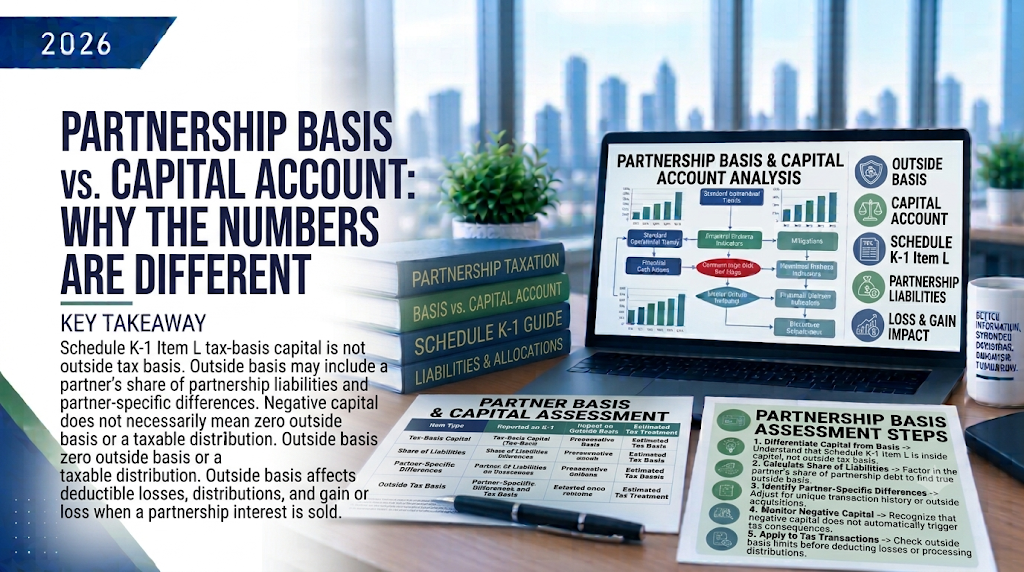
Schedule K-1 Item L tax-basis capital is not outside tax basis. Outside basis may include a partner’s share of partnership liabilities and partner-specific differences. Negative capital does not necessarily mean zero outside basis or a taxable distribution. Outside basis affects deductible losses, distributions, and gain or loss when a partnership interest is sold.
1. Scope and Key Issues
Partners in partnerships and members of LLCs taxed as partnerships often see different amounts for their Schedule K-1 capital account and their tax basis in the ownership interest. These figures measure different things and should not be used interchangeably.
- Tax-basis capital generally reflects contributions, allocated tax income or loss, and distributions for K-1 reporting.
- Outside basis is the partner’s adjusted tax basis in the partnership interest, including certain liability adjustments. It is tracked at the partner level.
- Inside basis is the partnership’s tax basis in its own assets; it is not the partner’s outside basis.
2. Applicable Rules and Requirements
Key provisions of the Internal Revenue Code include:
- IRC §§ 705 and 722: Adjustments to outside basis and basis of an interest acquired through contribution.
- IRC § 752: Changes in a partner’s share of partnership liabilities may be treated as deemed cash contributions or distributions.
- IRC §§ 704(d) and 731: Basis limitations on partnership losses and gain recognition on certain distributions.
- IRC § 751: Certain gains on sale of a partnership interest may be treated as ordinary income rather than capital gain.
Schedule K-1 Item L reports tax-basis capital; Item K1 reports the partner’s share of liabilities. Neither replaces a complete partner-specific outside-basis schedule.
3. Accounting or Tax Treatment
| Measure | Main purpose | Partnership debt included? |
|---|---|---|
| Tax-basis capital (Item L) | Reports capital activity on a tax basis | No |
| Outside basis | Tests partner-level tax consequences | Generally yes, under §752 |
| Inside basis | Tracks basis of partnership assets | Not a partner-level balance |
Outside basis generally increases with contributions, allocated income, and increases in qualifying liability shares. It generally decreases with distributions, allocated losses and deductions, certain nondeductible expenditures, and liability-share decreases. Outside basis cannot be reduced below zero; tax-basis capital can be negative.
Capital plus an allocated liability share may help explain differences, but it is not a universal outside-basis formula. Purchased interests, transfers, historical adjustments, and other partner-specific facts require separate analysis. A §743(b) adjustment generally changes inside asset basis with respect to a particular partner; it should not simply be added to outside basis.
4. Exceptions, Elections, and Limitations
- Debt shifts can create taxable consequences without cash. A decrease in an allocated liability share is generally treated as a deemed distribution under §752; if money distributed exceeds outside basis, §731 gain may arise.
- Basis is only the first loss limitation. Losses passing §704(d) may still be limited under the at-risk rules, passive activity rules, or other applicable provisions.
- Acquisition method matters. A purchased interest generally has a different starting-basis analysis from an interest received for contributed property, by gift, or by inheritance.
- Sales require additional analysis. Liability relief is generally included in amount realized; §751 may recharacterize part of the gain as ordinary income.
5. Practical Example and Calculations
Assume Partner A contributes $50,000 for a 50% interest in a real-estate LLC and is allocated $100,000 of qualifying partnership liabilities. The liability allocation remains unchanged through Year 2. Assume the allocated loss passes the basis test; other loss limitations are evaluated separately.
| Event | Item L tax capital | Outside basis |
|---|---|---|
| Initial contribution plus allocated debt | $50,000 | $150,000 |
| Year 1: $60,000 allocated tax loss | ($10,000) | $90,000 |
| Year 2: $10,000 income; $30,000 cash distribution | ($30,000) | $70,000 |
At the end of Year 2, tax-basis capital is negative $30,000 while outside basis remains positive $70,000. The cash distribution does not by itself create gain under these assumptions.
Assume the outside basis remains $70,000, A receives $20,000 cash, and A is relieved of the $100,000 liability share. Amount realized is $120,000, giving a $50,000 gain before any §751 character analysis or other adjustments.
If the $100,000 liability share instead falls to zero while outside basis is $70,000, the deemed cash distribution may produce $30,000 of gain, even with no cash payment to A.
6. Reporting, Documentation, and Key Considerations
- Maintain a partner-level outside-basis rollforward covering beginning basis, income, losses, distributions, acquisitions, and §752 liability changes.
- Reconcile Schedule K-1 Items K1 and L to debt schedules, capital activity, and partner-specific records; investigate unexplained differences.
- Track suspended losses separately by basis, at-risk, and passive-activity limitation, where relevant.
- Model major transactions in advance including refinancing, guarantees, distributions, redemptions, and ownership-interest sales.
How PNJ Group Can Help
PNJ Group supports partnership tax reporting, outside-basis schedules, K-1 reconciliations, loss-limitation analysis, and planning for distributions, debt changes, and ownership transactions.
Technical References
- IRS Publication 541, Partnerships
- IRS Partner’s Instructions for Schedule K-1 (Form 1065)
- Internal Revenue Code §§ 704(d), 705, 722, 731, 743(b), 751, and 752.
Disclaimer
This article is general educational information, not individualized tax advice. Results depend on partnership agreements, debt arrangements, elections, transaction history, and each partner’s circumstances.