Suggested: tax preparer reconciling Schedule L, K-1 Item L, and outside-basis schedules.
 –>
–>
Partnership Tax Technical Guide | Advanced
Partnership Capital Accounts vs Tax Basis
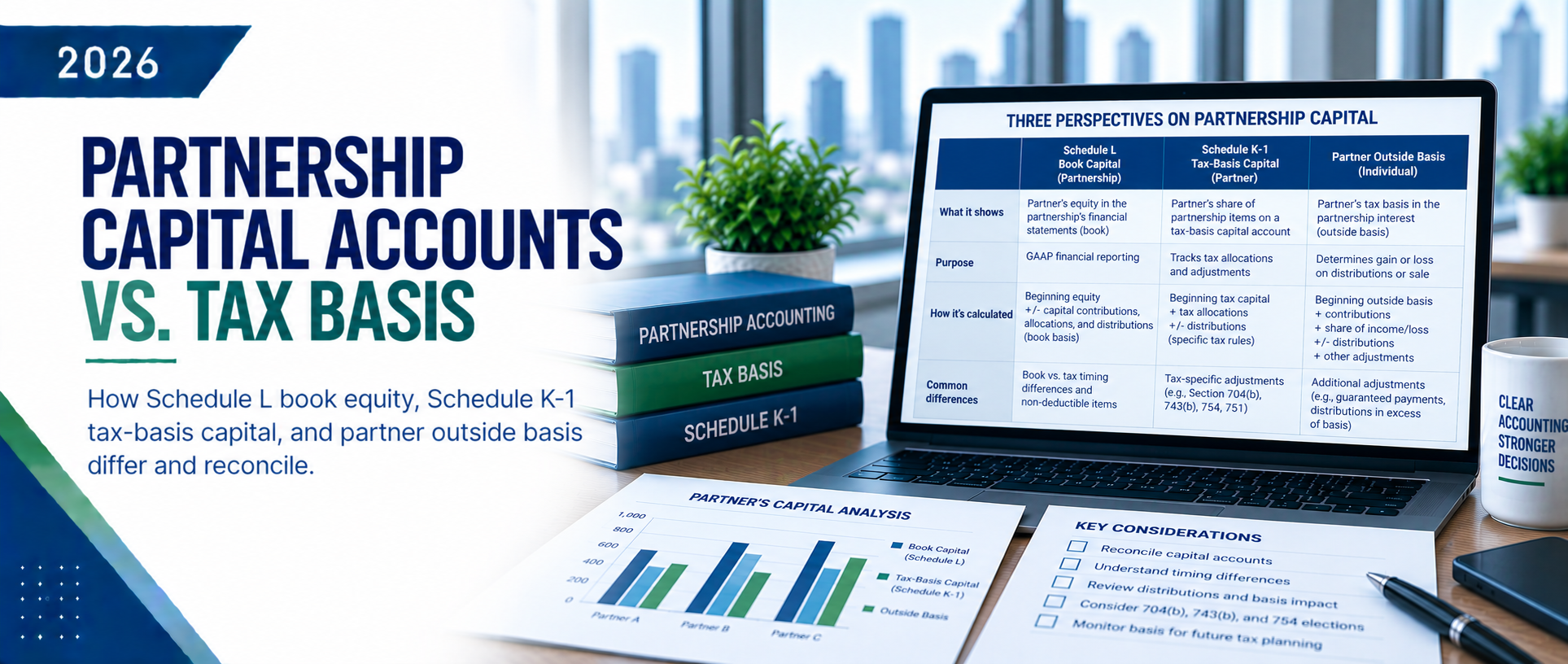
How Schedule L book equity, Schedule K-1 tax-basis capital, and partner outside basis differ and reconcile.
Schedule L capital, Schedule K-1 Item L tax-basis capital and partner outside basis are separate measurements. Schedule L follows the books, Item L follows federal tax-capital rules, and outside basis is the partner’s tax investment used for partner-level tax decisions. Book-to-tax income differences do not automatically create the same capital difference—each item must be traced through the applicable rules.
1. Definition
- Schedule L capital: partnership-level equity reported on Form 1065’s balance sheet per books. It follows the accounting basis used in the partnership’s books and records.
- Schedule K-1 Item L: each partner’s tax-basis capital. It generally increases for contributions and income and decreases for losses, nondeductible expenditures, and distributions. Partnership liabilities generally are not included.
- Outside basis: the partner’s adjusted tax basis in the partnership interest. It changes for contributions, income, losses, distributions, and the partner’s share of partnership debt, and it is used for partner-level tax decisions.
| Measurement | Level and Purpose | Primary Difference |
|---|---|---|
| Schedule L partners capital | Partnership balance sheet per books | Uses carrying amounts in the partnership’s books |
| K-1 Item L tax-basis capital | Individual partner tax-capital reporting | Generally excludes the partner’s liability share |
| Partner outside basis | Partner-level losses, distributions, and interest disposition | Includes liabilities and partner-specific basis history; cannot be negative |
2. Why It Matters
- Schedule L vs. Item L: They do not have to match when Schedule L is maintained on a non-tax book basis. If Schedule L is tax basis and still differs from aggregate Item L capital, the difference should be reconciled and explained.
- Outside basis controls partner-level tax results: It is used for loss limitations, cash-distribution gain, and gain or loss on sale or liquidation. Using Item L instead can produce the wrong answer.
| Question | Measurement | Why |
|---|---|---|
| What equity appears on the partnership balance sheet? | Schedule L capital | Reports the books and records |
| What tax capital is assigned to this partner? | K-1 Item L | Reports the transactional tax-capital rollforward |
| Can this partner deduct the allocated loss? | Partner outside basis | Item L is not the partner’s adjusted tax basis |
| Does a cash distribution trigger gain? | Outside basis before the distribution | Gain may arise when cash exceeds outside basis |
| How is contributed property reflected? | Book value, tax-basis capital, and Section 704(b) capital | Book and tax values may begin at different amounts |
3. How It Works
Start With Schedule L and the Book Basis
Start with the books. Tie Schedule L assets, liabilities, and partners’ capital to the general ledger, then identify book-to-tax differences. Schedule M-1 or M-3 may explain income differences, but it does not automatically explain every capital difference.
Roll Forward K-1 Item L
Roll Item L forward from the prior year:
- Add contributions, taxable income, and tax-exempt income.
- Subtract losses, nondeductible expenses, and distributions.
- Include other supported tax-capital adjustments.
Item L can be negative, and a partner’s share of partnership debt is generally not added to Item L.
Classify the Schedule L to Tax Capital Difference
Temporary differences often create capital differences that reverse. Example: if book depreciation is $20,000 and tax depreciation is $50,000, tax-basis capital may be $30,000 lower than book capital, assuming no offsetting items.
Permanent income differences require a separate review. A $10,000 nondeductible penalty reduces book income but not taxable income; however, it generally still reduces tax-basis capital. Likewise, tax-exempt interest may increase tax-basis capital even though it is not taxable income.
Not every difference is simply “temporary” or “permanent.” Contributed property, fair-value book-ups/book-downs, property distributions, and historical adjustments can create differences that require transaction-specific schedules.
Calculate Outside Basis Separately
Calculate outside basis separately. Start with beginning outside basis, then:
- Add contributions, taxable and tax-exempt income, and increases in the partner’s share of partnership debt.
- Subtract distributions, losses, nondeductible expenses, and decreases in the partner’s debt share.
- Include any other partner-specific adjustments.
In a simple case, outside basis may approximate Item L capital + the partner’s share of partnership debt. But purchases of partnership interests and other partner-specific transactions can create additional differences. Maintain a separate outside-basis schedule every year.
Track Contributed Property and Section 704(b) Capital
Contributed property can create an immediate book-tax difference. If land has a $40,000 tax basis and $100,000 fair value, book or Section 704(b) capital may show $100,000 while tax-basis capital shows $40,000. Later revaluations can create additional differences, so Section 704(b) capital should be tracked separately.
4. Integrated Example
AB Partnership reports $300,000 of Schedule L book capital. Book depreciation is $40,000 and tax depreciation is $70,000. Assuming no other capital differences, aggregate K-1 tax-basis capital is approximately $270,000.
Partner A owns 50%, so A’s Item L capital is about $135,000. If A is allocated $50,000 of partnership liabilities and has no other partner-specific adjustments, A’s outside basis is about $185,000.
| Measurement | Amount | Explanation |
|---|---|---|
| Total Schedule L book capital | $300,000 | Equity from the partnership’s books |
| Aggregate K-1 tax-basis capital | $270,000 | Book capital less $30,000 cumulative depreciation difference |
| Partner A K-1 Item L capital | $135,000 | A’s assumed 50 percent tax-capital share |
| Partner A outside basis | $185,000 | Item L capital plus $50,000 liability share |
A $10,000 nondeductible penalty creates a permanent book-to-tax income difference, but it generally reduces both book capital and tax-basis capital. Therefore, it does not necessarily create another $10,000 difference between ending Schedule L capital and Item L capital.
5. Common Mistakes and Quick Answers
Common Mistakes
- Forcing Schedule L to equal Item L: They may properly differ when Schedule L is maintained on a non-tax book basis.
- Assuming every M-1/M-3 difference creates the same capital difference: Income differences and capital differences must be traced separately.
- Using Item L as outside basis: Outside basis is the measure used for losses, distributions, sales, and liquidations.
- Using partnership debt to explain Schedule L vs. Item L: Debt generally explains the bridge from Item L to outside basis, not book capital to tax capital.
- Ignoring contributed-property and 704(b) adjustments: Track fair-value contributions, book-ups/book-downs, and historical adjustments separately.
Are Temporary Differences the Main Reason Schedule L and Item L Differ?
Temporary differences are common, but not the only reason. Differences can also arise from contributed property, fair-value adjustments, property distributions, permanent items, and prior-year corrections. Review the cause of each difference rather than assuming it will reverse.
Can a Partner Have Negative Item L Capital and Positive Outside Basis?
Yes. For example, negative $20,000 of Item L capital + $70,000 of properly allocated partnership liabilities may produce $50,000 of outside basis before other adjustments. Negative Item L does not automatically mean zero outside basis.
6. Practical Checklist: What’s Next
Work through these role-based items when reconciling partnership capital.
0 of 4 complete
PNJ Perspective
Schedule L capital, K-1 Item L capital, and outside basis should be maintained as separate schedules that reconcile to the same underlying transactions. PNJ helps partnerships identify temporary, permanent, contributed-property, liability, and partner-specific differences so the books, Form 1065, Schedule K-1, and partner-level tax analysis remain consistent.
Technical Reference Points
- 2025 Instructions for Form 1065
- 2025 Partner’s Instructions for Schedule K-1 (Form 1065)
- IRS Publication 541, Partnerships
Disclaimer
This article provides general educational information and is not tax or legal advice. Partnership capital, basis, liability allocations, distributions, transfers, and special allocations are fact-specific and may require analysis of the partnership agreement, transaction documents, and current federal and state law.