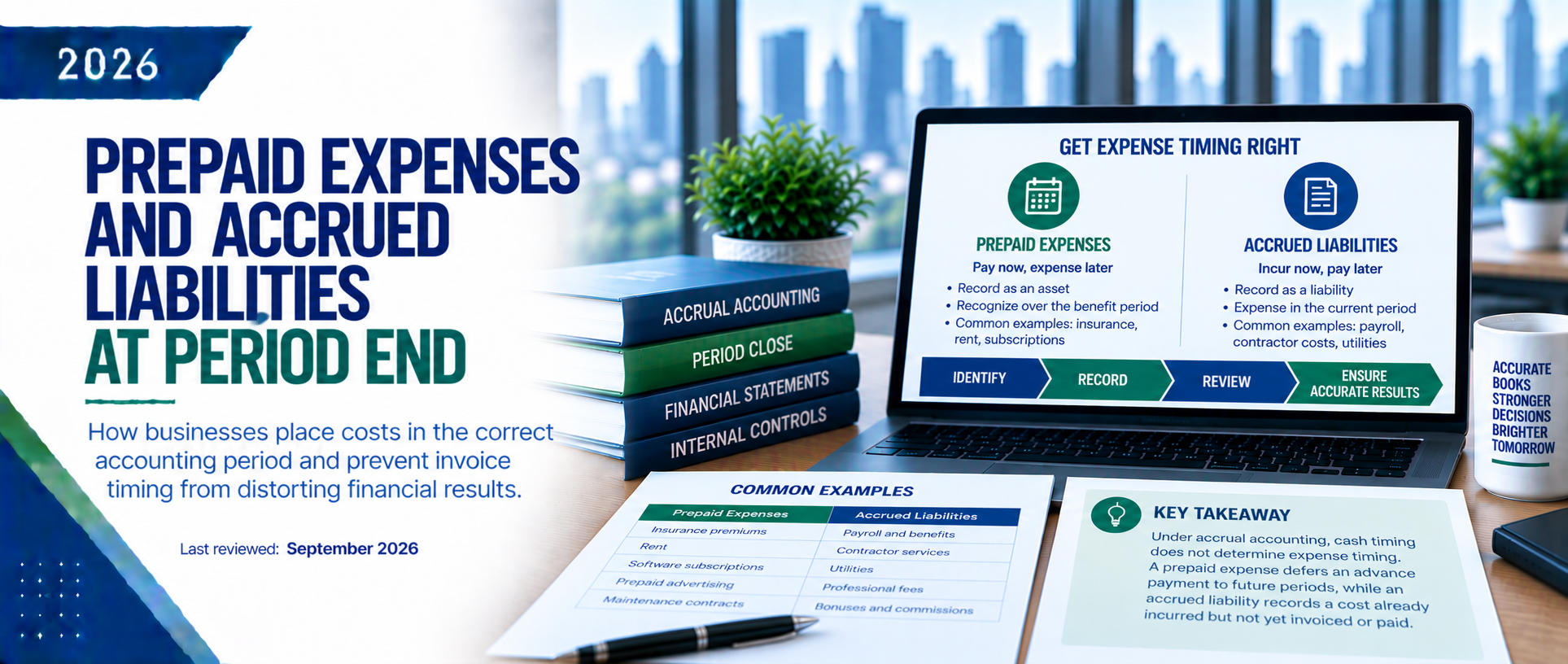
Suggested: accountant reviewing a prepaid expense schedule and accrual worksheet.
 –>
–>
Accounting Practical Guide | Intermediate
Prepaid Expenses and Accrued Liabilities at Period End
How businesses place costs in the correct accounting period and prevent invoice timing from distorting financial results.
Under accrual accounting, cash timing does not determine expense timing. A prepaid expense defers an advance payment to future periods, while an accrued liability records a cost already incurred but not yet invoiced or paid.
1. Definition
Prepaid expense: payment for goods or services that benefit future accounting periods. The unused portion remains an asset until the benefit is received. Common examples: insurance, software, rent, maintenance, licenses, and retainers.
Accrued liability: an obligation for goods or services already received even though the invoice has not been entered or paid. Common examples: payroll, bonuses, commissions, utilities, professional fees, interest, freight, hosting, and contractor services.
| Account | Timing | Balance Sheet Effect | Income Statement Effect |
|---|---|---|---|
| Prepaid expense | Cash paid before the cost is incurred | Records an asset for the unused benefit | Recognizes expense in future periods |
| Accrued liability | Cost incurred before invoice or payment | Records a liability until settled | Recognizes expense in the current period |
2. Why It Matters
- Correct period reporting: Prepaids and accruals match costs to the period that received the benefit or incurred the obligation.
- Financial impact: Errors can distort net income, EBITDA, margins, working capital, budgets, and lender reporting. Stale prepaids may overstate assets, while missing accruals may hide obligations.
3. How It Works
Record and Amortize Prepaid Expenses
Example: a company pays $24,000 on January 1 for 12 months of insurance. Record the payment as Prepaid Insurance, then recognize $2,000 of Insurance Expense each month over the policy term.
The prepaid schedule should track vendor, description, original amount, service dates, amortization method, additions, expense recognized, and ending balance. Start amortization when the service period begins, not necessarily when cash is paid. Evaluate current vs. long-term classification when benefits extend beyond 12 months.
A documented materiality threshold can keep the process practical. Immaterial annual payments may be expensed immediately if the policy is appropriate and consistently applied. Financial-statement policy should be evaluated separately from tax capitalization rules.
Identify and Measure Accrued Liabilities
At period end, search for costs that belong to the closing period but are missing from accounts payable. Useful evidence includes contracts, purchase orders, vendor statements, later invoices, usage reports, payroll registers, project milestones, and department-owner confirmations.
Use the best information available at the close date. An accrual may be based on contract rates, prior invoices adjusted for volume, employee workdays, units consumed, or a supported business estimate. Large or recurring variances should trigger a better estimation method.
Distinguish Accruals from Accounts Payable
Accounts payable generally contains vendor invoices already entered. An accrued liability records an obligation that belongs in the period but is not yet in AP. When the later invoice posts, clear or reverse the accrual to avoid double-counting the expense.
Use Reversals and True-Ups Carefully
Example: outside counsel performs $15,000 of December work and bills in January. At December 31, record Dr Legal Expense / Cr Accrued Liabilities $15,000. A January reversing entry can allow the normal AP invoice to post without duplication.
A reversing entry is useful but not mandatory. The accrual may instead be cleared when the invoice posts. Recurring estimates may roll forward and be remeasured rather than fully reversed.
If the final invoice is $16,200, recognize the $1,200 true-up when known, subject to close policy and materiality. Track the original estimate, reversal/clearing entry, actual invoice, and variance.
Perform the Period End Cutoff Review
- Post-close activity: review significant payments and invoices entered shortly after period end.
- Department confirmations: ask about services received, payroll earned, and work completed but not billed.
- Trend review: compare recurring expenses with prior periods, budget, and expected activity.
- Unexpected drops: investigate unusual decreases in expenses that normally recur.
- Reconciliation: tie prepaid and accrual schedules to the general ledger.
4. Simple Example
Assume unadjusted December operating expense is $420,000. The close identifies four timing adjustments shown below.
| Adjustment | Amount | December Expense Effect |
|---|---|---|
| Annual software payment includes 11 months for next year | $55,000 | Decrease expense and record a prepaid asset |
| December legal services are not yet billed | $18,000 | Increase expense and record an accrued liability |
| Five payroll days remain unpaid | $42,000 | Increase expense and record payroll liabilities |
| December insurance amortization was not recorded | $6,000 | Increase expense and reduce the prepaid asset |
Adjusted December expense is $431,000 = $420,000 – $55,000 + $18,000 + $42,000 + $6,000. Cash did not change; the entries simply move each cost to the period that received the benefit or incurred the obligation.
5. Common Mistakes and Quick Answers
Common Mistakes
- Expensing a large advance payment immediately: review the service period first.
- Starting amortization from the payment date: use the contract or service start date.
- Leaving stale balances: remove expired prepaids and settled accruals.
- Using unsupported round-number accruals: base material estimates on documented evidence.
- Double-counting the expense: clear or reverse the accrual when the invoice posts.
- Closing AP without a cutoff review: review later invoices and significant disbursements.
Does Every Advance Payment Become a Prepaid Asset?
No. The payment must represent a future economic benefit and be material under the company’s policy. Deposits, inventory advances, fixed assets, contract acquisition costs, and refundable amounts may require different classification.
Should an Accrual Equal the Final Invoice?
Not necessarily. An accrual is a reasonable estimate using information available at period end. The later invoice provides the true-up. Large recurring variances may indicate that the population, usage data, rate, or estimation method should be improved.
6. Practical Checklist: What’s Next
Work through these role-based items when closing prepaids and accruals.
0 of 5 complete
Next step: Maintain one controlled schedule for each account, assign owners and deadlines, document estimation methods, and review actual-to-accrual differences monthly. Repeated large variances should lead to a revised calculation or earlier operational reporting.
PNJ Perspective
Prepaids and accruals are basic accounts, but they require disciplined cutoff, estimation, reconciliation, and true-up controls. PNJ helps businesses build reliable rollforward schedules and month-end procedures so expenses are recognized in the correct period and balance-sheet amounts remain supportable.
Technical Reference Points
- FASB Conceptual Framework for Financial Reporting
- FASB Accounting Standards Codification
Disclaimer
This article provides general educational information and is not accounting, tax, or legal advice. Accounting treatment depends on the reporting framework, contracts, materiality, company policies, and specific facts. Consult qualified advisers when needed.